Roques Clément, Weber Ulrich W, Brixel Bernard, Krietsch Hannes, Dutler Nathan, Brennwald Matthias S, Villiger Linus, Doetsch Joseph, Jalali Mohammadreza, Gischig Valentin, Amann Florian, Valley Benoît, Klepikova Maria, Kipfer Rolf
ETH Zürich, Department of Earth Sciences, Sonneggstrasse 5, 8092, Zürich, Switzerland.
University Rennes 1, Géosciences Rennes, UMR 6118, Av. du Général Leclerc, 35042, Rennes, France.
Sci Rep. 2020 Apr 24;10(1):6949. doi: 10.1038/s41598-020-63458-x.
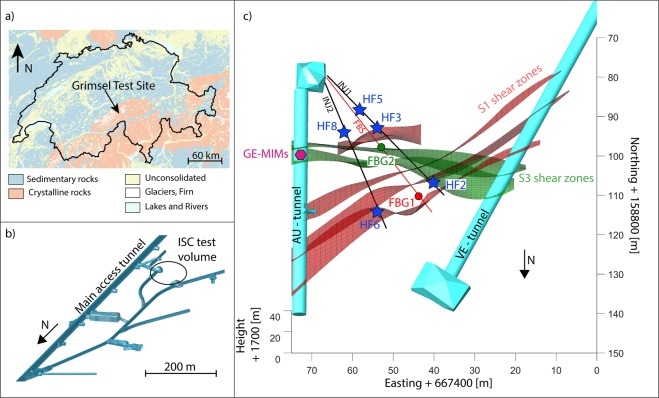
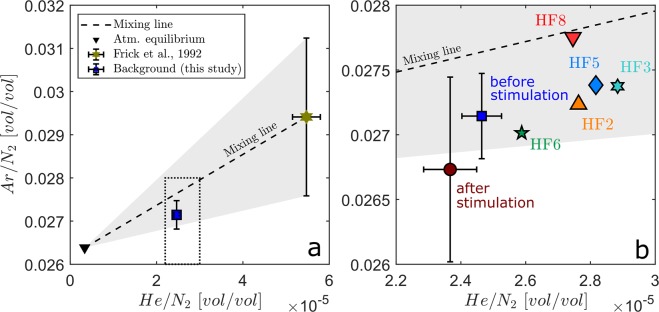
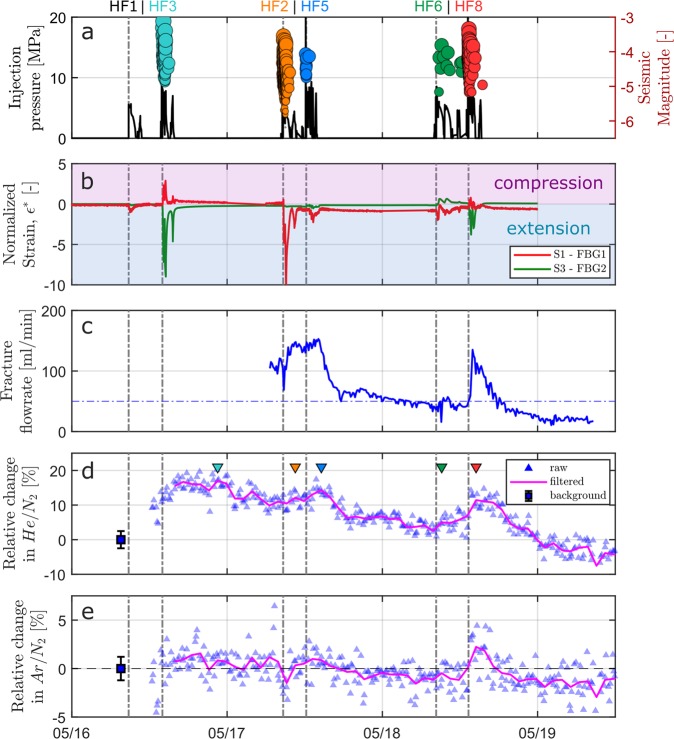
Temporal changes in groundwater chemistry can reveal information about the evolution of flow path connectivity during crustal deformation. Here, we report transient helium and argon concentration anomalies monitored during a series of hydraulic reservoir stimulation experiments measured with an in situ gas equilibrium membrane inlet mass spectrometer. Geodetic and seismic analyses revealed that the applied stimulation treatments led to the formation of new fractures (hydraulic fracturing) and the reactivation of natural fractures (hydraulic shearing), both of which remobilized (He, Ar)-enriched fluids trapped in the rock mass. Our results demonstrate that integrating geochemical information with geodetic and seismic data provides critical insights to understanding dynamic changes in fracture network connectivity during reservoir stimulation. The results of this study also shed light on the linkages between fluid migration, rock deformation and seismicity at the decameter scale.
地下水化学的时间变化可以揭示地壳变形过程中流动路径连通性演化的信息。在此,我们报告了在一系列水力储层增产实验中监测到的瞬态氦和氩浓度异常,这些实验是使用原位气体平衡膜进样质谱仪进行测量的。大地测量和地震分析表明,所施加的增产处理导致了新裂缝(水力压裂)的形成和天然裂缝(水力剪切)的重新激活,这两者都使被困在岩体中的富含(氦、氩)的流体重新活动起来。我们的结果表明,将地球化学信息与大地测量和地震数据相结合,为理解储层增产过程中裂缝网络连通性的动态变化提供了关键见解。本研究结果还揭示了米级尺度上流体运移、岩石变形和地震活动之间的联系。