Department of Population Health, London School of Hygiene and Tropical Medicine, London, UK.
Centre for Development, Environment and Policy, SOAS University of London, London, UK.
BMJ Glob Health. 2020 Mar 29;5(3):e002173. doi: 10.1136/bmjgh-2019-002173. eCollection 2020.
Undernutrition rates remain high in rural, low-income settings, where large, gender-based inequities persist. We hypothesised that increasing gender equity in agriculture could improve nutrition.
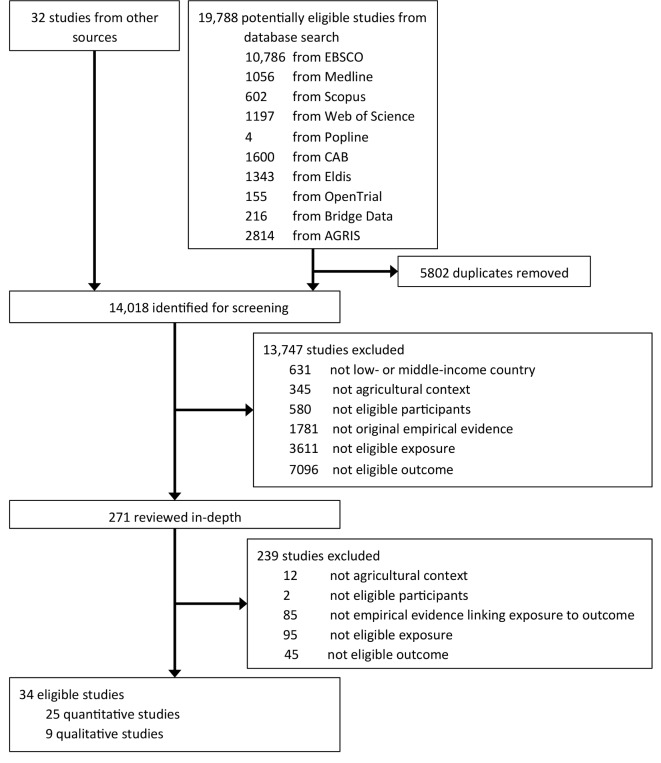
We conducted a systematic review to assess the associations between gender-based inequities (in income, land, livestock, and workloads) and nutrition, diets and food security outcomes in agricultural contexts of low-income and middle-income countries. Between 9 March and 7 August 2018, we searched 18 databases and 14 journals, and contacted 27 experts. We included quantitative and qualitative literature from agricultural contexts in low-income and middle-income countries, with no date restriction. Outcomes were women's and children's anthropometric status, dietary quality and household food security. We conducted meta-analyses using random-effects models.
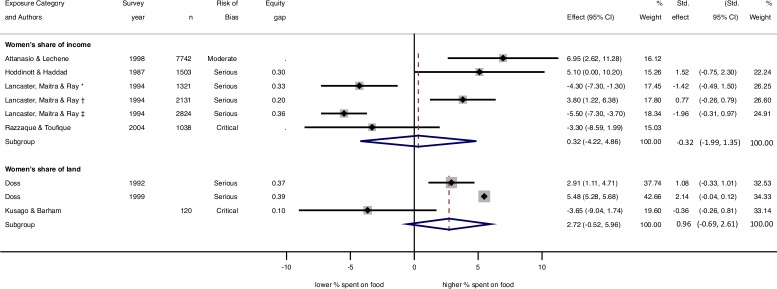
We identified 19 820 records, of which 34 studies (42 809 households) met the inclusion criteria. Most (22/25) quantitative studies had a high risk of bias, and qualitative evidence was of mixed quality. Income, land and livestock equity had heterogeneous associations with household food security and child anthropometric outcomes. Meta-analyses showed women's share of household income earned (0.32, 95% CI -4.22 to 4.86; six results) and women's share of land owned (2.72, 95% CI -0.52 to 5.96; three results) did not increase the percentage of household budget spent on food. Higher-quality studies showed more consistently positive associations between income equity and food security. Evidence is limited on other exposure-outcome pairings.
We find heterogeneous associations between gender equity and household-level food security. High-quality research is needed to establish the impact of gender equity on nutrition outcomes across contexts.
CRD42018093987.
在农村和低收入地区,营养不良率仍然很高,而且存在着严重的性别不平等。我们假设,提高农业领域的性别平等可以改善营养状况。
我们进行了一项系统综述,以评估在低收入和中等收入国家的农业环境中,基于性别的不平等(在收入、土地、牲畜和工作量方面)与营养、饮食和粮食安全结果之间的关联。在 2018 年 3 月 9 日至 8 月 7 日期间,我们检索了 18 个数据库和 14 种期刊,并联系了 27 名专家。我们纳入了来自低收入和中等收入国家农业背景的定量和定性文献,没有时间限制。结果是妇女和儿童的人体测量学状况、饮食质量和家庭粮食安全。我们使用随机效应模型进行了荟萃分析。
我们确定了 19820 条记录,其中 34 项研究(42809 户家庭)符合纳入标准。大多数(22/25)定量研究存在高偏倚风险,定性证据质量参差不齐。收入、土地和牲畜公平性与家庭粮食安全和儿童人体测量结果的关联具有异质性。荟萃分析显示,家庭收入中妇女所占份额(0.32,95%CI-4.22 至 4.86;6 项结果)和妇女拥有土地份额(2.72,95%CI-0.52 至 5.96;3 项结果)并未增加家庭预算中用于食品的比例。高质量的研究更一致地显示出收入公平与粮食安全之间的积极关联。关于其他暴露-结果配对的证据有限。
我们发现性别平等与家庭粮食安全之间存在异质关联。需要高质量的研究来确定性别平等对跨环境营养结果的影响。
PROSPERO 注册号:CRD42018093987。