Beam Therapeutics, Cambridge, MA, USA.
Nat Commun. 2020 Apr 28;11(1):2052. doi: 10.1038/s41467-020-15887-5.
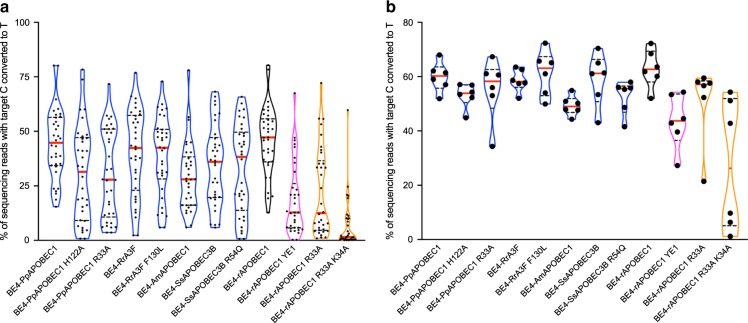
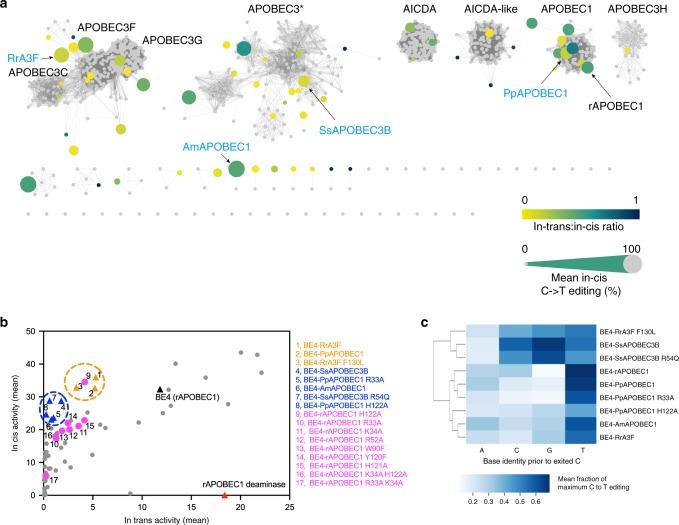
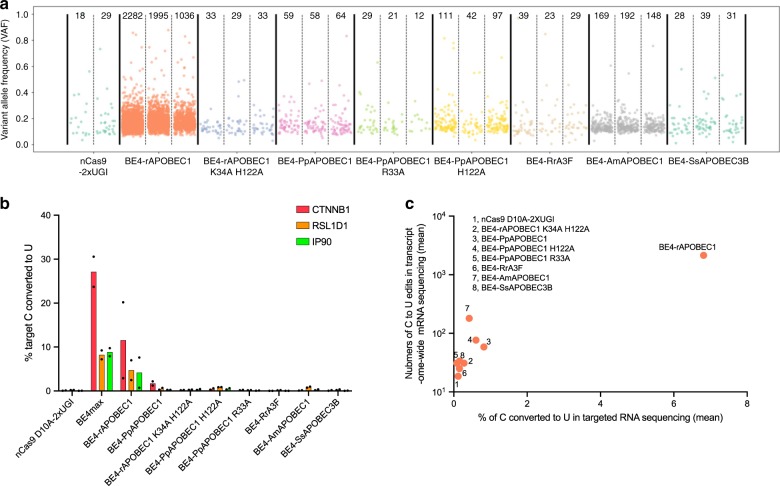
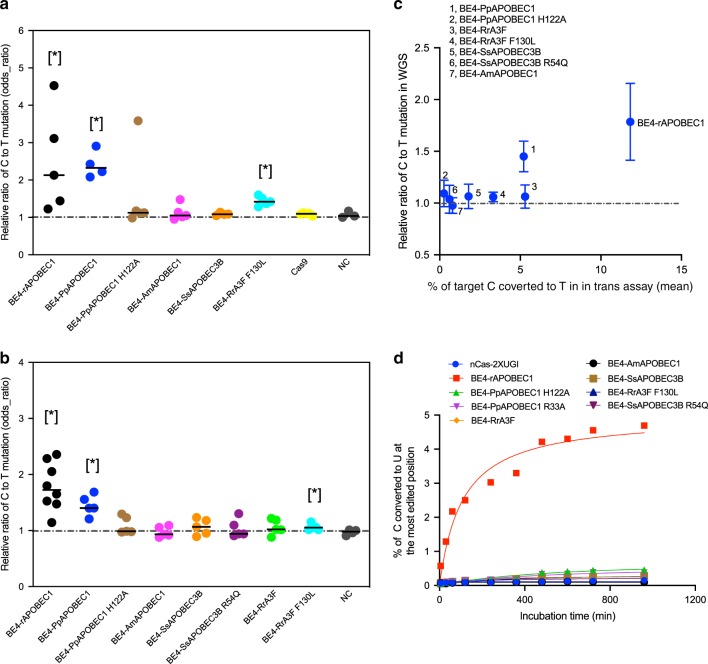
Cytosine base editors (CBEs) enable efficient, programmable reversion of T•A to C•G point mutations in the human genome. Recently, cytosine base editors with rAPOBEC1 were reported to induce unguided cytosine deamination in genomic DNA and cellular RNA. Here we report eight next-generation CBEs (BE4 with either RrA3F [wt, F130L], AmAPOBEC1, SsAPOBEC3B [wt, R54Q], or PpAPOBEC1 [wt, H122A, R33A]) that display comparable DNA on-target editing frequencies, whilst eliciting a 12- to 69-fold reduction in C-to-U edits in the transcriptome, and up to a 45-fold overall reduction in unguided off-target DNA deamination relative to BE4 containing rAPOBEC1. Further, no enrichment of genome-wide C•G to T•A edits are observed in mammalian cells following transfection of mRNA encoding five of these next-generation editors. Taken together, these next-generation CBEs represent a collection of base editing tools for applications in which minimized off-target and high on-target activity are required.
胞嘧啶碱基编辑器(CBEs)可在人类基因组中高效、可编程地将 T•A 突变为 C•G 点突变。最近,有研究报道,带有 rAPOBEC1 的胞嘧啶碱基编辑器可在基因组 DNA 和细胞 RNA 中诱导非指导的胞嘧啶脱氨酶。在这里,我们报告了 8 种新一代 CBEs(BE4 与 RrA3F [wt,F130L]、AmAPOBEC1、SsAPOBEC3B [wt,R54Q]或 PpAPOBEC1 [wt,H122A,R33A]),它们具有可比的 DNA 靶向编辑频率,同时在转录本中导致 C 到 U 的编辑减少 12 到 69 倍,相对于包含 rAPOBEC1 的 BE4,非靶向 DNA 脱氨的无引导脱靶减少高达 45 倍。此外,在转染编码这 5 种新一代编辑器之一的 mRNA 后,在哺乳动物细胞中未观察到全基因组 C•G 到 T•A 编辑的富集。总之,这些新一代 CBEs 代表了一组碱基编辑工具,适用于需要最小化脱靶和高靶向活性的应用。