Meng Ziyan, Zhang Jiayou, Shi Jinrong, Zhao Wei, Huang Xiaoyuan, Cheng Li, Yang Xiaoming
National Institute of Engineering Technology Research in Combination Vaccines , Wuhan, China.
Wuhan Institute of Biological Products 430207 , Wuhan, China.
Hum Vaccin Immunother. 2020 Nov 1;16(11):2680-2689. doi: 10.1080/21645515.2020.1747375. Epub 2020 Apr 29.
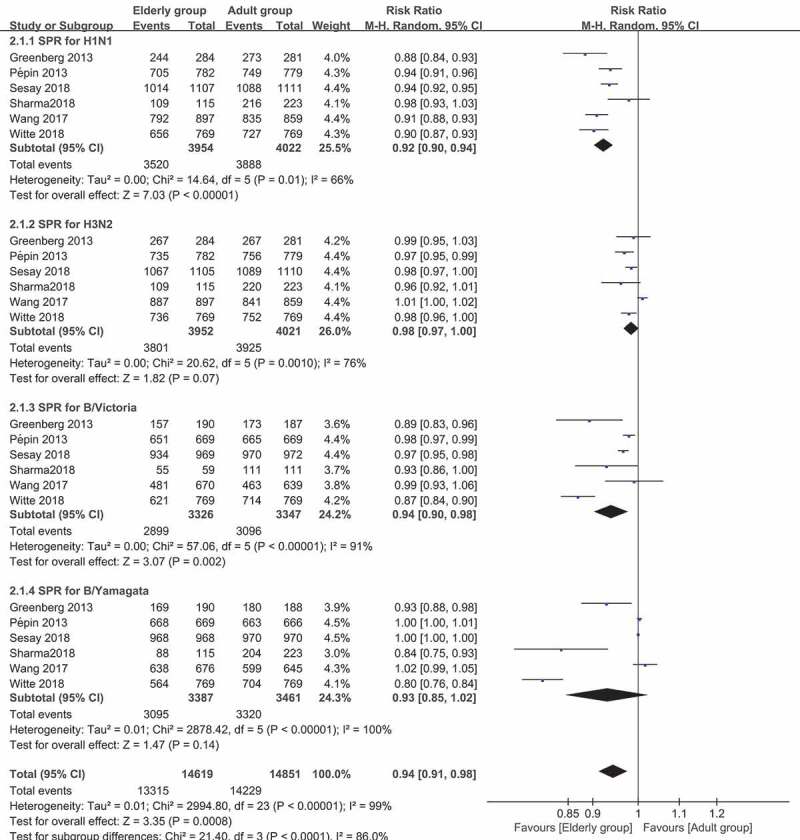
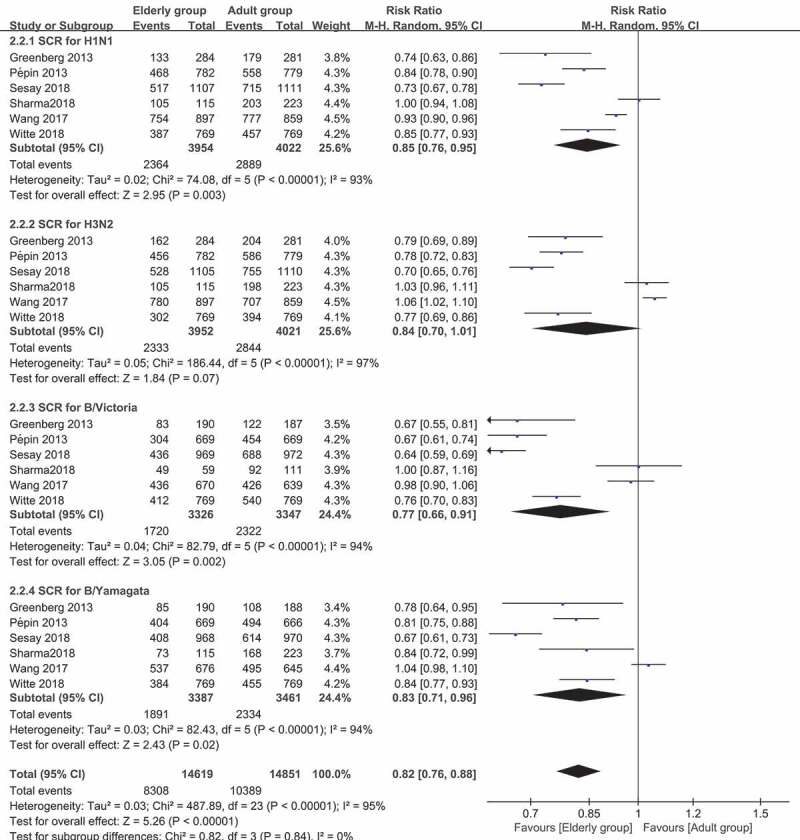
: Older people (≥60 years old) are particularly vulnerable to influenza virus infection, and vaccine is effective in reducing the disease burden in this population. However, it remains obscure whether their antibody response is lower than those of younger adults (18-60 years old). Thus, this meta-analysis was performed to compare the immunogenicity of influenza vaccines and understand their association with real-world vaccine effectiveness (VE) between these two age groups. : A systematic literature search was conducted to identify relevant studies from Jan 01, 2008 to Nov 10, 2018. These are randomized controlled trials that included older adult samples, which assessed the immunogenicity of inactivated quadrivalent influenza vaccines produced in embryonated eggs. We excluded the studies focused only in children or adults. The outcomes were seroprotecton rate (SPR) and seroconversion rate (SCR). : Six studies were eventually included in the present meta-analysis (7,976 participants). For the SPR, the pooled risk ratio (RR) was 0.92 (95% CI: 0.90-0.94, = 66%, < .0001) for A/H1N1 and 0.94 (95% CI: 0.90-0.98, = 91%, = .002) for B/Victoria, and the antibody responses of A/H3N2 and B/Yamagata were similar in the two age groups. For the SCR, the pooled RR was 0.85 (95% CI: 0.76-0.94, = 93%, = .003), 0.77 (95% CI: 0.66-0.91, = 94%, = .002), and 0.83 (95% CI: 0.71-0.96, = 94%, = .02) for A/H1N1, B/Victoria and B/Yamagata, respectively, and the antibody responses of A/H3N2 were similar in the two groups. Some variations were found in the antibody responses across virus types and subtypes after influenza vaccination. : The SPR and SCR of older adults were lower than those in younger adults for A/H1N1 and B/Victoria, while the two age groups had similar antibody responses for A/H3N2. The antibody responses to vaccines were not significantly associated with real-world VE, indicating that antibody response might not fully reflect the vaccine effectiveness of A/H3N2.
老年人(≥60岁)特别容易感染流感病毒,疫苗在减轻该人群的疾病负担方面是有效的。然而,他们的抗体反应是否低于年轻成年人(18 - 60岁)仍不清楚。因此,进行了这项荟萃分析,以比较流感疫苗的免疫原性,并了解这两个年龄组之间它们与实际疫苗效力(VE)的关联。:进行了系统的文献检索,以识别2008年1月1日至2018年11月10日期间的相关研究。这些是包括老年成人样本的随机对照试验,评估了鸡胚中生产的四价灭活流感疫苗的免疫原性。我们排除了仅关注儿童或成年人的研究。结局指标是血清保护率(SPR)和血清转化率(SCR)。:本荟萃分析最终纳入了6项研究(7976名参与者)。对于SPR,A/H1N1的合并风险比(RR)为0.92(95%CI:0.90 - 0.94,I² = 66%,P <.0001),B/Victoria的为0.94(95%CI:0.90 - 0.98,I² = 91%,P = 0.002),A/H3N2和B/Yamagata在两个年龄组中的抗体反应相似。对于SCR,A/H1N1、B/Victoria和B/Yamagata的合并RR分别为0.85(95%CI:0.76 - 0.94,I² = 93%,P = 0.003)、0.77(95%CI:0.66 - 0.91,I² = 94%,P = 0.002)和0.83(95%CI:0.71 - 0.96,I² = 94%,P = 0.02),A/H3N2在两组中的抗体反应相似。流感疫苗接种后,不同病毒类型和亚型的抗体反应存在一些差异。:对于A/H1N1和B/Victoria,老年人的SPR和SCR低于年轻人,而对于A/H3N2,两个年龄组的抗体反应相似。疫苗的抗体反应与实际VE无显著关联,表明抗体反应可能不能完全反映A/H3N2的疫苗效力。