Department of Neurology, First Affiliated Hospital of Soochow University, Suzhou, Jiangsu, China.
Department of Cardiovascular surgery, First Affiliated Hospital, Yijishan Hospital of Wannan Medical College, Wuhu, Anhui, China.
Braz J Med Biol Res. 2020;53(5):e9162. doi: 10.1590/1414-431x20209162. Epub 2020 Apr 27.
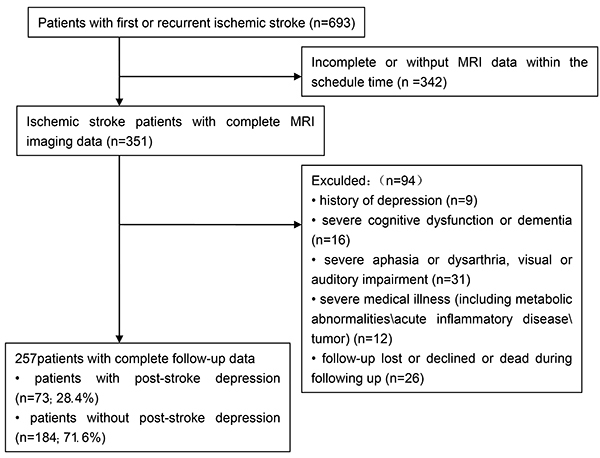
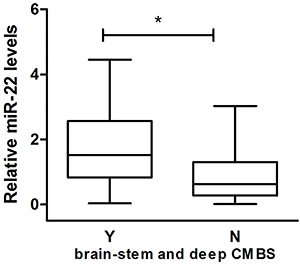
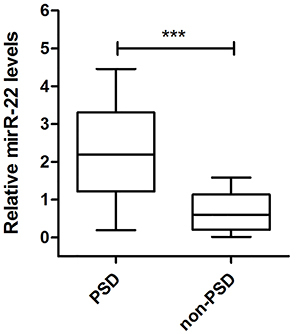
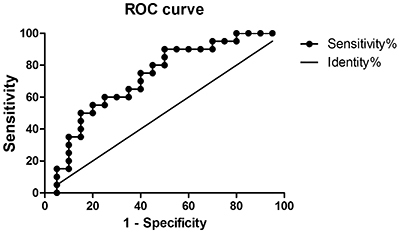
In this study, we aimed to explore the relationship among miR-22, deep cerebral microbleeds (CMBs), and post-stroke depression (PSD) 1 month after ischemic stroke. We consecutively recruited 257 patients with first-ever and recurrent acute cerebral infarction and performed PSD diagnosis in accordance with the Diagnostic and Statistical Manual IV criteria for depression. Clinical information, assessments of stroke severity, and imaging data were recorded on admission. We further detected plasma miR-22 using quantitative PCR and analyzed the relationship among miR-22, clinical data, and PSD using SPSS 23.0 software. Logistic regression showed that deep (OR=1.845, 95%CI: 1.006-3.386, P=0.047) and brain stem CMBs (OR=2.652, 95%CI: 1.110-6.921, P=0.040), as well as plasma miR-22 levels (OR=2.094, 95%CI: 1.066-4.115, P=0.032) were independent risk factors for PSD. In addition, there were significant differences in baseline National Institutes of Health Stroke Scale scores (OR=1.881, 95%CI: 1.180-3.011, P=0.007) and Widowhood scores (OR=1.903, 95%CI: 1.182-3.063, P=0.012). Analysis of the receiver operating curve (AUC=0.723, 95%CI: 0.562-0.883, P=0.016) revealed that miR-22 could predict PSD one month after ischemic stroke. Furthermore, plasma miR-22 levels in brainstem and deep CMBs patients showed an upward trend (P=0.028) relative to the others. Patients with acute ischemic stroke, having brainstem and deep cerebral microbleeds, or a higher plasma miR-22 were more likely to develop PSD. These findings indicate that miR-22 might be involved in cerebral microvascular impairment and post-stroke depression.
在这项研究中,我们旨在探讨 miR-22、深部脑微出血(CMBs)和缺血性卒中后 1 个月的卒中后抑郁(PSD)之间的关系。我们连续招募了 257 例首次和复发性急性脑梗死患者,并根据抑郁诊断和统计手册第四版标准进行 PSD 诊断。入院时记录临床信息、卒中严重程度评估和影像学数据。我们进一步使用定量 PCR 检测血浆 miR-22,并使用 SPSS 23.0 软件分析 miR-22 与临床数据和 PSD 之间的关系。逻辑回归显示,深部(OR=1.845,95%CI:1.006-3.386,P=0.047)和脑干 CMBs(OR=2.652,95%CI:1.110-6.921,P=0.040)以及血浆 miR-22 水平(OR=2.094,95%CI:1.066-4.115,P=0.032)是 PSD 的独立危险因素。此外,基线国立卫生研究院卒中量表评分(OR=1.881,95%CI:1.180-3.011,P=0.007)和丧偶评分(OR=1.903,95%CI:1.182-3.063,P=0.012)存在显著差异。受试者工作特征曲线(AUC=0.723,95%CI:0.562-0.883,P=0.016)分析表明,miR-22 可预测缺血性卒中后 1 个月的 PSD。此外,与其他患者相比,脑干和深部 CMBs 患者的血浆 miR-22 水平呈上升趋势(P=0.028)。患有急性缺血性卒中、有脑干和深部脑微出血或血浆 miR-22 较高的患者更容易发生 PSD。这些发现表明,miR-22 可能参与脑微血管损伤和卒中后抑郁。