College of Agriculture & Biotechnology, Zhejiang University, Zijingang Campus, Hangzhou 310058, China.
Agro-product Safety Research Center, Chinese Academy of Inspection and Quarantine, Beijing 100176, China.
Molecules. 2020 Apr 27;25(9):2036. doi: 10.3390/molecules25092036.
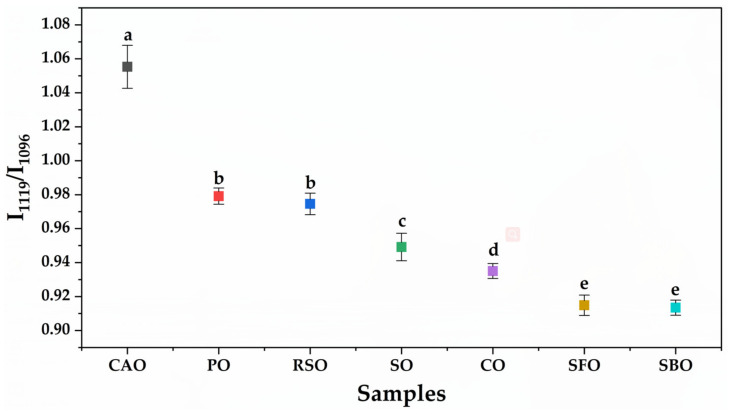
Currently, the authentication of camellia oil (CAO) has become very important due to the possible adulteration of CAO with cheaper vegetable oils such as rapeseed oil (RSO). Therefore, we report a Fourier transform infrared (FTIR) spectroscopic method for detecting the authenticity of CAO and quantifying the blended levels of RSO. In this study, two characteristic spectral bands (1119 cm and 1096 cm) were selected and used for monitoring the purity of CAO. In combination with principal component analysis (PCA), linear discriminant analysis (LDA), and partial least squares regression (PLSR) analysis, qualitative and quantitative methods for the detection of camellia oil adulteration were proposed. The results showed that the calculated I/I intensity ratio facilitated an initial check for pure CAO and six other edible oils. PCA was used on the optimized spectral region of 1800-650 cm. We observed the classification of CAO and RSO as well as discrimination of CAO with RSO adulterants. LDA was utilized to classify CAO from RSO. We could differentiate and classify RSO adulterants up to 1% /. In the quantitative PLSR models, the plots of actual values versus predicted values exhibited high linearity. Root mean square error of calibration (RMSEC) and root mean square error of cross validation (RMSECV) values of the PLSR models were 1.4518%-3.3164% / and 1.7196%-3.8136% /, respectively. This method was successfully applied in the classification and quantification of CAO adulteration with RSO.
目前,由于山茶油(CAO)可能与廉价植物油(如菜籽油(RSO))掺假,因此对其进行真伪鉴别变得非常重要。因此,我们报告了一种傅里叶变换红外(FTIR)光谱法,用于检测 CAO 的真实性并定量 RSO 的混合水平。在这项研究中,选择了两个特征谱带(1119cm 和 1096cm),用于监测 CAO 的纯度。结合主成分分析(PCA)、线性判别分析(LDA)和偏最小二乘回归(PLSR)分析,提出了用于检测山茶油掺假的定性和定量方法。结果表明,计算的 I/I 强度比有助于初步检查纯 CAO 和其他六种食用植物油。在 1800-650cm 的优化光谱区域上使用 PCA。我们观察到 CAO 和 RSO 的分类以及 CAO 与 RSO 掺杂物的鉴别。利用 LDA 对 CAO 进行分类。我们可以将 RSO 掺杂物区分和分类到 1% /。在定量 PLSR 模型中,实际值与预测值的图显示出高度的线性。PLSR 模型的校准均方根误差(RMSEC)和交叉验证均方根误差(RMSECV)值分别为 1.4518%-3.3164% / 和 1.7196%-3.8136% /。该方法成功应用于 CAO 与 RSO 掺假的分类和定量。