Department of Neurology, Tokyo Medical University, 6-7-1 Nishishinjuku, Shinjuku-ku, Tokyo, 160-0023, Japan.
Medical Education Promotion Center, Tokyo Medical University, 6-7-1 Nishishinjuku, Shinjuku-ku, Tokyo, 160-0023, Japan.
BMC Neurol. 2020 Apr 29;20(1):161. doi: 10.1186/s12883-020-01729-w.
We investigated the gait characteristics of patients with Parkinson's disease (PD), under free-living conditions, using a wearable device, and assessed their relationships with global cognitive function and motor abnormalities.
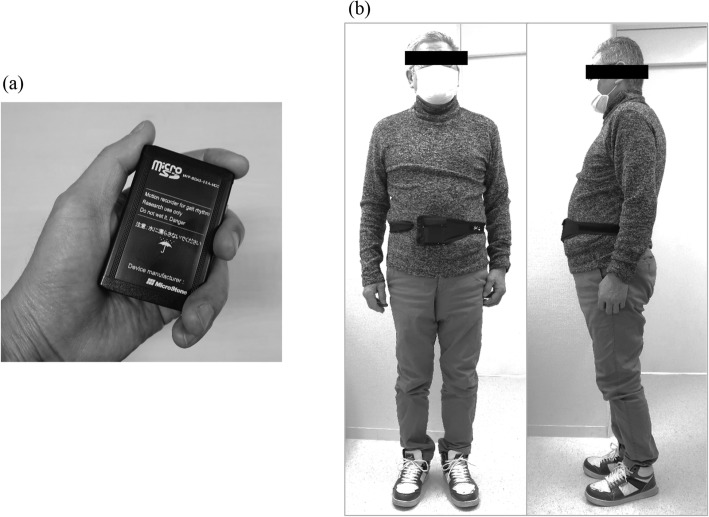
The study subjects comprised patients with PD aged < 80 years, with a Mini-Mental State Examination (MMSE) score of ≥20, free of any motor complications. A wearable sensor with a built-in tri-axial accelerometer was waist-mounted on each patient, and continuous, 24-h records were obtained. The mean gait cycle duration and mean gait acceleration amplitude, under free-living conditions, were computed and analyzed to determine their relationship with disease duration, MMSE score, Unified Parkinson's Disease Rating Scale (UPDRS) Part III score, and postural instability and gait difficulty (PIGD) score.
The study included 106 consecutive patients with PD. The mean gait cycle duration was 1.18 ± 0.12 s, which was similar to that of the normal controls. However, the mean gait acceleration amplitude of PD patients (1.83 ± 0.36 m/s) was significantly lower than that of the control (p < 0.001). In PD patients, the mean gait acceleration amplitude correlated with the MMSE (β = 0.197, p = 0.028), UPDRS Part III (β = - 0.327, p < 0.001), and PIGD (β = - 0.235, p = 0.008) scores.
The gait rhythm of PD patients is preserved at levels similar to those of normal subjects. However, the mean gait acceleration amplitude was significantly reduced in patients with PD. The results indicate that gait acceleration amplitude correlates with the severity of motor disorders and global cognitive function.
我们使用可穿戴设备研究了帕金森病(PD)患者在自由生活条件下的步态特征,并评估了它们与整体认知功能和运动异常的关系。
本研究纳入了年龄<80 岁、简易精神状态检查(MMSE)评分≥20 分、无任何运动并发症的 PD 患者。每位患者腰部均佩戴带有内置三轴加速度计的可穿戴传感器,以获取 24 小时连续记录。计算并分析自由生活条件下的平均步态周期持续时间和平均步态加速度幅度,以确定它们与疾病持续时间、MMSE 评分、统一帕金森病评定量表(UPDRS)第三部分评分以及姿势不稳和步态困难(PIGD)评分的关系。
本研究纳入了 106 例连续的 PD 患者。平均步态周期持续时间为 1.18±0.12s,与正常对照组相似。然而,PD 患者的平均步态加速度幅度(1.83±0.36m/s)明显低于对照组(p<0.001)。在 PD 患者中,平均步态加速度幅度与 MMSE(β=0.197,p=0.028)、UPDRS 第三部分(β=-0.327,p<0.001)和 PIGD(β=-0.235,p=0.008)评分均相关。
PD 患者的步态节律与正常受试者相似,但平均步态加速度幅度明显降低。研究结果表明,步态加速度幅度与运动障碍的严重程度和整体认知功能相关。