Laboratorio de microRNAs y Cáncer, Unidad Académica de Ciencias Biológicas, Universidad Autónoma de Zacatecas, Zacatecas 98068, Mexico.
School of Chemistry, Universidad Autónoma de San Luis Potosí, San Luis Potosí 78210, Mexico.
Molecules. 2020 Apr 28;25(9):2058. doi: 10.3390/molecules25092058.
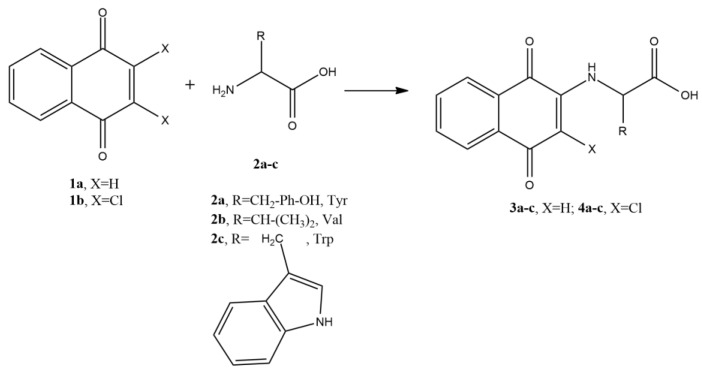
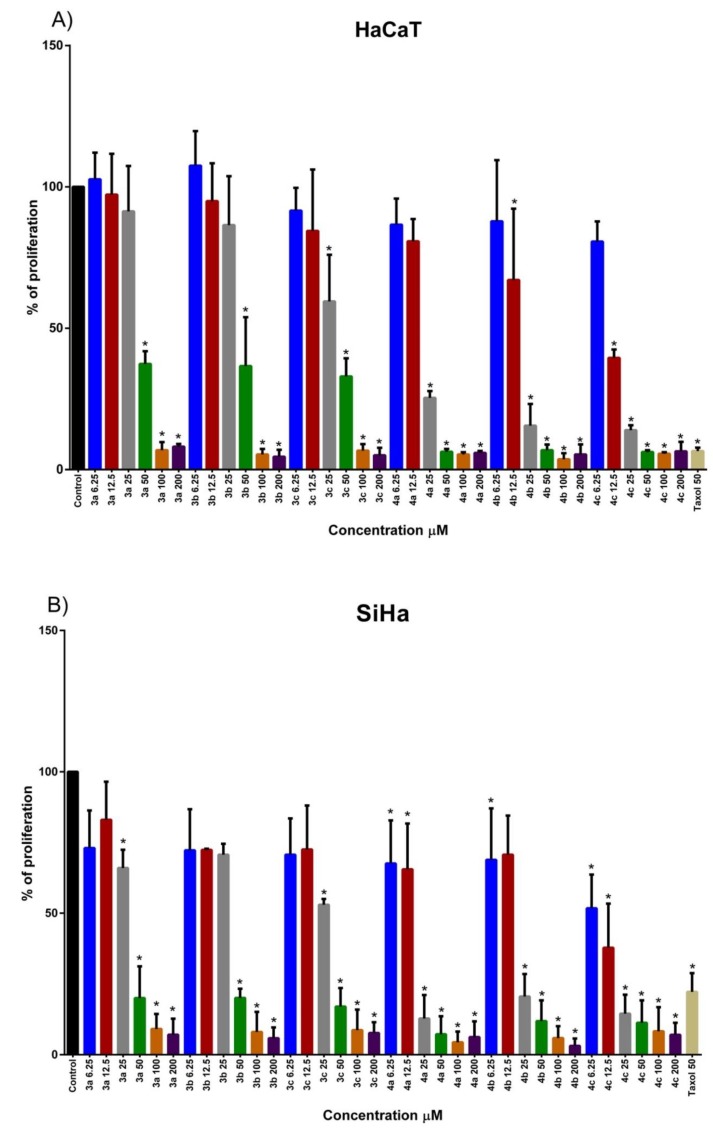
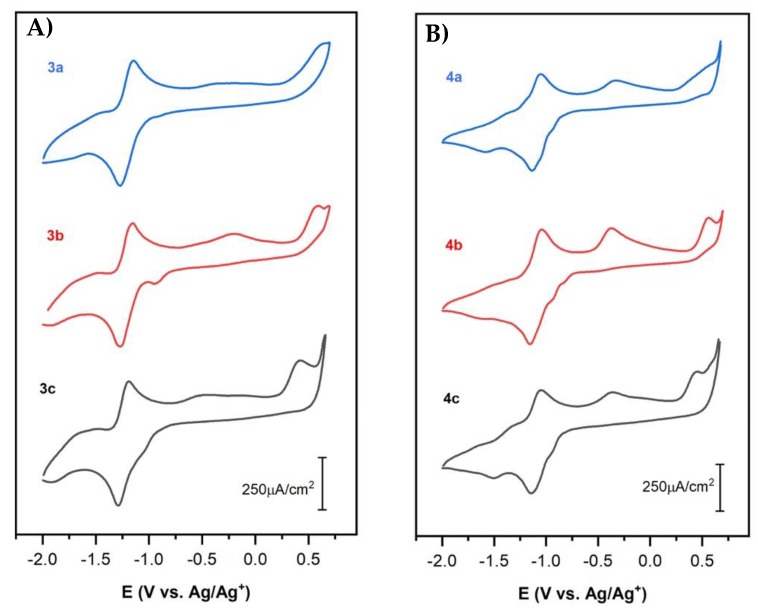
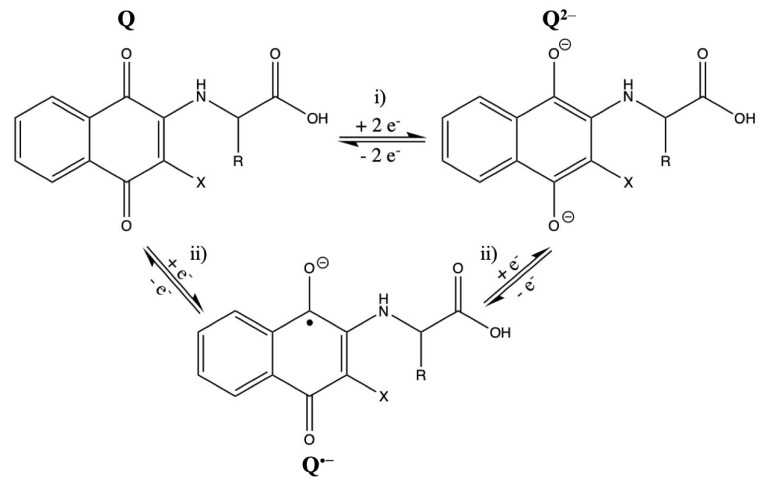
We previously showed that microwave assisted synthesis is the best method for the synthesis of naphthoquinone amino acid and chloride-naphthoquinone amino acid derivatives by a complete evaluation of reaction conditions such as stoichiometry, bases, and pH influence. Following the same strategy, we synthesized chloride and non-chloride tyrosine, valine, and tryptophan-naphthoquinones achieving 85-95%, 80-92%, and 91-95% yields, respectively. The cyclic voltammetry profiles showed that both series of naphthoquinone amino acid derivatives mainly display one redox reaction process. Overall, chloride naphthoquinone amino acid derivatives exhibited redox potential values (E) more positive than non-chloride compounds. The six newly synthesized compounds were tested in HPV positive and negative as well as in immortal and tumorigenic cell lines to observe the effects in different cellular context simulating precancerous and cancerous status. A dose-response was achieved to determine the IC50 of six newly synthesized compounds in SiHa (Tumorigenic and HPV16 positive), CaLo (Tumorigenic and HPV18 positive), C33-A (Tumorigenic and HPV negative) and HaCaT (Keratinocytes immortal HPV negative) cell lines. Non-chloride tryptophan-naphthoquinone (3c) and chloride tyrosine-naphthoquine (4a) effects were more potent in tumorigenic SiHa, CaLo, and C33-A cells with respect to non-tumorigenic HaCaT cells. Interestingly, there seems to be a differential effect in non-chloride and chloride naphthoquinone amino acid derivatives in tumorigenic versus non tumorigenic cells. Considering all naphthoquinone amino acid derivatives that our group synthesized, it seems that hydrophobic and aromatic amino acids have the greatest effect on cell proliferation inhibition. These results show promising compounds for cervical cancer treatment.
我们之前通过全面评估反应条件(如化学计量、碱和 pH 值的影响)表明,微波辅助合成是合成萘醌氨基酸和氯代萘醌氨基酸衍生物的最佳方法。按照同样的策略,我们合成了氯代和非氯代酪氨酸、缬氨酸和色氨酸-萘醌,产率分别为 85-95%、80-92%和 91-95%。循环伏安曲线表明,这两个系列的萘醌氨基酸衍生物主要显示一个氧化还原反应过程。总的来说,氯代萘醌氨基酸衍生物的氧化还原电位(E)值比非氯代化合物更正。新合成的六种化合物在 HPV 阳性和阴性以及永生和肿瘤细胞系中进行了测试,以观察在不同的细胞环境中对癌前和癌症状态的影响。通过剂量反应确定了六种新合成化合物在 SiHa(肿瘤发生和 HPV16 阳性)、CaLo(肿瘤发生和 HPV18 阳性)、C33-A(肿瘤发生和 HPV 阴性)和 HaCaT(角蛋白细胞永生 HPV 阴性)细胞系中的 IC50。非氯代色氨酸-萘醌(3c)和氯代酪氨酸-萘醌(4a)对肿瘤发生的 SiHa、CaLo 和 C33-A 细胞的作用比对非肿瘤发生的 HaCaT 细胞更有效。有趣的是,非氯代和氯代萘醌氨基酸衍生物在肿瘤发生细胞和非肿瘤发生细胞中的作用似乎存在差异。考虑到我们小组合成的所有萘醌氨基酸衍生物,似乎疏水性和芳香性氨基酸对细胞增殖抑制的影响最大。这些结果为宫颈癌的治疗提供了有前途的化合物。