Kawashima Mitsuaki, Juvet Stephen C
Latner Thoracic Research Laboratories, University Health Network, University of Toronto, Toronto, Ontario, Canada.
Ann Transl Med. 2020 Mar;8(6):412. doi: 10.21037/atm.2020.03.20.
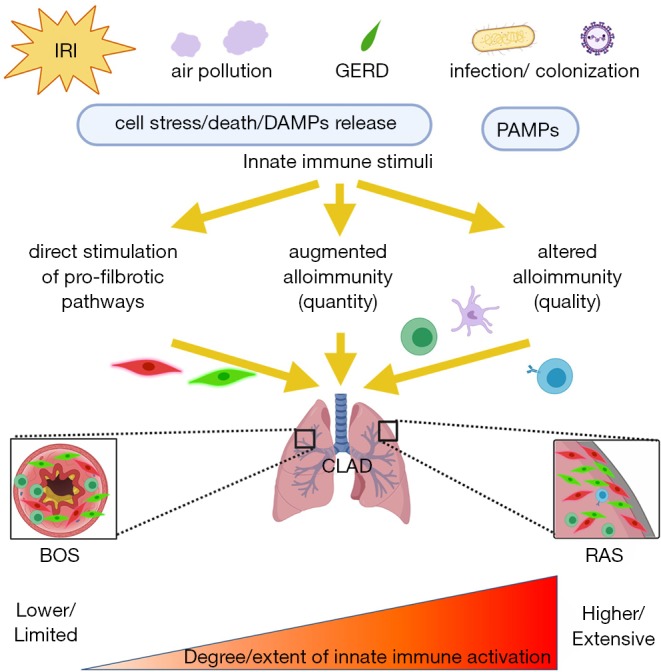
Long-term survival after lung transplantation remains suboptimal due to chronic lung allograft dysfunction (CLAD), a progressive scarring process affecting the graft. Although anti-donor alloimmunity is central to the pathogenesis of CLAD, its underlying mechanisms are not fully elucidated and it is neither preventable nor treatable using currently available immunosuppression. Recent evidence has shown that innate immune stimuli are fundamental to the development of CLAD. Here, we examine long-standing assumptions and new concepts linking innate immune activation to late lung allograft fibrosis.
由于慢性肺移植功能障碍(CLAD),肺移植后的长期生存率仍然不尽人意,这是一种影响移植肺的进行性瘢痕形成过程。尽管抗供体同种免疫是CLAD发病机制的核心,但其潜在机制尚未完全阐明,并且使用目前可用的免疫抑制方法既无法预防也无法治疗。最近的证据表明,先天免疫刺激是CLAD发生发展的基础。在此,我们审视了将先天免疫激活与晚期肺移植纤维化联系起来的长期假设和新概念。