Font-Clos Francesc, Zapperi Stefano, La Porta Caterina A M
Center for Complexity and Biosystems, Department of Physics, University of Milan, Via Celoria 16, 20133 Milano, Italy.
Center for Complexity and Biosystems, Department of Physics, University of Milan, Via Celoria 16, 20133 Milano, Italy; CNR - Consiglio Nazionale delle Ricerche, Istituto di Chimica della Materia Condensata e di Tecnologie per l'Energia, Via R. Cozzi 53, 20125 Milano, Italy.
iScience. 2020 May 22;23(5):101073. doi: 10.1016/j.isci.2020.101073. Epub 2020 Apr 18.
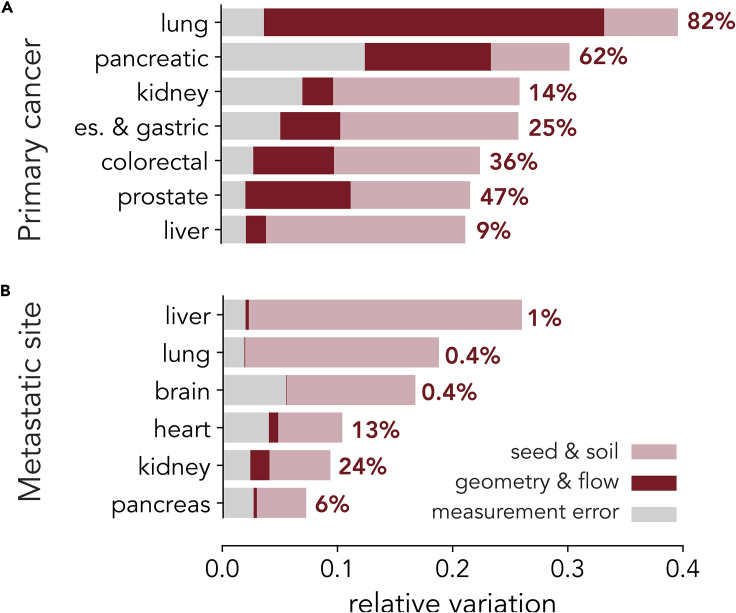
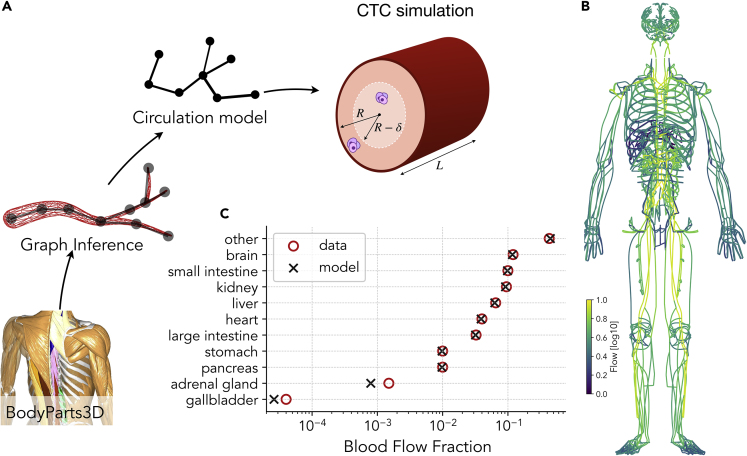
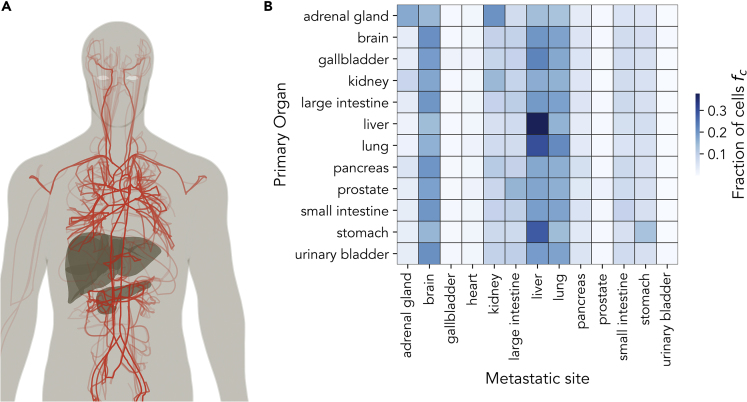
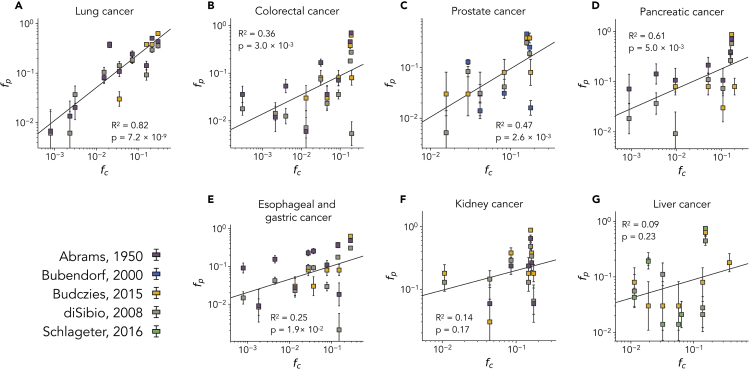
The distribution patterns of cancer metastasis depend on a sequence of steps involving adhesion molecules and on mechanical and geometrical effects related to blood circulation, but how much each of these two aspects contributes to the metastatic spread of a specific tumor is still unknown. Here we address this question by simulating cancer cell trajectories in a high-resolution humanoid model of global blood circulation, including stochastic adhesion events, and comparing the results with the location of metastasis recorded in thousands of human autopsies for seven different solid tumors, including lung, prostate, pancreatic and colorectal cancers, showing that on average 40% of the variation in the metastatic distribution can be attributed to blood circulation. Our humanoid model of circulating tumor cells allows us to predict the metastatic spread in specific realistic conditions and can therefore guide precise therapeutic interventions to fight metastasis.
癌症转移的分布模式取决于一系列涉及黏附分子的步骤以及与血液循环相关的机械和几何效应,但这两个方面各自对特定肿瘤转移扩散的贡献程度仍不清楚。在这里,我们通过在一个包含随机黏附事件的高分辨率人体全身血液循环类人模型中模拟癌细胞轨迹,并将结果与数千例人体尸检记录的七种不同实体瘤(包括肺癌、前列腺癌、胰腺癌和结直肠癌)转移部位进行比较,来解决这个问题,结果表明转移分布中平均40%的变异可归因于血液循环。我们的循环肿瘤细胞类人模型使我们能够预测特定现实条件下的转移扩散,因此可以指导对抗转移的精确治疗干预。