From the, Department of Psychiatry and Human Behavior, (RMJ, SSO, HTP, RW, DEF, MLR, JBF, THC, SBM, RZL), Brown University, Providence, Rhode Island, USA.
Department of Psychiatry, (RMJ, SSO, HTP, RW, DEF, MLR, JBF, THC, SBM, RZL), Yale School of Medicine, New Haven, Connecticut, USA.
Alcohol Clin Exp Res. 2020 Jul;44(7):1431-1443. doi: 10.1111/acer.14352. Epub 2020 May 25.
The alcohol cue reactivity paradigm is increasingly used to screen medications for the treatment of alcohol use disorder (AUD) and other substance use disorders. Yet, its prospective association with craving and naturalistic drinking outcomes in clinical trials remains unknown. This study embedded repeated human laboratory assessments of alcohol cue reactivity within the context of a randomized controlled trial to examine the effects of varenicline tartrate (Chantix ), a partial agonist of α4β2 nicotinic acetylcholine receptors, on alcohol craving among treatment-seeking heavy drinkers with AUD. Our main objectives were to test whether varenicline, as compared to placebo, blunts alcohol cue-elicited craving and test whether alcohol cue reactivity observed in the human laboratory predicts subsequent alcohol craving and use during the remainder of the trial.
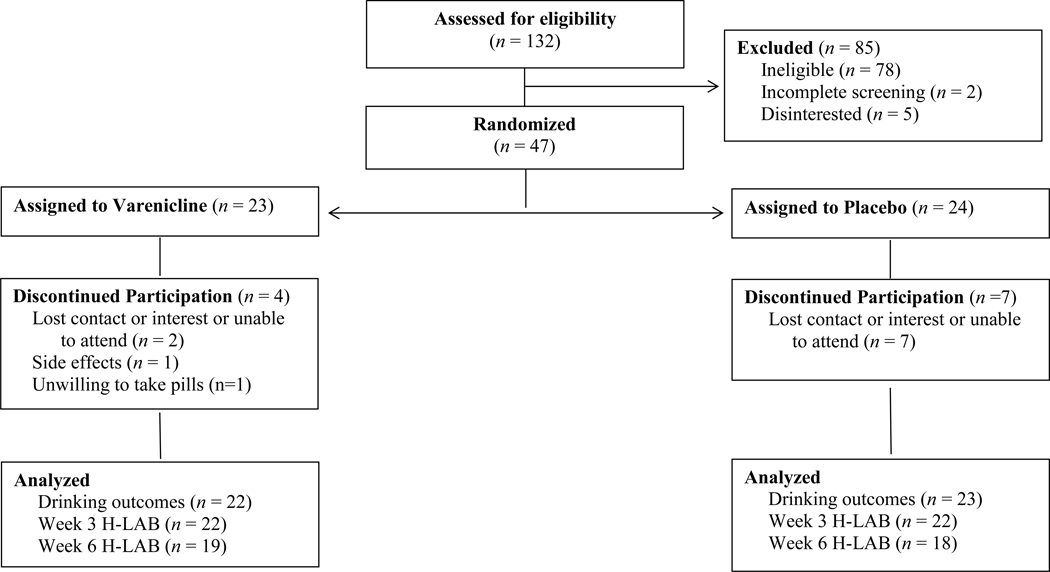
This double-blind, randomized, 2-site study compared the effects of varenicline (up to 2 mg/d) and placebo on responses to in vivo alcohol cue and affective picture cue exposure in the human laboratory. Forty-seven volunteers (18 females, 29 males), ages 23 to 67 years (M = 43.7, SD = 11.5), were recruited from the community via advertisements to participate in a clinical trial designed to study the effects of varenicline on alcohol use. Participants were randomized to either varenicline or placebo for 6 weeks.
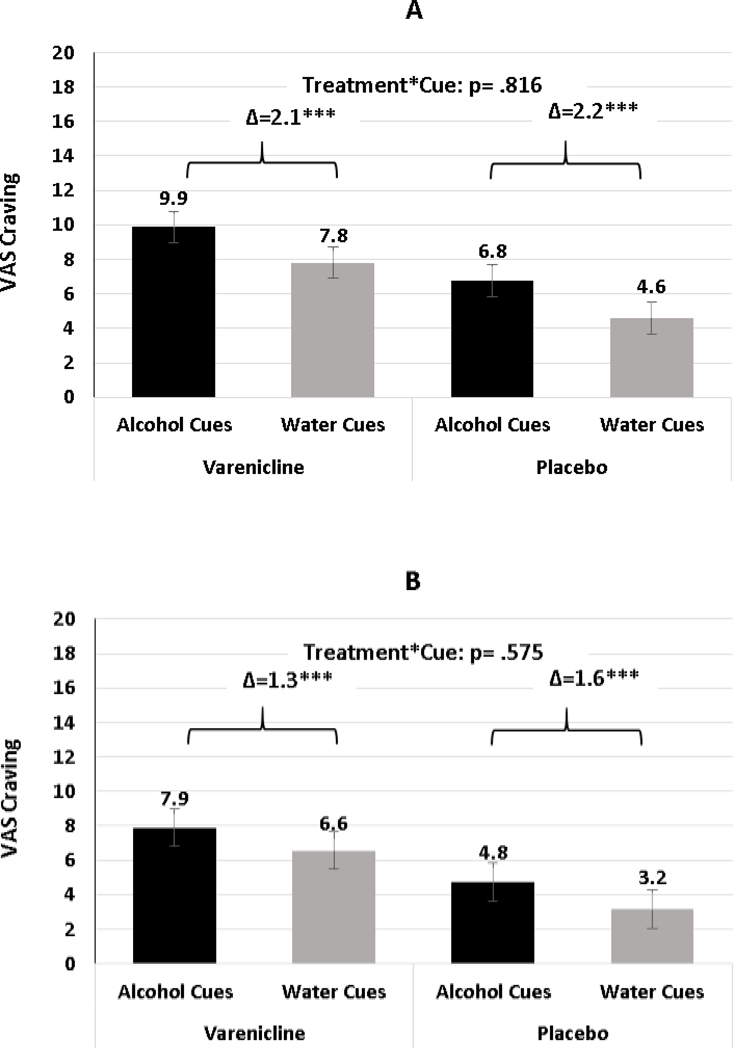
Varenicline did not attenuate cue-induced alcohol craving relative to placebo, but craving captured during the cue reactivity paradigm significantly predicted subsequent alcohol use in real-world settings during the clinical trial. Higher craving predicted heavier alcohol use.
Our results are among the first to show alcohol cue-induced craving captured during a human laboratory paradigm predicts drinking outcomes in the context of a clinical trial.
酒精线索反应范式越来越多地用于筛选治疗酒精使用障碍(AUD)和其他物质使用障碍的药物。然而,它与临床试验中渴望和自然饮酒结果的前瞻性关联仍然未知。本研究在随机对照试验的背景下,将重复的人类实验室酒精线索反应评估嵌入其中,以研究酒石酸伐仑西定(Chantix),一种α4β2 烟碱型乙酰胆碱受体部分激动剂,对寻求治疗的 AUD 重度饮酒者的酒精渴望的影响。我们的主要目的是检验伐仑西定是否与安慰剂相比,减弱酒精线索诱发的渴望,以及检验人类实验室中观察到的酒精线索反应是否预测试验剩余期间后续的酒精渴望和使用。
这项双盲、随机、2 个地点的研究比较了酒石酸伐仑西定(高达 2mg/d)和安慰剂对体内酒精线索和情感图片线索暴露在人类实验室中的反应的影响。47 名志愿者(18 名女性,29 名男性),年龄 23 至 67 岁(M=43.7,SD=11.5),通过广告从社区招募,参加一项旨在研究酒石酸伐仑西定对酒精使用影响的临床试验。参与者被随机分配到酒石酸伐仑西定或安慰剂组,为期 6 周。
酒石酸伐仑西定并没有减轻与安慰剂相比的线索引起的酒精渴望,但在临床实验中,在线索反应范式中捕获的渴望显著预测了随后的现实世界环境中的饮酒行为。更高的渴望预示着更大量的饮酒。
我们的结果是首批表明在人类实验室范式中捕获的酒精线索引起的渴望预测临床试验背景下的饮酒结果的结果之一。