Mack Philip C, Banks Kimberly C, Espenschied Carin R, Burich Rebekah A, Zill Oliver A, Lee Christine E, Riess Jonathan W, Mortimer Stefanie A, Talasaz AmirAli, Lanman Richard B, Gandara David R
Division of Hematology-Oncology, Department of Internal Medicine, University of California Davis Comprehensive Cancer Center, Sacramento, California.
College of Medicine, California Northstate University, Elk Grove, California.
Cancer. 2020 Jul 15;126(14):3219-3228. doi: 10.1002/cncr.32876. Epub 2020 May 4.
Circulating cell-free tumor DNA (ctDNA)-based mutation profiling, if sufficiently sensitive and comprehensive, can efficiently identify genomic targets in advanced lung adenocarcinoma. Therefore, the authors investigated the accuracy and clinical utility of a commercially available digital next-generation sequencing platform in a large series of patients with non-small cell lung cancer (NSCLC).
Plasma-based comprehensive genomic profiling results from 8388 consecutively tested patients with advanced NSCLC were analyzed. Driver and resistance mutations were examined with regard to their distribution, frequency, co-occurrence, and mutual exclusivity.
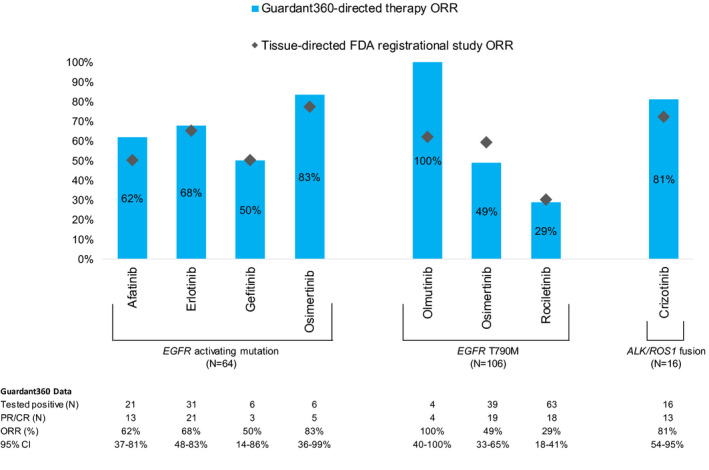
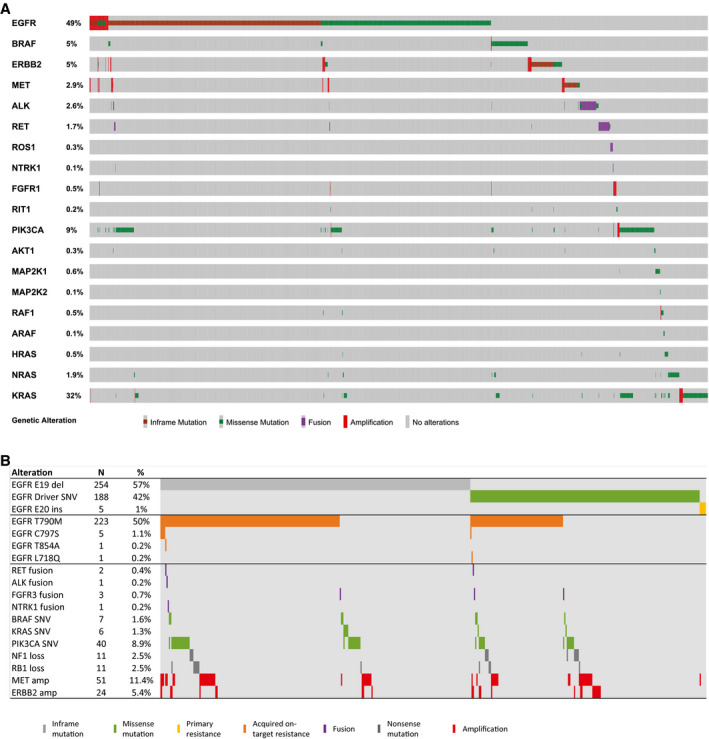
Somatic alterations were detected in 86% of samples. The median variant allele fraction was 0.43% (range, 0.03%-97.62%). Activating alterations in actionable oncogenes were identified in 48% of patients, including EGFR (26.4%), MET (6.1%), and BRAF (2.8%) alterations and fusions (ALK, RET, and ROS1) in 2.3%. Treatment-induced resistance mutations were common in this cohort, including driver-dependent and driver-independent alterations. In the subset of patients who had progressive disease during EGFR therapy, 64% had known or putative resistance alterations detected in plasma. Subset analysis revealed that ctDNA increased the identification of driver mutations by 65% over standard-of-care, tissue-based testing at diagnosis. A pooled data analysis on this plasma-based assay demonstrated that targeted therapy response rates were equivalent to those reported from tissue analysis.
Comprehensive ctDNA analysis detected the presence of therapeutically targetable driver and resistance mutations at the frequencies and distributions predicted for the study population. These findings add support for comprehensive ctDNA testing in patients who are incompletely tested at the time of diagnosis and as a primary option at the time of progression on targeted therapies.
基于循环游离肿瘤DNA(ctDNA)的突变分析,如果具有足够的敏感性和全面性,可有效识别晚期肺腺癌中的基因组靶点。因此,作者在大量非小细胞肺癌(NSCLC)患者中研究了一种商用数字下一代测序平台的准确性和临床实用性。
分析了8388例连续检测的晚期NSCLC患者基于血浆的综合基因组分析结果。对驱动突变和耐药突变的分布、频率、共现情况及相互排斥性进行了研究。
86%的样本检测到体细胞改变。变异等位基因分数中位数为0.43%(范围为0.03%-97.62%)。48%的患者中发现了可操作致癌基因的激活改变,包括EGFR(26.4%)、MET(6.1%)和BRAF(2.8%)改变,2.3%的患者存在融合(ALK、RET和ROS1)。治疗诱导的耐药突变在该队列中很常见,包括依赖驱动基因和不依赖驱动基因的改变。在EGFR治疗期间病情进展的患者亚组中,64%的患者血浆中检测到已知或推定的耐药改变。亚组分析显示,与诊断时基于组织的标准治疗检测相比,ctDNA将驱动突变的识别率提高了65%。对这种基于血浆的检测方法进行汇总数据分析表明,靶向治疗反应率与组织分析报告的反应率相当。
全面的ctDNA分析在研究人群预测的频率和分布上检测到了可治疗的驱动突变和耐药突变的存在。这些发现支持在诊断时检测不完全的患者中进行全面的ctDNA检测,并作为靶向治疗进展时的主要选择。