Dipartimento di Farmacia, Università di Pisa, Via Bonanno 6, 56126 Pisa, Italy.
Centro Interdipartimentale di Ricerca "Nutraceutica e Alimentazione per la Salute", Università di Pisa, 56126 Pisa, Italy.
Molecules. 2020 Apr 29;25(9):2082. doi: 10.3390/molecules25092082.
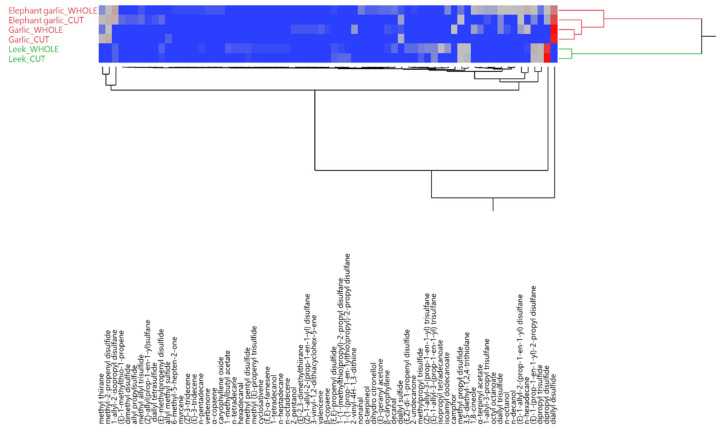
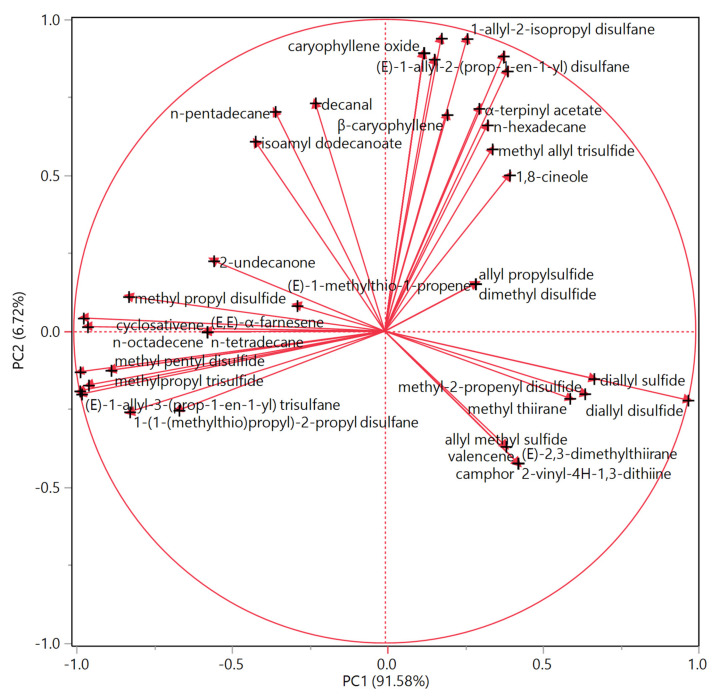
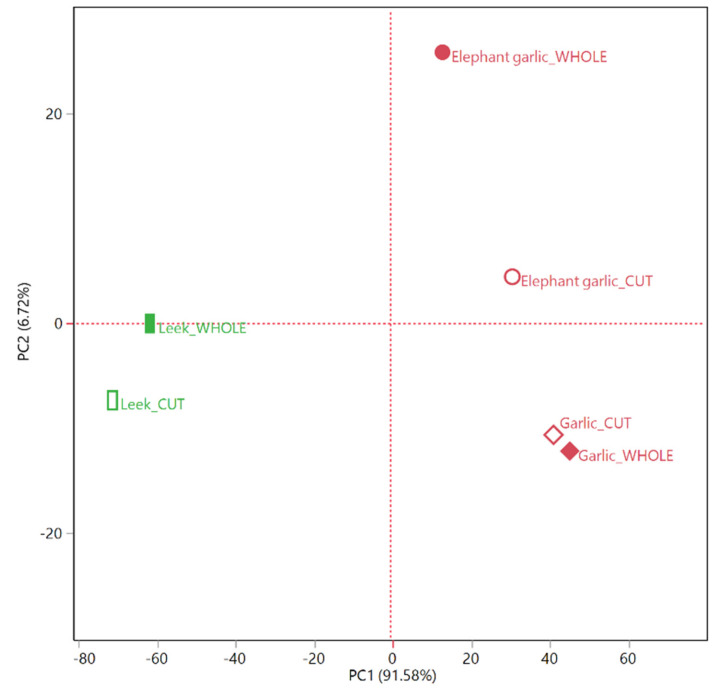
"Aglione della Valdichiana" is listed among the Traditional Agronomic and Edible Products of Italy, as it is a typical product of the Chiana Valley (Tuscany, Italy). It is also known as "elephant garlic", due to the dimension of its cloves, and, other than in the Italian Mediterranean area, its presence is also reported in North Africa and Southwest Asia. The current botanical classification identifies it as a leek variety ( L.), although its appearance, except for its larger dimensions, resembles that of garlic. In the present study, the spontaneous volatile emission of whole and cut cloves of "Aglione della Valdichiana" (elephant garlic), garlic, and leek has been profiled by headspace solid phase micro-extraction. The results have been subjected to statistical analyses (analysis of variance, hierarchical cluster, and principal component analysis) to assess whether the chemical profile confirmed the botanical proximity of elephant garlic and leek, rather than garlic. The phytochemical volatiles evaluation indicated a higher proximity of elephant garlic to garlic, rather than leek, at least for the Chiana Valley specimen analyzed in this study.
“瓦第奇亚纳阿格利奥内”被列为意大利传统农业和食用产品之一,因为它是恰纳谷(意大利托斯卡纳地区)的典型产品。它也被称为“象蒜”,因为其蒜瓣的尺寸较大,除了在意大利地中海地区,它也分布于北非和西南亚。目前的植物学分类将其鉴定为韭菜品种(L.),尽管其外观除了尺寸较大之外,与大蒜相似。在本研究中,通过顶空固相微萃取对“瓦第奇亚纳阿格利奥内”(象蒜)、大蒜和韭菜的整个和切块蒜瓣的自发挥发性排放进行了分析。结果经过统计分析(方差分析、层次聚类和主成分分析),以评估化学特征是否证实了象蒜和韭菜与大蒜的植物亲缘关系,而不是与大蒜的关系。植物化学挥发性物质的评估表明,至少就本研究分析的恰纳谷样本而言,象蒜与大蒜的亲缘关系更为密切,而不是与韭菜。