Lexhaller Barbara, Ludwig Christina, Scherf Katharina Anne
Leibniz-Institute for Food Systems Biology at the Technical University of Munich, Lise-Meitner-Str. 34, 85354, Freising, Germany.
Bavarian Center for Biomolecular Mass Spectrometry (BayBioMS), Technical University of Munich, Gregor-Mendel-Str. 4, 85354, Freising, Germany.
Sci Rep. 2020 May 4;10(1):7426. doi: 10.1038/s41598-020-64143-9.
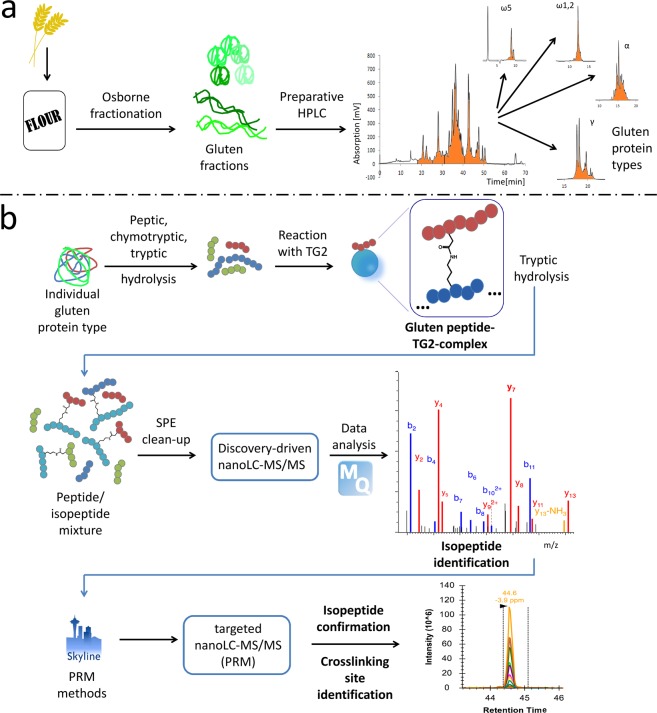
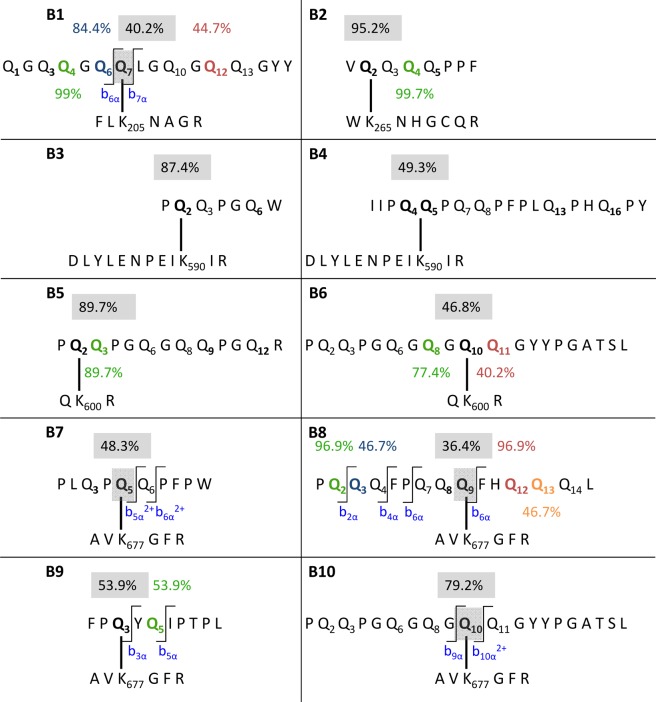
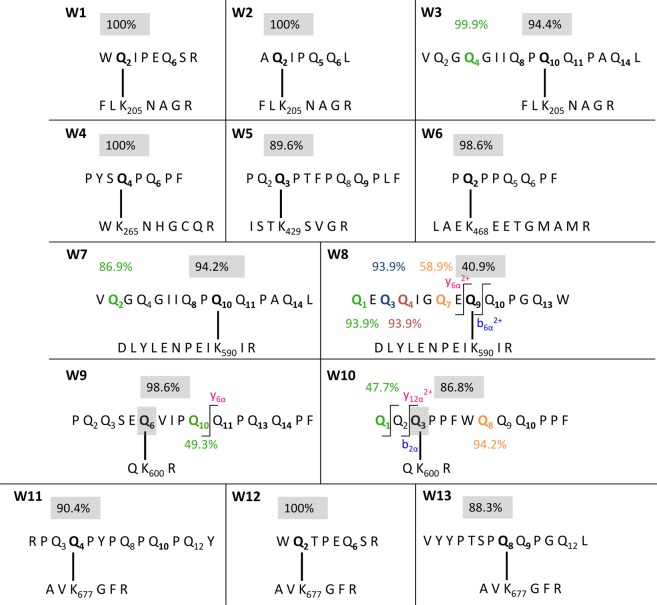
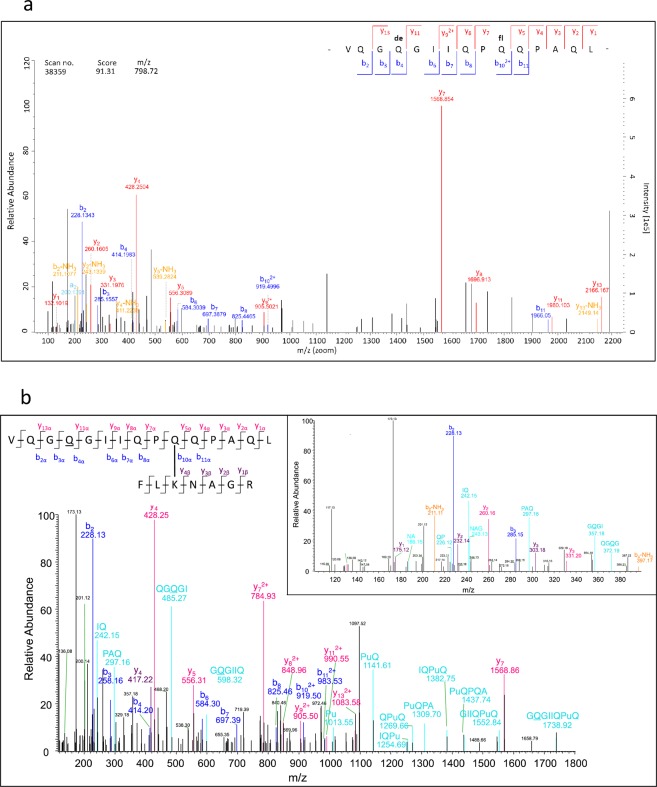
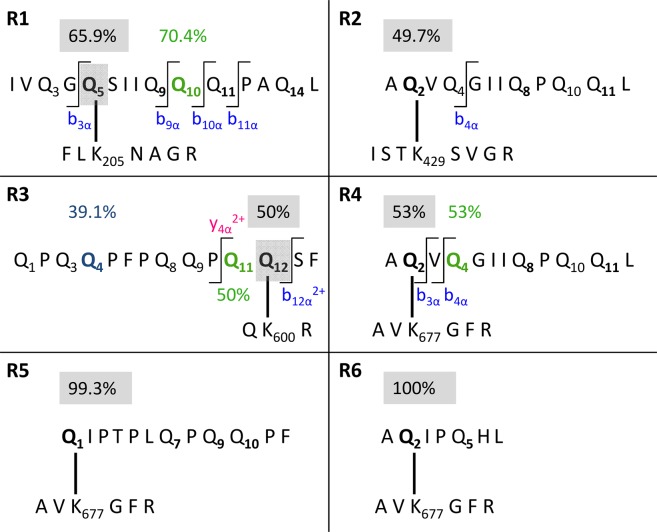
Celiac disease (CD) is a chronic immune-mediated enteropathy of the small intestine, which is triggered by the ingestion of storage proteins (gluten) from wheat, rye, and barley in genetically predisposed individuals. Human tissue transglutaminase (TG2) plays a central role in the pathogenesis of CD, because it is responsible for specific gluten peptide deamidation and covalent crosslinking, resulting in the formation of N-(γ-glutamyl)-lysine isopeptide bonds. The resulting TG2-gluten peptide complexes are assumed to cause the secretion of anti-TG2 autoantibodies, but the underlying mechanisms are only partly known. To gain more insight into the structures of these complexes, the aim of our study was to identify TG2-gluten isopeptides. With the use of discovery-driven as well as targeted nanoscale liquid chromatography tandem mass spectrometry, we detected 29 TG2-gluten isopeptides in total, involving seven selected TG2 lysine residues (K205, K265, K429, K468, K590, K600, K677). Several gluten peptides carried known B-cell epitopes and/or T-cell epitopes, either intact 9-mer core regions or partial sequences, as well as sequences bearing striking similarities to already known epitopes. These novel insights into the molecular structures of TG2-gluten peptide complexes may help clarify their physiological relevance in the initiation of CD autoimmunity and the role of anti-TG2 autoantibodies.
乳糜泻(CD)是一种由遗传易感性个体摄入小麦、黑麦和大麦中的储存蛋白(麸质)引发的慢性免疫介导性小肠病。人组织转谷氨酰胺酶(TG2)在CD发病机制中起核心作用,因为它负责特定麸质肽的脱酰胺作用和共价交联,导致形成N-(γ-谷氨酰)-赖氨酸异肽键。由此产生的TG2-麸质肽复合物被认为会导致抗TG2自身抗体的分泌,但其潜在机制仅部分为人所知。为了更深入了解这些复合物的结构,我们研究的目的是鉴定TG2-麸质异肽。通过使用发现驱动型以及靶向纳米级液相色谱串联质谱法,我们总共检测到29种TG2-麸质异肽,涉及七个选定的TG2赖氨酸残基(K205、K265、K429、K468、K590、K600、K677)。几种麸质肽带有已知的B细胞表位和/或T细胞表位,要么是完整的9聚体核心区域或部分序列,以及与已知表位具有显著相似性的序列。这些关于TG2-麸质肽复合物分子结构的新见解可能有助于阐明它们在CD自身免疫起始中的生理相关性以及抗TG2自身抗体的作用。