Lamont Doherty Earth Observatory at Columbia University, Palisades, New York, 10964, USA.
College of Economics and Management, Tiangong University, 399 Binshui West Road, Tianjin, 300387, P.R. China.
Sci Rep. 2020 May 4;10(1):7422. doi: 10.1038/s41598-020-64360-2.
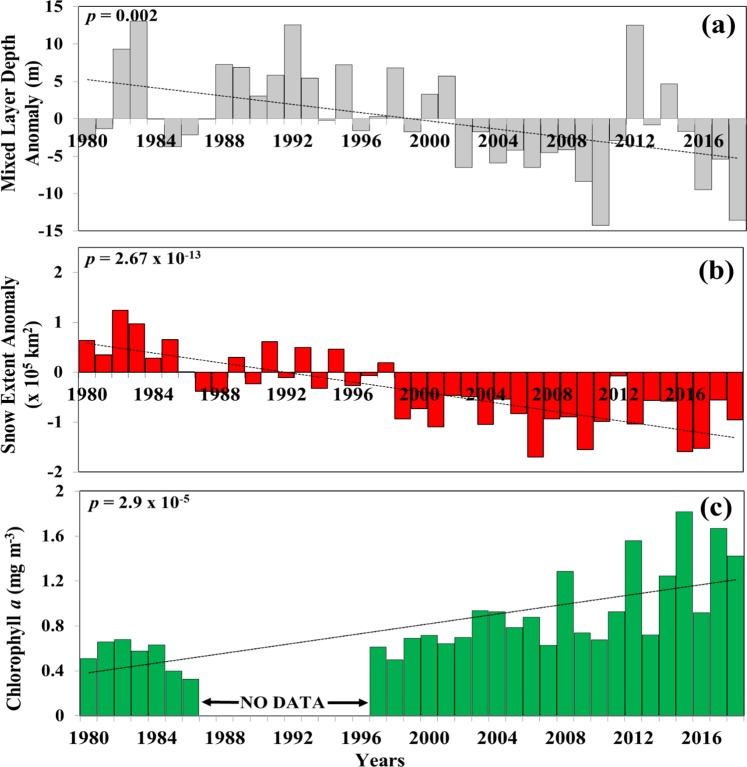
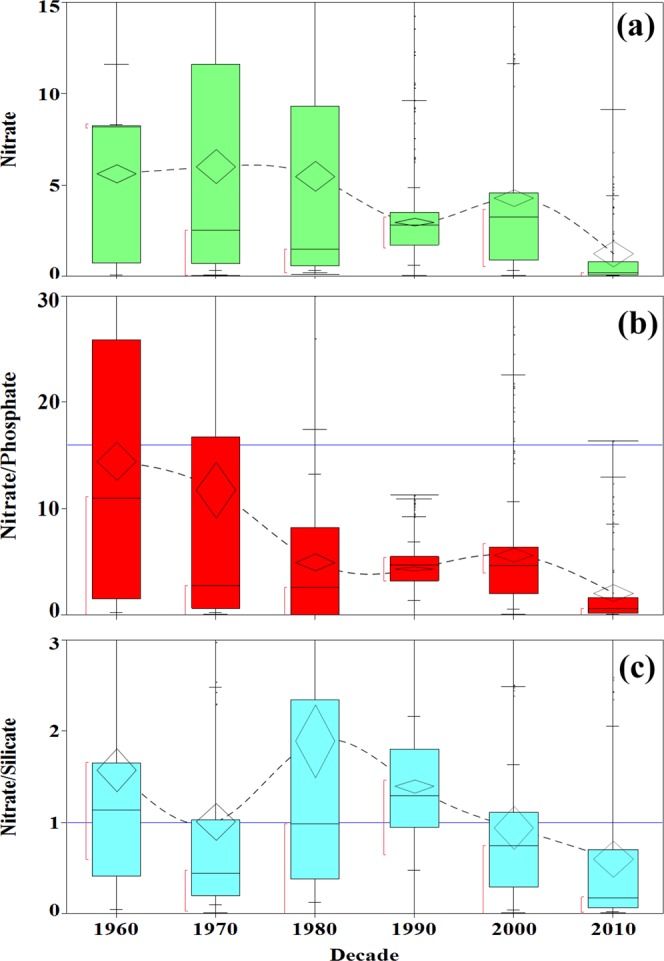
The recent trend of global warming has exerted a disproportionately strong influence on the Eurasian land surface, causing a steady decline in snow cover extent over the Himalayan-Tibetan Plateau region. Here we show that this loss of snow is undermining winter convective mixing and causing stratification of the upper layer of the Arabian Sea at a much faster rate than predicted by global climate models. Over the past four decades, the Arabian Sea has also experienced a profound loss of inorganic nitrate. In all probability, this is due to increased denitrification caused by the expansion of the permanent oxygen minimum zone and consequent changes in nutrient stoichiometries. These exceptional changes appear to be creating a niche particularly favorable to the mixotroph, Noctiluca scintillans which has recently replaced diatoms as the dominant winter, bloom forming organism. Although Noctiluca blooms are non-toxic, they can cause fish mortality by exacerbating oxygen deficiency and ammonification of seawater. As a consequence, their continued range expansion represents a significant and growing threat for regional fisheries and the welfare of coastal populations dependent on the Arabian Sea for sustenance.
最近的全球变暖趋势对亚欧大陆表面产生了不成比例的强烈影响,导致喜马拉雅-青藏高原地区的雪盖面积持续减少。在这里,我们表明,这种积雪的损失正在破坏冬季对流混合,并导致阿拉伯海上层分层的速度比全球气候模型预测的要快得多。在过去的四十年中,阿拉伯海的无机硝酸盐也经历了深刻的损失。很可能这是由于永久性氧气最小区域的扩大和营养化学计量的相应变化导致的脱氮作用增加所致。这些特殊的变化似乎创造了一个特别有利于混合营养体夜光藻的小生境,夜光藻最近已取代硅藻成为冬季的优势生物。尽管夜光藻的爆发没有毒性,但它们会通过加剧缺氧和海水氨化作用导致鱼类死亡。因此,它们的持续范围扩大对区域渔业以及依赖阿拉伯海维持生计的沿海人口的福利构成了重大且日益严重的威胁。