Cooke Andrew S, Watt Kathryn A, Albery Greg F, Morgan Eric R, Dungait Jennifer A J
Rothamsted Research, North Wyke, Okehampton, UK.
School of Veterinary Science, University of Bristol, Bristol, UK.
PeerJ. 2020 Feb 27;8:e8631. doi: 10.7717/peerj.8631. eCollection 2020.
Promoting and maintaining health is critical to ruminant welfare and productivity. Within human medicine, faecal lactoferrin is quantified for routine assessment of various gastrointestinal illnesses avoiding the need for blood sampling. This approach might also be adapted and applied for non-invasive health assessments in animals.
In this proof-of-concept study, a bovine lactoferrin enzyme-linked immunosorbent assays (ELISA), designed for serum and milk, was applied to a faecal supernatant to assess its potential for quantifying lactoferrin in the faeces of cattle. Faecal lactoferrin concentrations were compared to background levels to assess the viability of the technique. A comparison was then made against serum lactoferrin levels to determine if they were or were not reflective of one another.
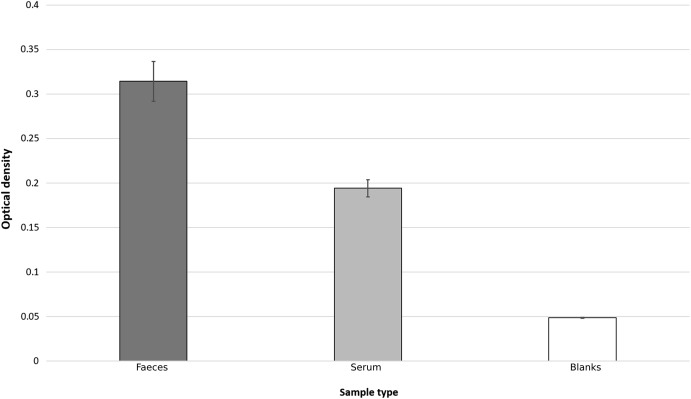
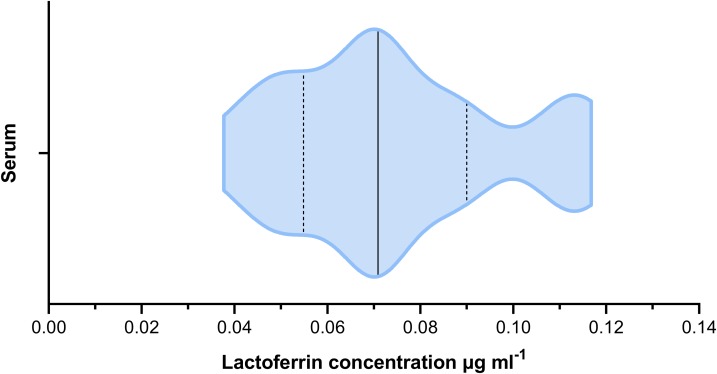
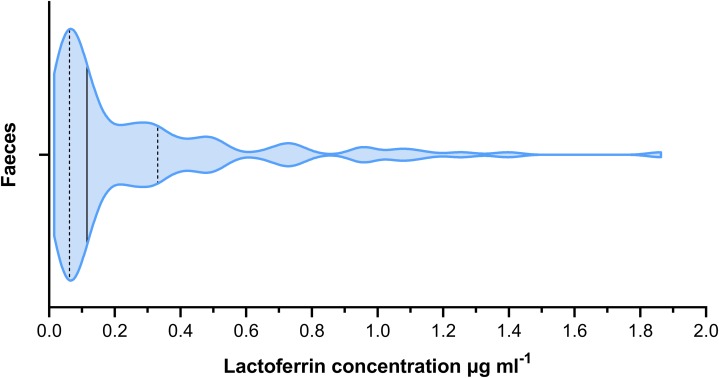
The optical densities of faecal samples were significantly greater than background readings, supporting the hypothesis that the assay was effective in quantifying faecal lactoferrin ( = 11.99, < 0.0005). The mean faecal lactoferrin concentration was 0.269 µg mL (S.E. 0.031) and the mean serum concentration 0.074 µg mL (S.E. 0.005). Lactoferrin concentrations of faecal and serum samples, taken from the same animals on the same day, were significantly different ( = 2.20, = 0.039) and did not correlate ( = 0.2699, = 0.238).
Results support the hypothesis that lactoferrin can be quantified in cattle faeces by ELISA. Whilst further research is required to determine the physiological source of the lactoferrin, this highlights the potential of the method for non-invasive assessment of cattle immunology and pathology.
促进和维持健康对反刍动物的福利和生产力至关重要。在人类医学中,粪便乳铁蛋白被定量用于各种胃肠道疾病的常规评估,无需进行血液采样。这种方法也可以适用于动物的非侵入性健康评估。
在这项概念验证研究中,一种设计用于血清和牛奶的牛乳铁蛋白酶联免疫吸附测定(ELISA)被应用于粪便上清液,以评估其在定量牛粪便中乳铁蛋白的潜力。将粪便乳铁蛋白浓度与背景水平进行比较,以评估该技术的可行性。然后将其与血清乳铁蛋白水平进行比较,以确定它们是否相互反映。
粪便样本的光密度显著高于背景读数,支持了该测定法在定量粪便乳铁蛋白方面有效的假设(t = 11.99,P < 0.0005)。粪便乳铁蛋白的平均浓度为0.269 μg/mL(标准误0.031),血清平均浓度为0.074 μg/mL(标准误0.005)。同一天从同一动物采集的粪便和血清样本中的乳铁蛋白浓度显著不同(t = 2.20,P = 0.039),且不相关(r = 0.2699,P = 0.238)。
结果支持了通过ELISA可对牛粪便中的乳铁蛋白进行定量的假设。虽然需要进一步研究以确定乳铁蛋白的生理来源,但这突出了该方法在牛免疫学和病理学非侵入性评估方面的潜力。