Rijlaarsdam David, Yous Hamza, Byrne Jonathan, Oddenino Davide, Furano Gianluca, Moloney David
Intel Corporation, Intel R&D Ireland Ltd., Collinstown, Collinstown Industrial Park, Co. Kildare, W23CW68 Collinstown, Ireland.
European Space Agency/ESTEC, 1 Keplerlaan 2201AZ, 3067 Noordwijk, The Netherlands.
Sensors (Basel). 2020 May 1;20(9):2579. doi: 10.3390/s20092579.
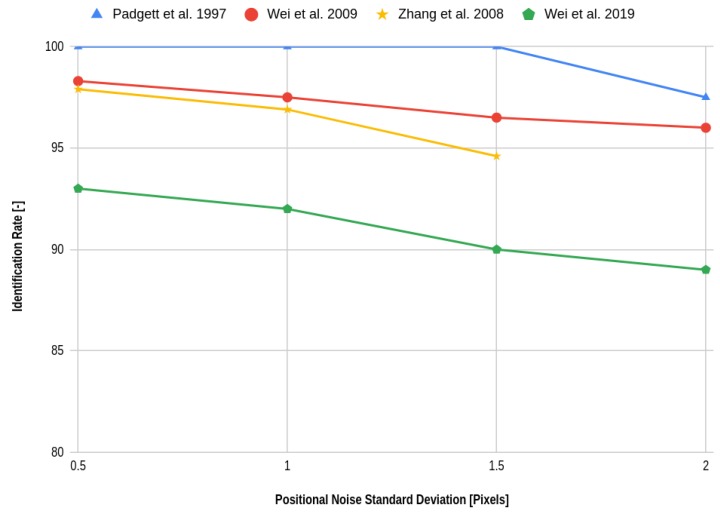
The lost-in-space star identification algorithm is able to identify stars without a priori attitude information and is arguably the most critical component of a star sensor system. In this paper, the 2009 survey by Spratling and Mortari is extended and recent lost-in-space star identification algorithms are surveyed. The covered literature is a qualitative representation of the current research in the field. A taxonomy of these algorithms based on their feature extraction method is defined. Furthermore, we show that in current literature the comparison of these algorithms can produce inconsistent conclusions. In order to mitigate these inconsistencies, this paper lists the considerations related to the relative performance evaluation of these algorithms using simulation.
空间迷失恒星识别算法能够在没有先验姿态信息的情况下识别恒星,可以说是恒星传感器系统中最关键的组件。本文扩展了斯普拉特林和莫塔里2009年的调查,并对近期的空间迷失恒星识别算法进行了综述。所涵盖的文献是该领域当前研究的定性表述。基于其特征提取方法对这些算法进行了分类。此外,我们表明在当前文献中,这些算法的比较可能会得出不一致的结论。为了减轻这些不一致性,本文列出了使用仿真对这些算法进行相对性能评估时的相关考虑因素。