Hwang Sun-Hee, Park Jin-Sil, Yang SeungCheon, Jung Kyung-Ah, Choi JeongWon, Kwok Seung-Ki, Park Sung-Hwan, Cho Mi-La
The Rheumatism Research Center, Catholic Research Institute of Medical Science, College of Medicine, The Catholic University of Korea, Seoul, 06591, Republic of Korea.
Department of Biomedicine & Health Sciences, College of Medicine, The Catholic University of Korea, Seoul, 06591, Republic of Korea.
J Transl Med. 2020 May 5;18(1):186. doi: 10.1186/s12967-020-02343-7.
Sjögren's syndrome (SS) is an autoimmune disease mediated by lymphocytic infiltration into exocrine glands, resulting in progressive lacrimal and salivary destruction and dysfunctional glandular secretion. Metabolic syndrome influences the immune system. To investigate its relationship with metabolic abnormalities, we evaluated the pathogenesis of SS and the immune cell populations in non-obese diabetic NOD/ShiLtJ mice with type 1 diabetes (T1D).
To induce metabolic abnormalities, streptozotocin (STZ)-a glucosamine-nitrosourea compound that destroys pancreatic β cells, resulting in T1D-was injected into NOD/ShiLtJ mice. The blood glucose level was measured to evaluate induction of T1D. The severity of SS was assessed by determining the body weight, salivary flow rate, and histologic parameters. The expression levels of proinflammatory factors in the salivary glands, lacrimal gland, and spleen were quantified by real-time PCR. The populations of various T- and B-cell subtypes in the peripheral blood, spleen, and salivary glands were assessed by flow cytometry.
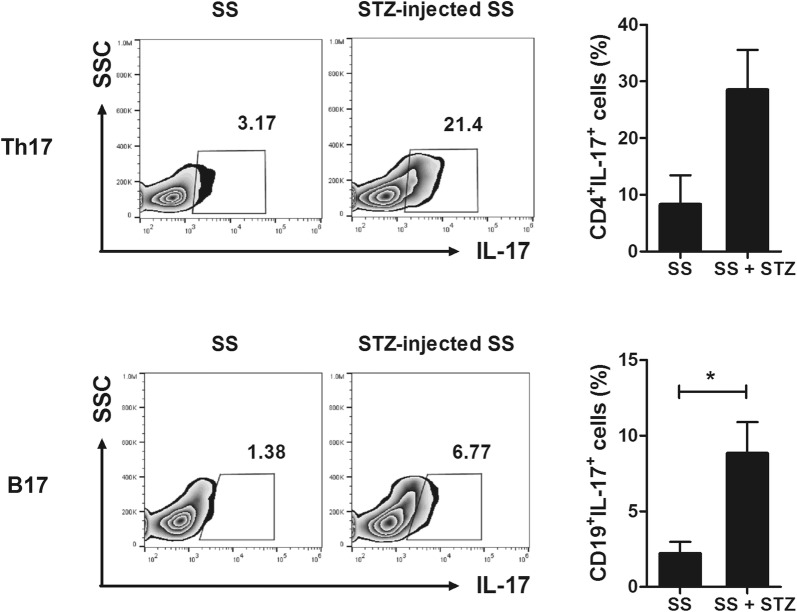
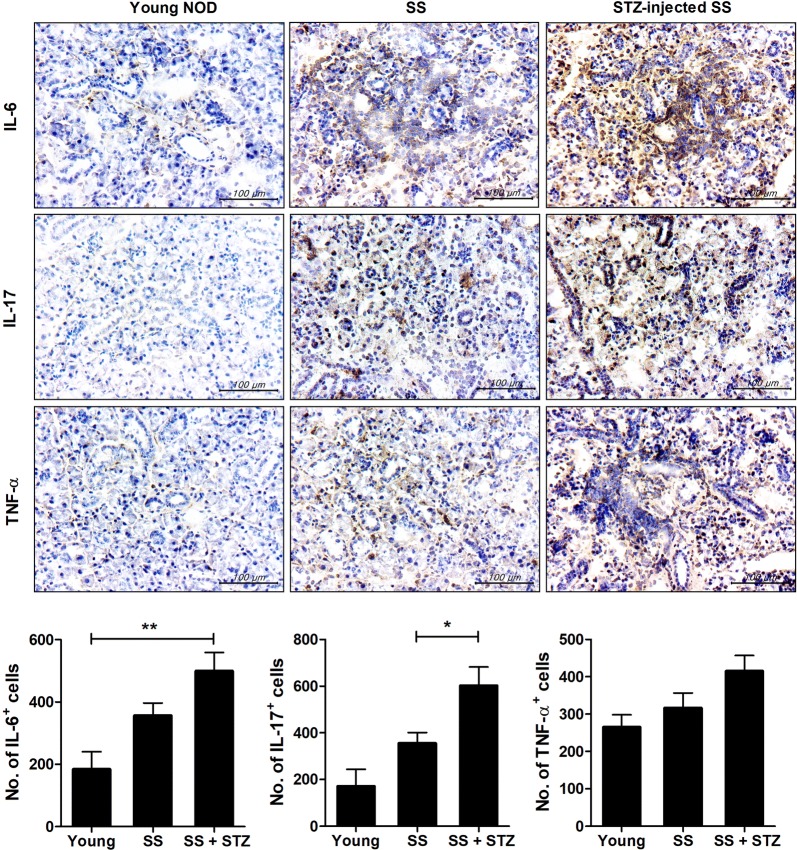
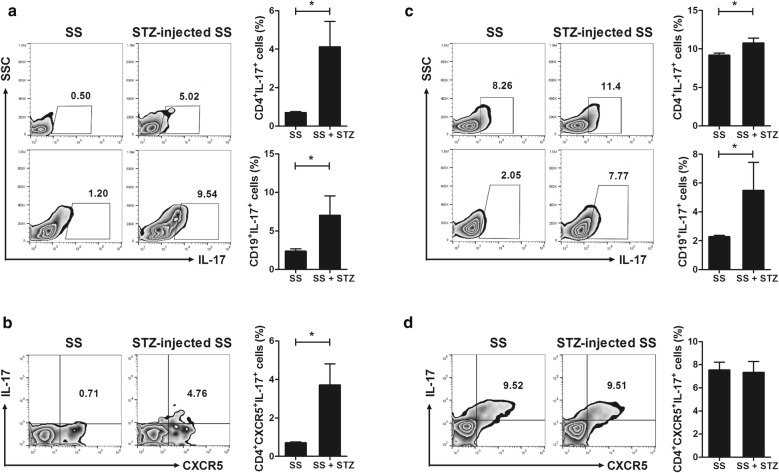
Induction of T1D in NOD/ShiLtJ mice increased both the severity of SS and the levels of proinflammatory cytokines in the salivary glands compared to the controls. Furthermore, the number of interleukin-17-producing immune cells in the peripheral blood, spleen, and salivary glands was increased in STZ- compared to vehicle-treated NOD/ShiLtJ mice.
Metabolic abnormalities play an important role in the development of SS.
干燥综合征(SS)是一种自身免疫性疾病,由淋巴细胞浸润外分泌腺介导,导致泪腺和唾液腺进行性破坏以及腺分泌功能障碍。代谢综合征会影响免疫系统。为了研究其与代谢异常的关系,我们评估了1型糖尿病(T1D)非肥胖糖尿病NOD/ShiLtJ小鼠中SS的发病机制和免疫细胞群体。
为诱导代谢异常,将链脲佐菌素(STZ)——一种破坏胰腺β细胞导致T1D的氨基葡萄糖亚硝基脲化合物——注射到NOD/ShiLtJ小鼠体内。测量血糖水平以评估T1D的诱导情况。通过测定体重、唾液流速和组织学参数来评估SS的严重程度。通过实时PCR定量唾液腺、泪腺和脾脏中促炎因子的表达水平。通过流式细胞术评估外周血、脾脏和唾液腺中各种T细胞和B细胞亚型的群体。
与对照组相比,NOD/ShiLtJ小鼠中T1D的诱导增加了SS的严重程度以及唾液腺中促炎细胞因子的水平。此外,与载体处理的NOD/ShiLtJ小鼠相比,STZ处理的小鼠外周血、脾脏和唾液腺中产生白细胞介素-17的免疫细胞数量增加。
代谢异常在SS的发展中起重要作用。