Division of Cardiovascular Surgery, Tohoku University Graduate School of Medicine, 1-1 Seiryo-machi, Aoba-ku, Sendai, 980-8574, Japan.
Research Division of Sciences for Aortic Disease, Tohoku University Graduate School of Medicine, Sendai, Japan.
Gen Thorac Cardiovasc Surg. 2020 Nov;68(11):1240-1251. doi: 10.1007/s11748-020-01364-9. Epub 2020 May 5.
To investigate the efficacy of prophylactic administration of low-dose landiolol on postoperative atrial fibrillation (POAF) in patients after cardiovascular surgery.
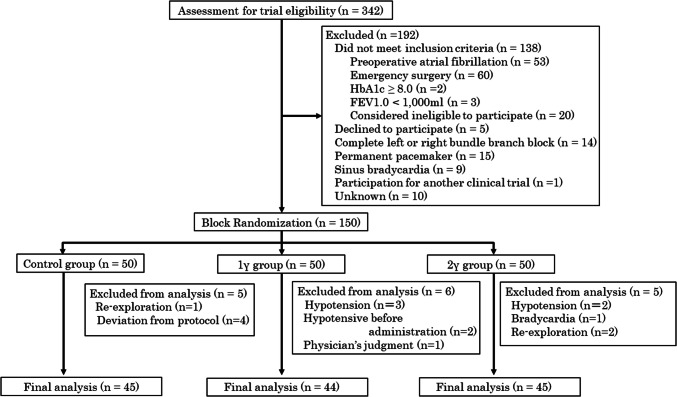
Consecutive 150 patients over 70 years of age who underwent cardiovascular surgery for valvular, ischemic heart, and aortic diseases were enrolled in this single-center prospective randomized control study from 2010 to 2014. They were assigned to three treatment groups: 1γ group (landiolol at 1 μg/kg/min), 2γ group (landiolol at 2 μg/kg/min), or control group (no landiolol). In the two landiolol groups, landiolol hydrochloride was intravenously administered for a period of 4 days postoperatively. Electrocardiography was continuously monitored during the study period, and cardiologists eventually assessed whether POAF occurred or not.
POAF occurred in 24.4% of patients in the control group, 18.2% in 1γ group, and 11.1% in 2γ group (p = 0.256). Multivariate logistic regression analysis showed that the incidence of POAF tended to decrease depending on the dose of landiolol (trend-p = 0.120; 1γ group: OR = 0.786, 95% CI 0.257-2.404; 2γ group: OR = 0.379, 95% CI 0.112-1.287). Subgroup analysis showed a significant dose-dependent reduction in POAF among categories of female sex, non-use of angiotensin II receptor blockers (ARBs) before surgery, and valve surgery (each trend-p = 0.02, 0.03, and 0.004).
These findings indicate that prophylactic administration of low-dose landiolol may not be effective for preventing the occurrence of POAF in overall patients after cardiovascular surgery, but the administration could be beneficial to female patients, patients not using ARBs preoperatively, and those after valvular surgery.
研究心血管手术后预防性应用低剂量拉地洛尔对心房颤动(POAF)的疗效。
本研究为单中心前瞻性随机对照研究,纳入 2010 年至 2014 年期间因瓣膜、缺血性心脏病和主动脉疾病接受心血管手术的 150 例 70 岁以上患者。将患者分为三组:1γ 组(拉地洛尔 1μg/kg/min)、2γ 组(拉地洛尔 2μg/kg/min)和对照组(不给拉地洛尔)。在两组拉地洛尔组中,术后静脉滴注盐酸拉地洛尔 4 天。研究期间持续行心电图监测,由心脏病专家最终评估是否发生 POAF。
对照组 POAF 发生率为 24.4%,1γ 组为 18.2%,2γ 组为 11.1%(p=0.256)。多因素 logistic 回归分析显示,POAF 发生率随拉地洛尔剂量的降低而降低(趋势 p=0.120;1γ 组:OR=0.786,95%CI 0.257-2.404;2γ 组:OR=0.379,95%CI 0.112-1.287)。亚组分析显示,女性、术前未使用血管紧张素 II 受体阻滞剂(ARBs)和瓣膜手术的患者中,POAF 发生率随剂量的降低而显著降低(每种趋势 p=0.02、0.03 和 0.004)。
这些结果表明,对于总体心血管手术后患者,预防性应用低剂量拉地洛尔可能不能有效预防 POAF 的发生,但对于女性患者、术前未使用 ARBs 的患者和瓣膜手术后的患者可能有益。