Wang Lin, Zhang Lijuan
Department of Emergency Medicine, Shengjing Hospital of China Medical University, Shenyang, China.
Department of Obstetrics and Gynecology, Shengjing Hospital of China Medical University, Shenyang, China.
Front Neurosci. 2020 Apr 16;14:354. doi: 10.3389/fnins.2020.00354. eCollection 2020.
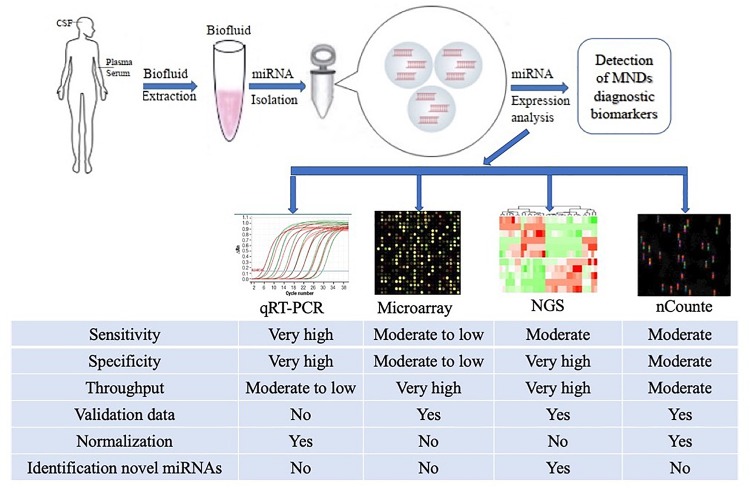
Motor neuron disease (MND) is a kind of neurodegenerative disease that selectively invades spinal cord anterior horn cells, brainstem motor neurons, cortical pyramidal cells and the pyramidal tract. The main clinical features are the symptoms and signs of impaired upper and lower motor neurons, manifested as muscle weakness, atrophy and pyramidal tract signs. Histopathology has shown the disappearance of pyramidal cells in the motor cortex, loss of motor neurons in the anterior horn of the spinal cord and brainstem, and degeneration of the corticospinal tract. Due to the lack of effective treatment methods, the prognosis is generally poor, so it is of great significance to confirm the diagnosis early by various means. However, the current diagnosis of MND mainly relies on the combination of clinical manifestations and neurophysiological examinations, lacking effective means of early diagnosis. Circulating microRNA (CmiRNA) is a kind of stable miRNA molecule in serum, plasma and other body fluids, which has the characteristics of distinct differential expression, sensitive detection and convenient sample collection. As a possible new biomarker of MND, CmiRNA can not only reveal the pathophysiological process of MND, but also monitor disease progression and response to drug therapy. With the development of miRNA detection technology, more and more CmiRNAs as biomarkers with potential diagnostic value have been investigated. In this review, we explored the possibility of circulating samples as different sources of biomarkers for the diagnosis of MND, analyzing the progress of CmiRNA detection techniques, and presenting potential diagnostic MND biomarkers that have been reported.
运动神经元病(MND)是一种神经退行性疾病,它选择性地侵袭脊髓前角细胞、脑干运动神经元、皮质锥体细胞和锥体束。主要临床特征是上下运动神经元受损的症状和体征,表现为肌肉无力、萎缩和锥体束征。组织病理学显示运动皮质中的锥体细胞消失、脊髓前角和脑干中的运动神经元丧失以及皮质脊髓束变性。由于缺乏有效的治疗方法,预后通常较差,因此通过各种手段早期确诊具有重要意义。然而,目前MND的诊断主要依靠临床表现和神经生理学检查相结合,缺乏有效的早期诊断手段。循环微小RNA(CmiRNA)是血清、血浆等体液中一种稳定的微小RNA分子,具有差异表达明显、检测灵敏、样本采集方便等特点。作为MND一种可能的新型生物标志物,CmiRNA不仅可以揭示MND的病理生理过程,还可以监测疾病进展和对药物治疗的反应。随着微小RNA检测技术的发展,越来越多具有潜在诊断价值的CmiRNAs作为生物标志物被研究。在本综述中,我们探讨了将循环样本作为诊断MND的不同生物标志物来源的可能性,分析了CmiRNA检测技术的进展,并展示了已报道的潜在诊断MND的生物标志物。