Chien Yin-Hsiu, Tsai Wen-Hui, Chang Chaw-Liang, Chiu Pao-Chin, Chou Yen-Yin, Tsai Fuu-Jen, Wong Siew-Lee, Lee Ni-Chung, Hwu Wuh-Liang
Department of Medical Genetics, National Taiwan University Hospital, Taipei, Taiwan.
Department of Pediatrics, National Taiwan University Hospital, Taipei, Taiwan.
Mol Genet Metab Rep. 2020 Apr 29;23:100591. doi: 10.1016/j.ymgmr.2020.100591. eCollection 2020 Jun.
Enzyme replacement therapy (ERT), the only approved therapy for infantile-onset Pompe disease (IOPD), had heterogeneous clinical effects due to factors such as severity, age at first treatment, dosage, and dosing regimens. We report the clinical and biochemical outcomes of a cohort of IOPD patients identified through newborn screening, and evaluating the dosage effect.
A retrospective observational study was designed to describe the long-term clinical and biochemical outcomes of a uniform cohort of IOPD patients who have been treated with high-dosage of ERT.
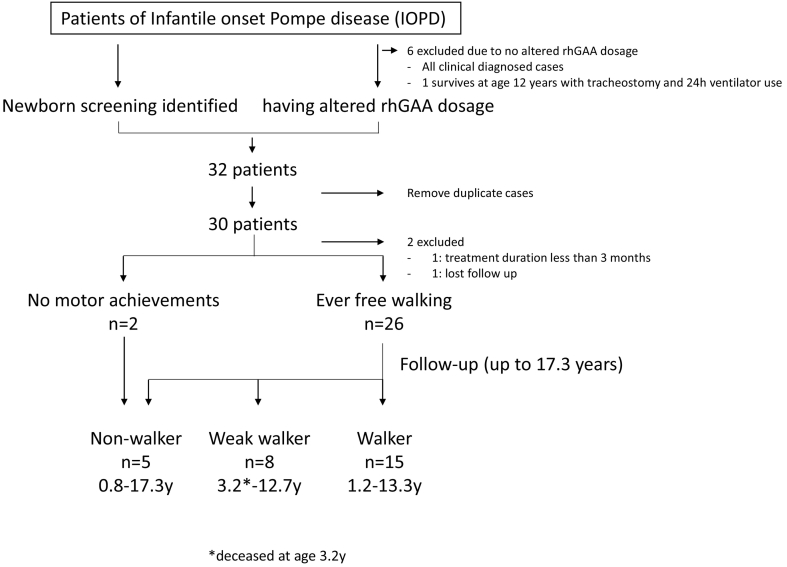
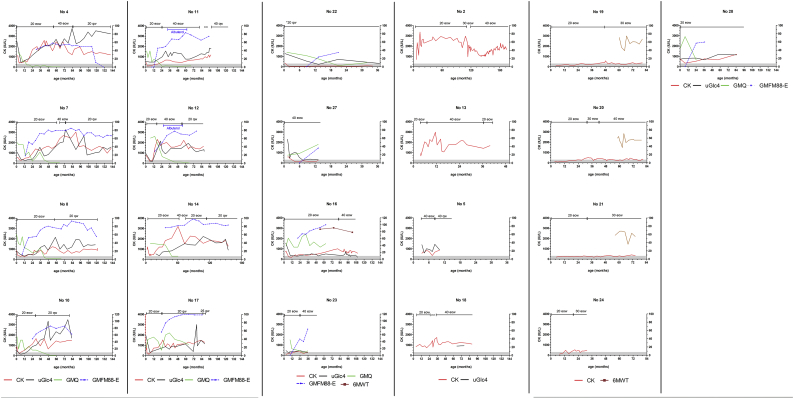
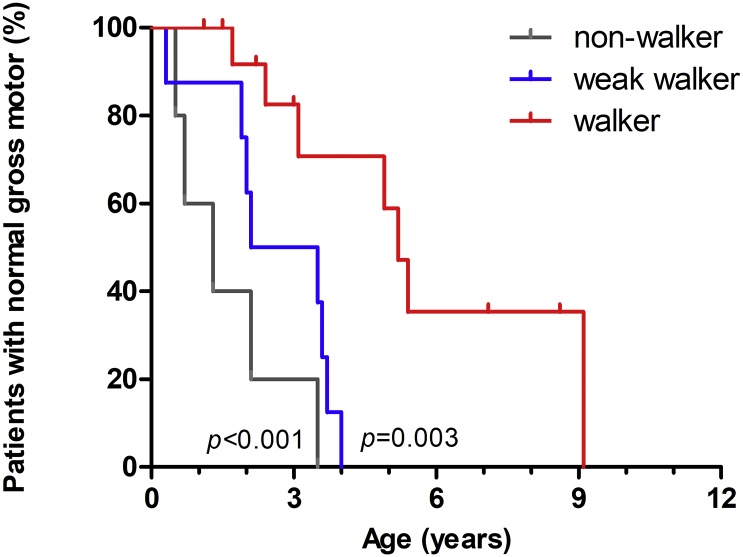
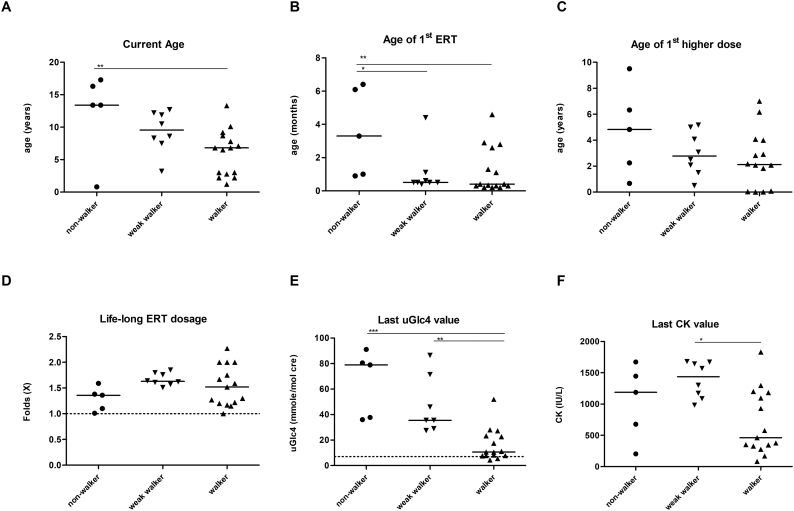
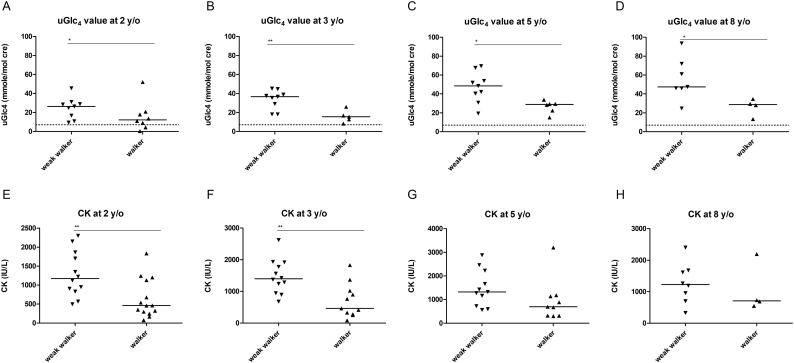
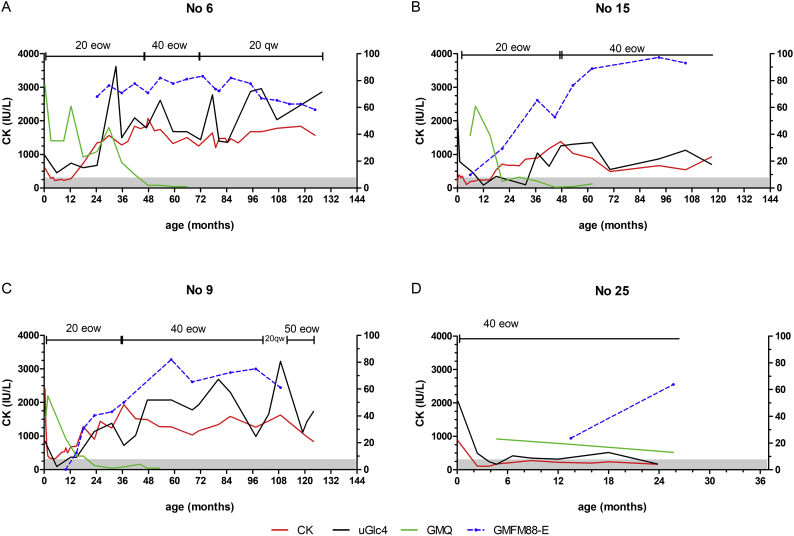
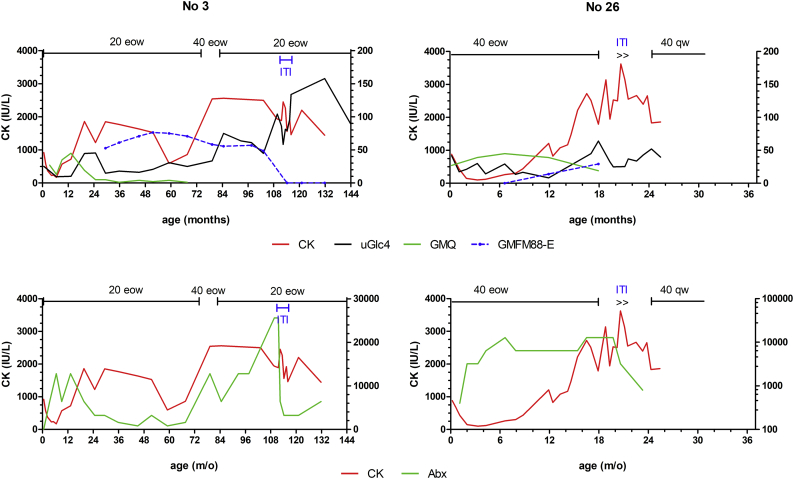
Twenty-eight patients received alglucosidase alpha at either the labeled dosage followed by a high dosage ( = 23) or a high dosage exclusively ( = 5). At a median age of 8.3 years (0.8-17.3), 15 patients were walkers, 8 were weak walkers, and 5 were nonwalkers. The three groups exhibited a significant difference in the age of gross motor decline ( < .001). In patients with classical IOPD diagnosed through newborn screening, those late in ERT initiation ( = .006) or late in high-dosage ERT initiation ( = .044) had a higher risk of motor decline. At the latest assessment, both serum creatine kinase (CK) and urinary glucose tetrasaccharide (uGlc4) levels were lowest in the walkers. During follow up, the biomarker levels, once rose, never returned to normal.
Low CK and uGlc4 levels were correlated with favorable response to ERT in IOPD patients, although CK may be more fluctuated than uGlc4. High-dose ERT instituted immediately at newborn screening seems to give the best outcome, and a dosage increase is necessary upon - or, even better, before - a rise in biomarker levels.
酶替代疗法(ERT)是唯一被批准用于婴儿型庞贝病(IOPD)的疗法,但其临床效果因疾病严重程度、首次治疗年龄、剂量和给药方案等因素而异。我们报告了一组通过新生儿筛查确诊的IOPD患者的临床和生化结果,并评估了剂量效应。
一项回顾性观察性研究旨在描述一组接受高剂量ERT治疗的IOPD患者的长期临床和生化结果。
28例患者接受了阿糖苷酶α治疗,其中23例先接受标记剂量治疗,随后接受高剂量治疗,5例仅接受高剂量治疗。患者中位年龄为8.3岁(0.8 - 17.3岁),15例患者能够行走,8例行走能力较弱,5例无法行走。三组患者在粗大运动功能衰退年龄方面存在显著差异(P <.001)。在通过新生儿筛查确诊的经典IOPD患者中,ERT起始较晚(P =.006)或高剂量ERT起始较晚(P =.044)的患者运动功能衰退风险更高。在最近一次评估时,血清肌酸激酶(CK)和尿葡萄糖四糖(uGlc4)水平在能够行走的患者中最低。在随访期间,生物标志物水平一旦升高,就再也没有恢复正常。
低CK和uGlc4水平与IOPD患者对ERT的良好反应相关,尽管CK可能比uGlc4波动更大。在新生儿筛查时立即开始高剂量ERT似乎能取得最佳效果,并且在生物标志物水平升高时或甚至更好在其升高之前增加剂量是必要的。