Sprague Brian L, Miglioretti Diana L, Lee Christoph I, Perry Hannah, Tosteson Anna A N, Kerlikowske Karla
Department of Surgery, University of Vermont, Burlington, Vermont, USA.
Department of Radiology, University of Vermont, Burlington, Vermont, USA.
Cancer. 2020 Jul 15;126(14):3289-3296. doi: 10.1002/cncr.32939. Epub 2020 May 6.
Established mammography screening performance metrics use the initial screening mammography assessment because they were developed for radiologist performance auditing, yet these metrics are frequently used to inform health policy and screening decision making. The authors have developed new performance metrics based on the final assessment that consider the entire screening episode, including diagnostic workup.
The authors used data from 2,512,577 screening episodes during 2005-2017 at 146 facilities in the United States participating in the Breast Cancer Surveillance Consortium. Screening performance metrics based on the final assessment of the screening episode were compared with conventional metrics defined with the initial assessment. Results were also stratified by breast density and breast cancer risk.
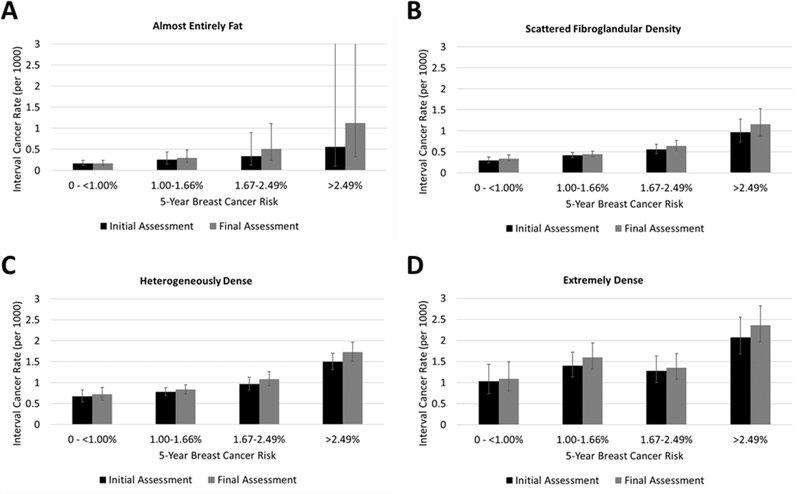
The cancer detection rates were similar for the final assessment (4.1 per 1000; 95% confidence interval [CI], 3.8-4.3 per 1000) and the initial assessment (4.1 per 1000; 95% CI, 3.9-4.3 per 1000). The interval cancer rate was 12% higher when it was based on the final assessment (0.77 per 1000; 95% CI, 0.71-0.83 per 1000) versus the initial assessment (0.69 per 1000; 95% CI, 0.64-0.74 per 1000), and this resulted in a modest difference in sensitivity (84.1% [95% CI, 83.0%-85.1%] vs 85.7% [95% CI, 84.8%-86.6%], respectively). Absolute differences in the interval cancer rate between final and initial assessments increased with breast density and breast cancer risk (eg, a difference of 0.29 per 1000 for women with extremely dense breasts and a 5-year risk >2.49%).
Established screening performance metrics underestimate the interval cancer rate of a mammography screening episode, particularly for women with dense breasts or an elevated breast cancer risk. Women, clinicians, policymakers, and researchers should use final-assessment performance metrics to support informed screening decisions.
既定的乳腺钼靶筛查性能指标采用初始筛查乳腺钼靶评估,因为这些指标是为放射科医生的性能审核而制定的,但这些指标经常被用于为卫生政策和筛查决策提供依据。作者基于最终评估开发了新的性能指标,该评估考虑了整个筛查过程,包括诊断检查。
作者使用了2005年至2017年期间美国146个参与乳腺癌监测联盟的机构的2512577次筛查过程的数据。将基于筛查过程最终评估的筛查性能指标与根据初始评估定义的传统指标进行比较。结果还按乳腺密度和乳腺癌风险进行了分层。
最终评估的癌症检出率(每1000人中有4.1例;95%置信区间[CI],每1000人中有3.8 - 4.3例)与初始评估(每1000人中有4.1例;95%CI,每1000人中有3.9 - 4.3例)相似。基于最终评估的间期癌症发生率(每1000人中有0.77例;95%CI,每1000人中有0.71 - 0.83例)比基于初始评估的间期癌症发生率(每1000人中有0.69例;95%CI,每1000人中有0.64 - 0.74例)高12%,这导致敏感性存在适度差异(分别为84.1%[95%CI,83.0% - 85.1%]和85.7%[95%CI,84.8% - 86.6%])。最终评估和初始评估之间的间期癌症发生率绝对差异随着乳腺密度和乳腺癌风险的增加而增大(例如,乳腺极度致密且5年风险>2.49%的女性,差异为每1000人中有0.29例)。
既定的筛查性能指标低估了乳腺钼靶筛查过程中的间期癌症发生率,尤其是对于乳腺致密或乳腺癌风险较高的女性。女性、临床医生、政策制定者和研究人员应使用最终评估性能指标来支持明智的筛查决策。