Ethiopian Public Health Institute, Addis Ababa, Ethiopia.
St Paul's Hospital Millennium Medical College, Addis Ababa, Ethiopia.
PLoS One. 2020 May 6;15(5):e0232426. doi: 10.1371/journal.pone.0232426. eCollection 2020.
Extrapulmonary tuberculosis is an emerging public health problem among HIV positives compared to the general population. This study aimed to assess the incidence and predictors of extrapulmonary tuberculosis among people living with HIV in selected health facilities in Addis Ababa, Ethiopia, from 01 January 2013 up to 31 December 2018.
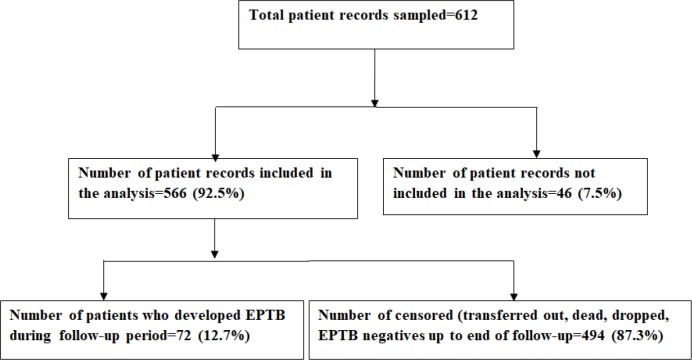
A retrospective cohort study design was employed based on data collected from 566 HIV positive individuals. Data were entered using EpiInfo version 7.1 and analyzed by SPSS version 20. The incidence rate was determined per 100 person-years. Kaplan-Meier estimates used to estimate survivor and the hazard function, whereas log-rank tests used to compare survival curves and hazard across different categories. Cox proportional hazard model was used to identify the predictors and 95%CI of the hazard ratio were computed. P-value<0.05 in the multivariable analysis was considered statistically significant.
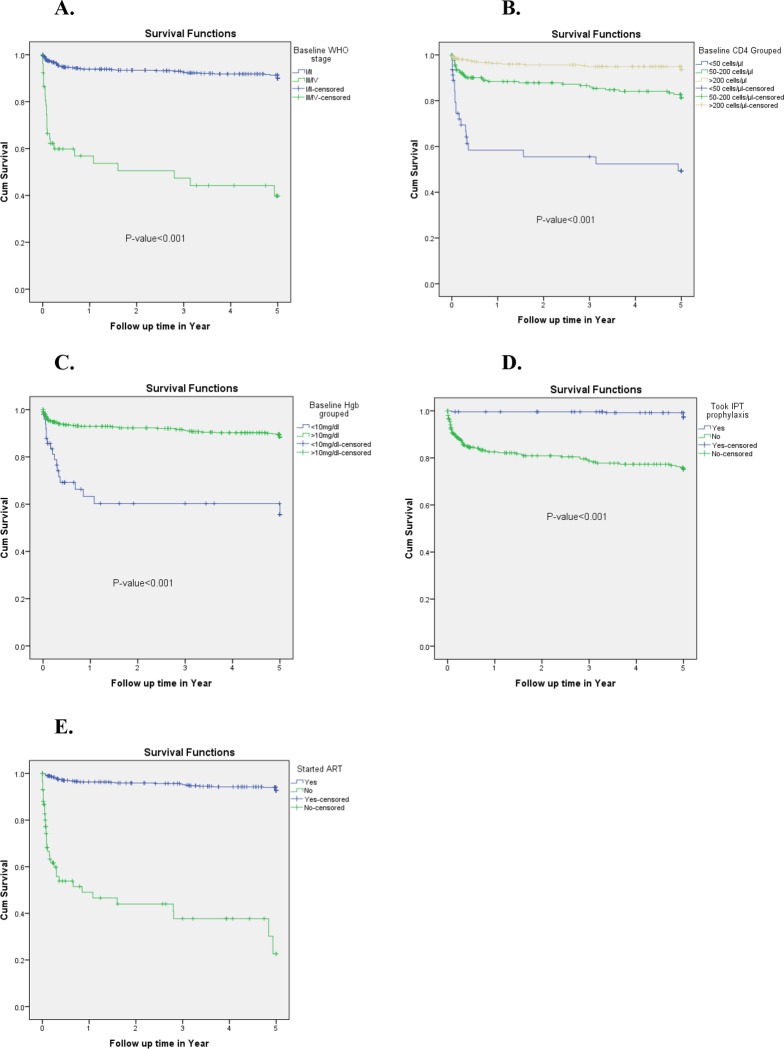
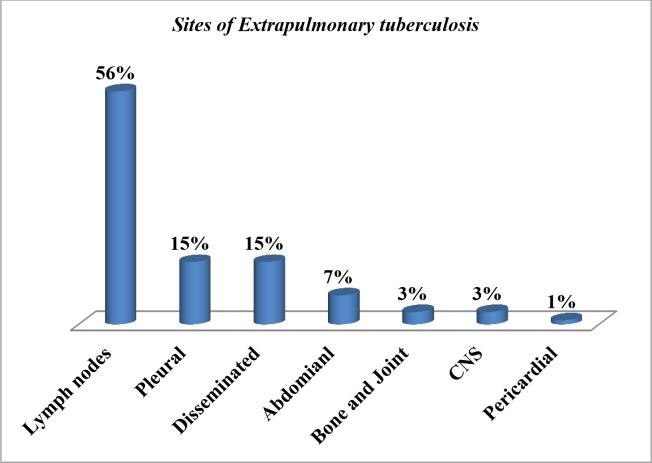
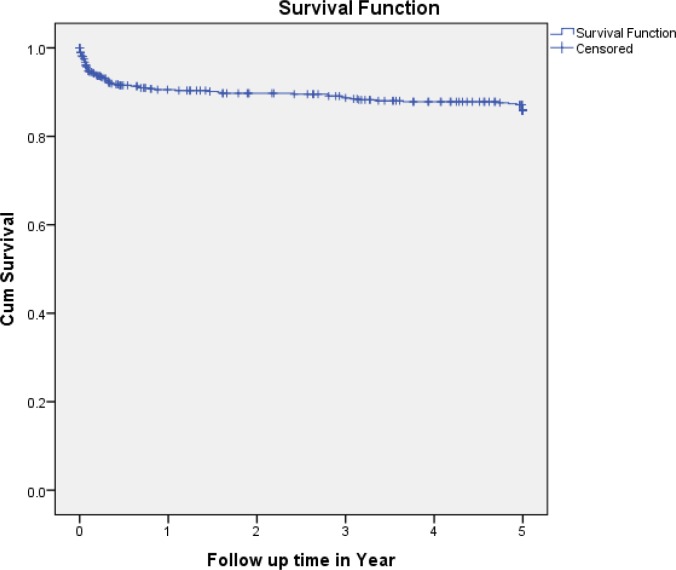
Five hundred sixty-six HIV positive individuals were followed for 2140.08 person-years. Among them, 72 developed extrapulmonary tuberculosis that gives an incidence rate of 3.36/100 person-years (95%CI = 2.68-4.22). The most frequent forms of extrapulmonary tuberculosis were; lymph node tuberculosis (56%, 41) followed equally by pleural tuberculosis (15%, 11) and disseminated tuberculosis (15%, 11). The majority (70.83%) of the cases occurred within the first year of follow-up. In multivariable Cox regression analysis, baseline WHO stage III/IV (AHR = 2.720, 95%CI = 1.575-4.697), baseline CD4 count<50cells/μl (AHR = 4.073, 95%CI = 2.064-8.040), baseline CD4 count 50-200 cells/μl (AHR = 2.360, 95%CI = 1.314-4.239) and baseline Hgb<10 mg/dl (AHR = 1.979, 95%CI = 1.091-3.591) were the independent risk factors. While isoniazid prophylaxis (AHR = 0.232, 95%CI = 0.095-0.565) and taking antiretroviral drugs (AHR = 0.134, 95%CI = 0.075-0.238) had a protective benefit.
Extrapulmonary tuberculosis co-infection was common among HIV positive individuals, and mostly occurred in those with advanced immune suppression. The risk decreases in those taking antiretroviral therapy and took isoniazid preventive treatment. Screening of HIV positives for extrapulmonary tuberculosis throughout their follow-up would be important.
与一般人群相比,HIV 阳性人群中肺外结核是一个新出现的公共卫生问题。本研究旨在评估 2013 年 1 月 1 日至 2018 年 12 月 31 日期间在埃塞俄比亚亚的斯亚贝巴选定医疗机构中 HIV 阳性个体中肺外结核的发病率和预测因素。
采用回顾性队列研究设计,基于从 566 名 HIV 阳性个体中收集的数据。数据使用 EpiInfo 版本 7.1 输入,并使用 SPSS 版本 20 进行分析。发病率按每 100 人年计算。使用 Kaplan-Meier 估计来估计幸存者和风险函数,而对数秩检验用于比较不同类别之间的生存曲线和风险。使用 Cox 比例风险模型来确定预测因素和危险比的 95%CI。多变量分析中 P 值<0.05 被认为具有统计学意义。
对 566 名 HIV 阳性个体进行了 2140.08 人年的随访。其中 72 人发生肺外结核,发病率为 3.36/100 人年(95%CI = 2.68-4.22)。最常见的肺外结核形式为;淋巴结结核(56%,41 例),同样常见的是胸腔结核(15%,11 例)和播散性结核(15%,11 例)。大多数(70.83%)病例发生在随访的第一年。在多变量 Cox 回归分析中,基线 WHO 分期 III/IV(AHR = 2.720,95%CI = 1.575-4.697)、基线 CD4 计数<50 个/μl(AHR = 4.073,95%CI = 2.064-8.040)、基线 CD4 计数 50-200 个/μl(AHR = 2.360,95%CI = 1.314-4.239)和基线 Hgb<10mg/dl(AHR = 1.979,95%CI = 1.091-3.591)是独立的危险因素。而异烟肼预防治疗(AHR = 0.232,95%CI = 0.095-0.565)和使用抗逆转录病毒药物(AHR = 0.134,95%CI = 0.075-0.238)具有保护作用。
HIV 阳性个体中肺外结核合并感染很常见,且主要发生在免疫抑制严重的患者中。接受抗逆转录病毒治疗和异烟肼预防治疗的风险降低。在整个随访过程中对 HIV 阳性个体进行肺外结核筛查非常重要。