Department of Therapeutic Radiology and Oncology, Medical University of Graz, Comprehensive Cancer Center Graz (CCC), Auenbruggerplatz 32, 8036, Graz, Austria.
Division of Neuroradiology, Vascular and Interventional Radiology, Medical University of Graz, Comprehensive Cancer Center Graz (CCC), Auenbruggerplatz 9, 8036, Graz, Austria.
Radiat Oncol. 2020 May 6;15(1):99. doi: 10.1186/s13014-020-01554-y.
Although controversial, there are data suggesting that clinical parameters can predict the probability of sphincter preserving procedures in rectal cancer. The purpose of this study was to investigate the association between clinical parameters and the sphincter-preserving surgery rate in patients who had undergone neoadjuvant combination therapy for advanced low rectal cancer.
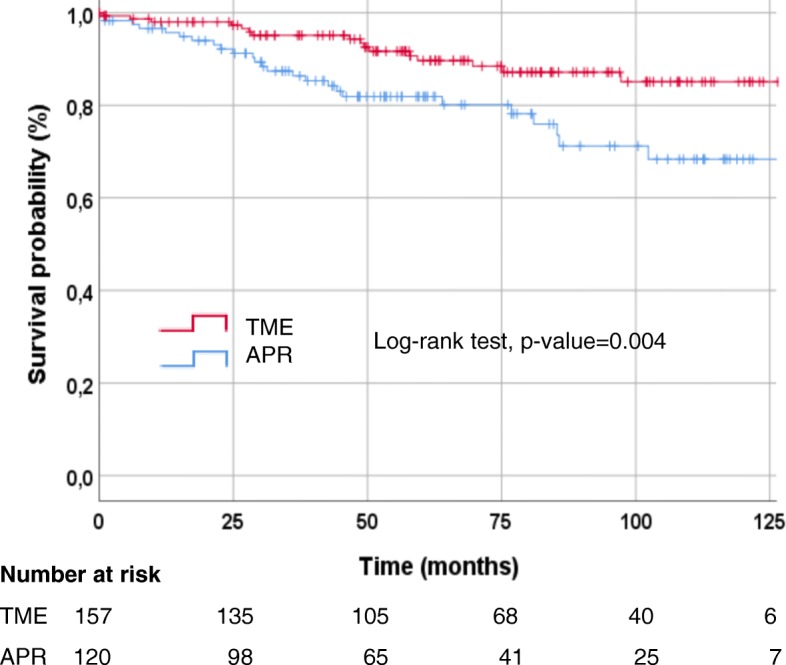
In this single center study, the charts of 540 patients with locally advanced rectal cancer who had been treated with induction chemotherapy-and/or neoadjuvant concomitant radiochemotherapy (nRCT) over an 11-year period were reviewed in order to identify patients with rectal cancer ≤6 cm from the anal verge, who had received the prescribed nRCT only. Univariate and multivariate analyses were used to identify pretreatment patient- and tumor associated parameters correlating with sphincter preservation. Survival rates were calculated using Kaplan-Meier analyses.
Two hundred eighty of the 540 patients met the selection criteria. Of the 280 patients included in the study, 158 (56.4%) underwent sphincter-preserving surgery. One hundred sixty-four of 280 patients (58.6%) had a downsizing of the primary tumor (ypT < cT) and 39 (23.8%) of these showed a complete histopathological response (ypT0 ypN0). In univariate analysis, age prior to treatment, Karnofsky performance status, clinical T-size, relative lymphocyte value, CRP value, and interval between nRCT and surgery, were significantly associated with sphincter-preserving surgery. In multivariate analysis, age (hazard ratio (HR) = 1.05, CI95%: 1.02-1.09, p = 0.003), relative lymphocyte value (HR = 0.94, CI95%: 0.89-0.99, p = 0.029), and interval between nRCT and surgery (HR = 2.39, CI95%: 1.17-4.88, p = 0.016) remained as independent predictive parameters.
These clinical parameters can be considered in the prognostication of sphincter-preserving surgery in case of low rectal adenocarcinoma. More future research is required in this area.
尽管存在争议,但有数据表明临床参数可以预测直肠癌保肛手术的可能性。本研究旨在探讨新辅助联合治疗中晚期低位直肠癌患者的临床参数与保肛手术率之间的关系。
本单中心研究回顾了 540 例接受诱导化疗和/或新辅助同期放化疗(nRCT)治疗的局部晚期直肠癌患者的病历,以确定距肛缘≤6cm 的直肠癌患者,仅接受规定的 nRCT。采用单因素和多因素分析方法确定与保肛相关的治疗前患者和肿瘤相关参数。采用 Kaplan-Meier 分析计算生存率。
540 例患者中,280 例符合入选标准。在纳入研究的 280 例患者中,158 例(56.4%)接受了保肛手术。280 例患者中有 164 例(58.6%)肿瘤原发灶缩小(ypT< cT),其中 39 例(23.8%)完全病理缓解(ypT0 ypN0)。单因素分析显示,治疗前年龄、卡氏功能状态评分、临床 T 分期、相对淋巴细胞值、CRP 值、nRCT 与手术间隔与保肛手术显著相关。多因素分析显示,年龄(风险比(HR)=1.05,95%CI:1.02-1.09,p=0.003)、相对淋巴细胞值(HR=0.94,95%CI:0.89-0.99,p=0.029)和 nRCT 与手术间隔(HR=2.39,95%CI:1.17-4.88,p=0.016)是独立的预测参数。
这些临床参数可用于预测低位直肠腺癌保肛手术的预后。该领域需要更多的进一步研究。