Centre for Health Informatics, The University of Manchester, Manchester, UK
Computer Science, The University of Manchester, Manchester, UK.
BMJ Open. 2020 May 5;10(5):e033618. doi: 10.1136/bmjopen-2019-033618.
National guidelines for identifying physiological deterioration and sepsis in hospitals depend on thresholds for blood pressure that do not account for age or sex. In populations outside hospital, differences in blood pressure are known to occur with both variables. Whether these differences remain in the hospitalised population is unknown. This database analysis study aims to generate representative centiles to quantify variations in blood pressure by age and sex in hospitalised patients.
Retrospective cross-sectional observational database analysis.
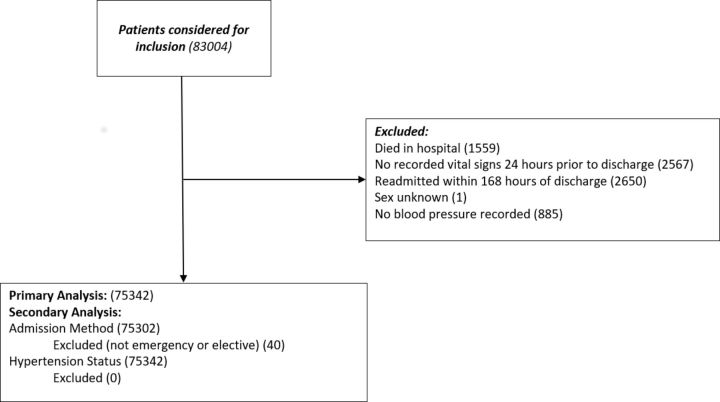
Four near-sea-level hospitals between April 2015 and April 2017 PARTICIPANTS: 75 342 adult patients who were admitted to the hospitals and had at least one set of documented vital sign observations within 24 hours before discharge were eligible for inclusion. Patients were excluded if they died in hospital, had no vital signs 24 hours prior to discharge, were readmitted within 7 days of discharge, had missing age or sex or had no blood pressure recorded.
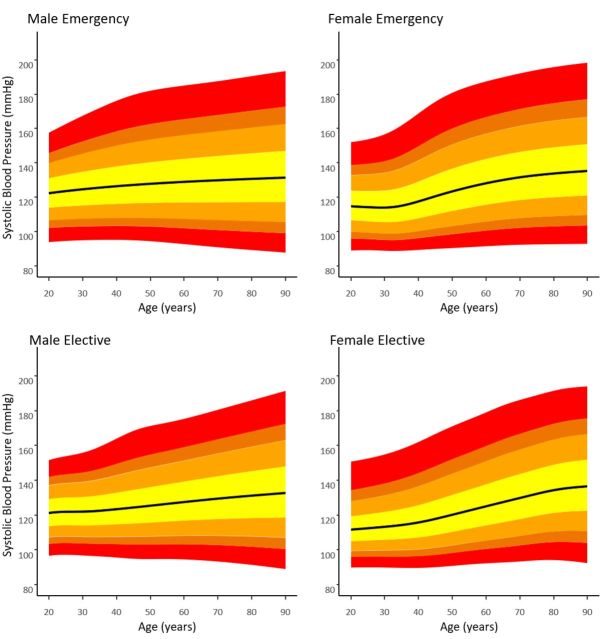
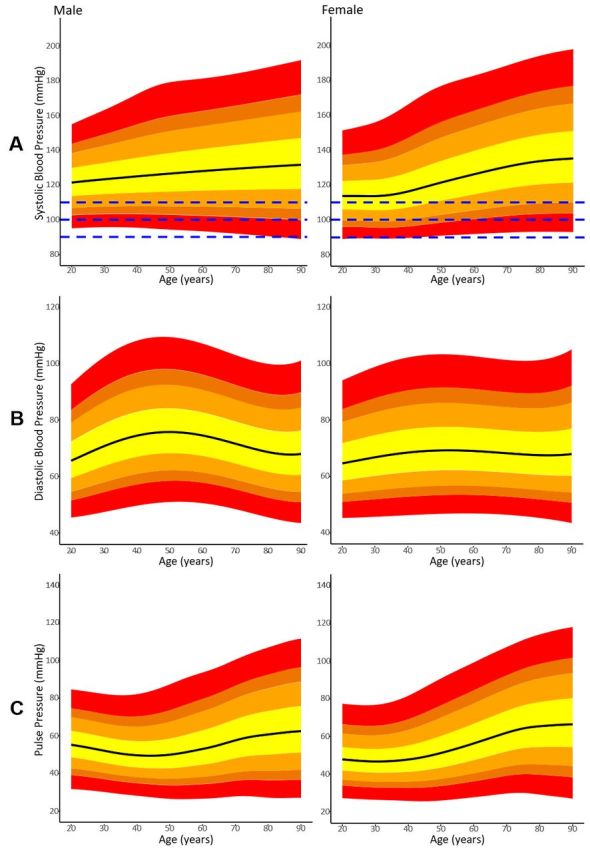
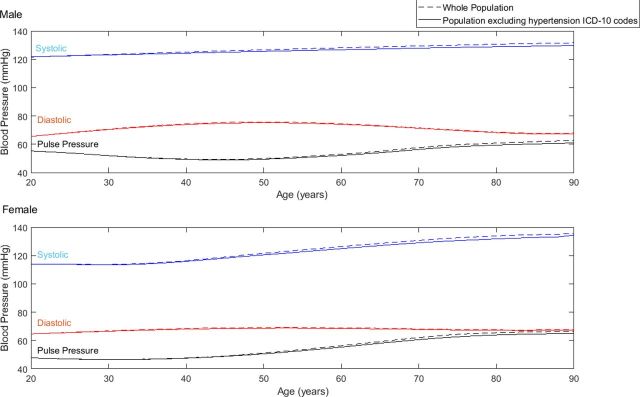
Systolic blood pressure (SBP) for hospitalised patients increases with age for both sexes. Median SBP increases from 122 (CI: 121.1 to 122.1) mm Hg to 132 (CI: 130.9 to 132.2) mm Hg in men, and 114 (CI: 113.1 to 114.4) mm Hg to 135 (CI: 134.5 to 136.2) mm Hg in women, between the ages of 20 and 90 years. Diastolic blood pressure peaked around 50 years for men 76 (CI: 75.5 to 75.9) mm Hg and women 69 (CI: 69.0 to 69.4) mm Hg. The blood pressure criterion for sepsis, systolic <100 mm Hg, was met by 2.3% of younger (20-30 years) men and 3.5% of older men (81-90 years). In comparison, the criterion was met by 9.7% of younger women and 2.6% of older women.
We have quantified variations in blood pressure by age and sex in hospitalised patients that have implications for recognition of deterioration. Nearly 10% of younger women met the blood pressure criterion for sepsis at hospital discharge.
用于识别医院内生理恶化和脓毒症的国家指南依赖于血压阈值,而这些阈值并未考虑年龄或性别因素。在医院以外的人群中,已知血压会随着这两个变量而变化。这些差异在住院人群中是否仍然存在尚不清楚。本数据库分析研究旨在生成代表性百分位数,以量化住院患者的血压随年龄和性别的变化。
回顾性横断面观察性数据库分析。
2015 年 4 月至 2017 年 4 月期间的四家近海医院。
符合以下条件的 75342 名成年患者入选:在出院前 24 小时内至少有一套记录的生命体征观察值的患者。如果患者在医院死亡、出院前 24 小时无生命体征、出院后 7 天内再次入院、年龄或性别缺失或无血压记录,则将其排除在外。
住院患者的收缩压(SBP)随性别和年龄的增长而升高。男性 SBP 从中位数 122(CI:121.1 至 122.1)mmHg 增加到 132(CI:130.9 至 132.2)mmHg,女性从中位数 114(CI:113.1 至 114.4)mmHg 增加到 135(CI:134.5 至 136.2)mmHg,年龄在 20 至 90 岁之间。男性舒张压在 50 岁左右达到峰值,为 76(CI:75.5 至 75.9)mmHg,女性为 69(CI:69.0 至 69.4)mmHg。收缩压<100mmHg 的脓毒症标准在 2.3%的年轻(20-30 岁)男性和 3.5%的年长男性(81-90 岁)中得到满足。相比之下,这一标准在 9.7%的年轻女性和 2.6%的年长女性中得到满足。
我们已经量化了住院患者的血压随年龄和性别的变化,这对识别病情恶化具有重要意义。近 10%的年轻女性在出院时符合脓毒症的血压标准。