Drug Resistance and Membrane Proteins group, IBCP, UMR 5086, CNRS-University of Lyon, 69367, Lyon, France.
Department of Pharmaceutical Sciences, Faculty of Pharmacy, Chiang Mai University, Chiang Mai, 50200, Thailand.
Sci Rep. 2020 May 6;10(1):7616. doi: 10.1038/s41598-020-64400-x.
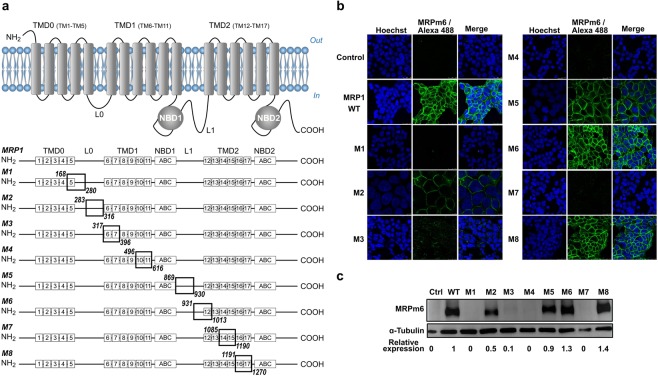
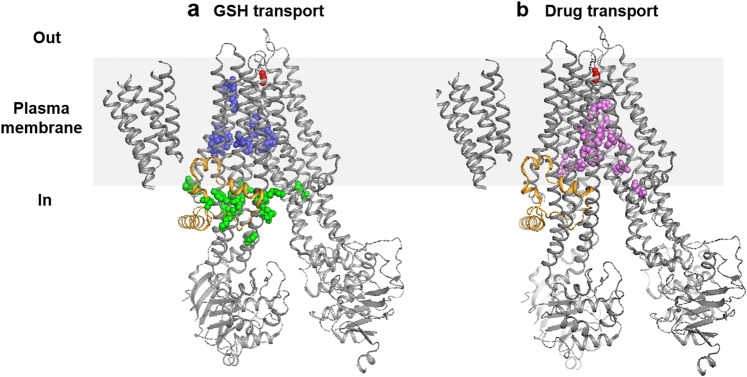
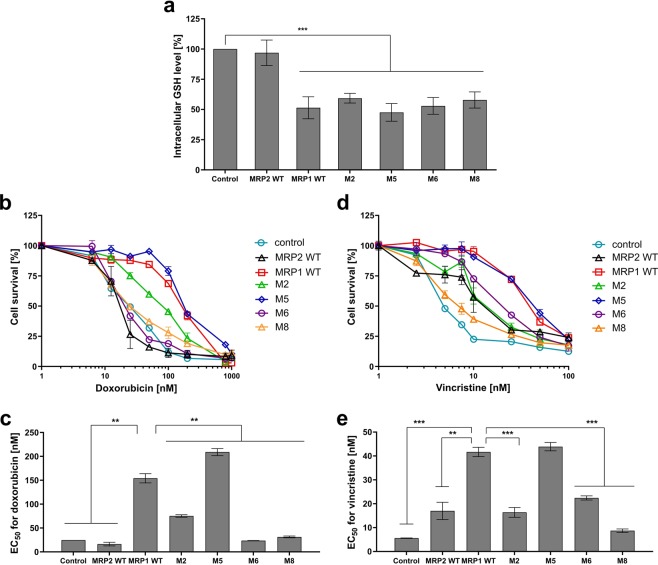
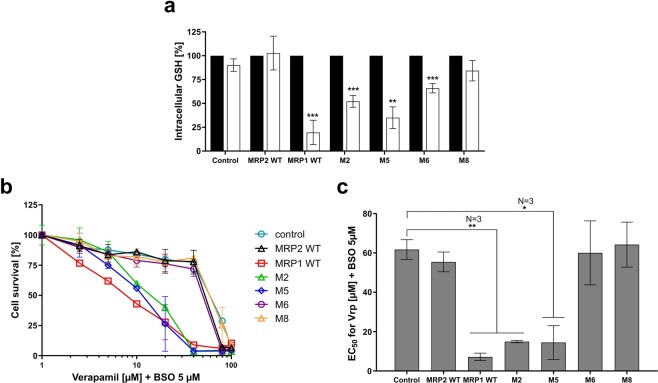
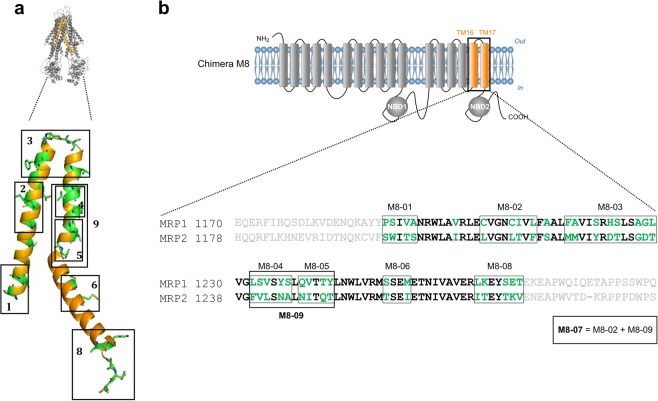
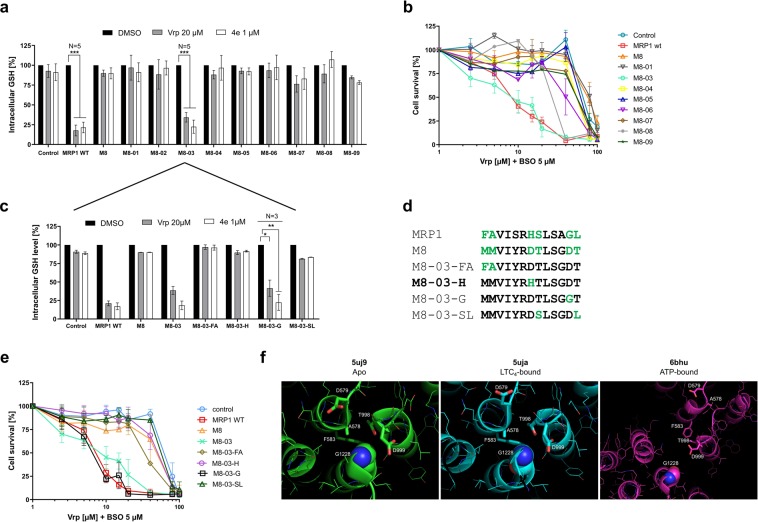
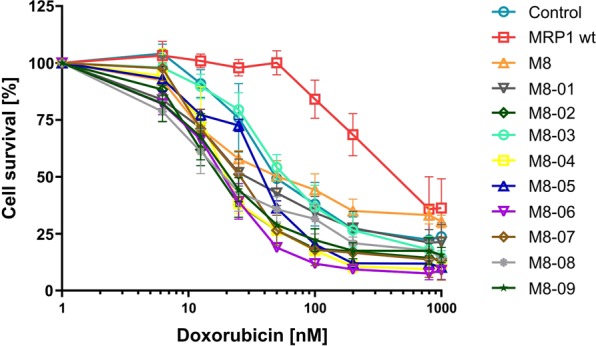
The transporter Multidrug Resistance Protein 1 (MRP1, ABCC1) is implicated in multidrug resistant (MDR) phenotype of cancer cells. Glutathione (GSH) plays a key role in MRP1 transport activities. In addition, a ligand-stimulated GSH transport which triggers the death of cells overexpressing MRP1, by collateral sensitivity (CS), has been described. This CS could be a way to overcome the poor prognosis for patients suffering from a chemoresistant cancer. The molecular mechanism of such massive GSH transport and its connection to the other transport activities of MRP1 are unknown. In this context, we generated MRP1/MRP2 chimeras covering different regions, MRP2 being a close homolog that does not trigger CS. The one encompassing helices 16 and 17 led to the loss of CS and MDR phenotype without altering basal GSH transport. Within this region, the sole restoration of the original G1228 (D1236 in MRP2) close to the extracellular loop between the two helices fully rescued the CS (massive GSH efflux and cell death) but not the MDR phenotype. The flexibility of that loop and the binding of a CS agent like verapamil could favor a particular conformation for the massive transport of GSH, not related to other transport activities of MRP1.
多药耐药蛋白 1(MRP1,ABCC1)转运体参与癌细胞的多药耐药(MDR)表型。谷胱甘肽(GSH)在 MRP1 转运活动中起关键作用。此外,已描述了配体刺激的 GSH 转运通过旁系敏感性(CS)触发过表达 MRP1 的细胞死亡,这种 CS 可以成为克服对化疗耐药的癌症患者预后不良的一种方法。这种大量 GSH 转运的分子机制及其与 MRP1 其他转运活性的联系尚不清楚。在这种情况下,我们生成了涵盖不同区域的 MRP1/MRP2 嵌合体,MRP2 是一个紧密的同源物,不会引发 CS。包含螺旋 16 和 17 的嵌合体导致 CS 和 MDR 表型的丧失,而不改变基础 GSH 转运。在该区域内,仅恢复原始 G1228(MRP2 中的 D1236)靠近两个螺旋之间的细胞外环,可完全挽救 CS(大量 GSH 外排和细胞死亡),但不能挽救 MDR 表型。该环的灵活性以及 CS 剂维拉帕米的结合可能有利于 GSH 大量转运的特定构象,而与 MRP1 的其他转运活性无关。