Service of Adult Intensive Care Medicine, University Hospital Medical Center and Faculty of Biology and Medicine, Lausanne, Switzerland.
Service of Cardiology, University Hospital Medical Center and Faculty of Biology and Medicine, Lausanne, Switzerland.
Sci Rep. 2020 May 6;10(1):7639. doi: 10.1038/s41598-020-64702-0.
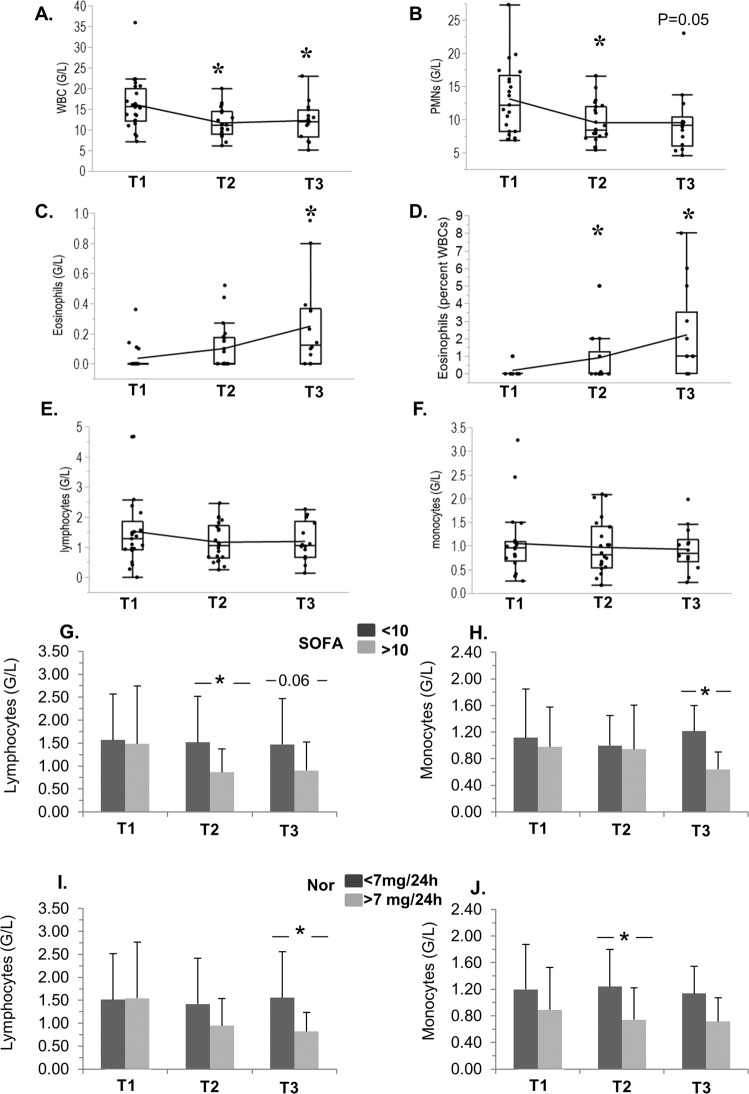
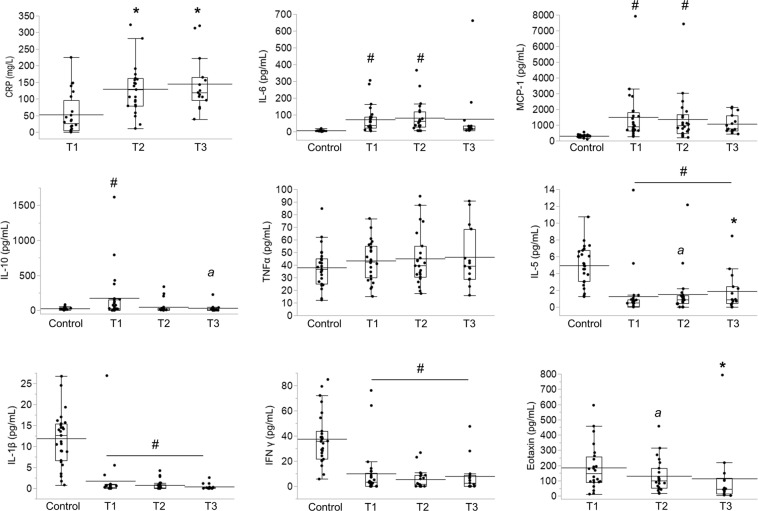
Patients with cardiogenic shock (CS) display systemic inflammation and a high rate of infections, suggesting important immune disturbances. To explore the immune response to CS, we prospectively measured, in 24 consecutive CS patients, differential white blood cell (WBC) counts and the cytokines IL-1β, IL-5, IL-6, IL-10, TNFα, IFNγ, MCP-1 and eotaxin (CCL11), at Day 1 (T1), day 3 (T2) and day 6-8 (T3). Secondary infections and their influence on cytokines and WBCs were determined. CS induced early (T1) neutrophilia and elevated levels of IL-6, IL-10 and MCP-1, correlating with shock severity. The eosinophil chemoattractant eotaxin was elevated at T1 and decreased thereafter, and a progressive rise of blood eosinophils was noted over time. Patients with the most severe shock had reduced lymphocytes and monocytes at T2 and T3. Sixty-two percent of patients developed an infection, which did not alter the profile of immune response, except from higher IL-6 levels at T2. Therefore, CS elicits an acute pro-inflammatory response, followed by a delayed increase in blood eosinophils, consistent with the development of a tissue repair response, as well as depletion of immune cells in the most severely affected patients, which might predispose to secondary infections.
患有心源性休克 (CS) 的患者表现出全身炎症和高感染率,表明存在重要的免疫紊乱。为了探索 CS 的免疫反应,我们前瞻性地测量了 24 例连续 CS 患者的白细胞 (WBC) 差异计数以及细胞因子 IL-1β、IL-5、IL-6、IL-10、TNFα、IFNγ、MCP-1 和嗜酸性粒细胞趋化因子 (CCL11),在第 1 天 (T1)、第 3 天 (T2) 和第 6-8 天 (T3)。确定了继发感染及其对细胞因子和 WBC 的影响。CS 早期 (T1) 诱导中性粒细胞增多,并导致 IL-6、IL-10 和 MCP-1 水平升高,与休克严重程度相关。嗜酸性粒细胞趋化因子 eotaxin 在 T1 时升高,随后降低,并且随着时间的推移,血液嗜酸性粒细胞逐渐增加。最严重休克的患者在 T2 和 T3 时淋巴细胞和单核细胞减少。62%的患者发生感染,但感染并未改变免疫反应的特征,除了 T2 时 IL-6 水平更高。因此,CS 引发急性促炎反应,随后血液嗜酸性粒细胞延迟增加,与组织修复反应的发展以及最受影响患者的免疫细胞耗竭一致,这可能易继发感染。