Department of Oncology, First Affiliated Hospital of Xi'an Jiaotong University, 277 West Yanta Road, Xi'an 710061 Shaanxi Province, China.
Department of Hepatobiliary Surgery, First Affiliated Hospital of Xi'an Jiaotong University, 277 West Yanta Road, Xi'an, 710061 Shaanxi Province, China.
Oxid Med Cell Longev. 2020 Apr 20;2020:1868764. doi: 10.1155/2020/1868764. eCollection 2020.
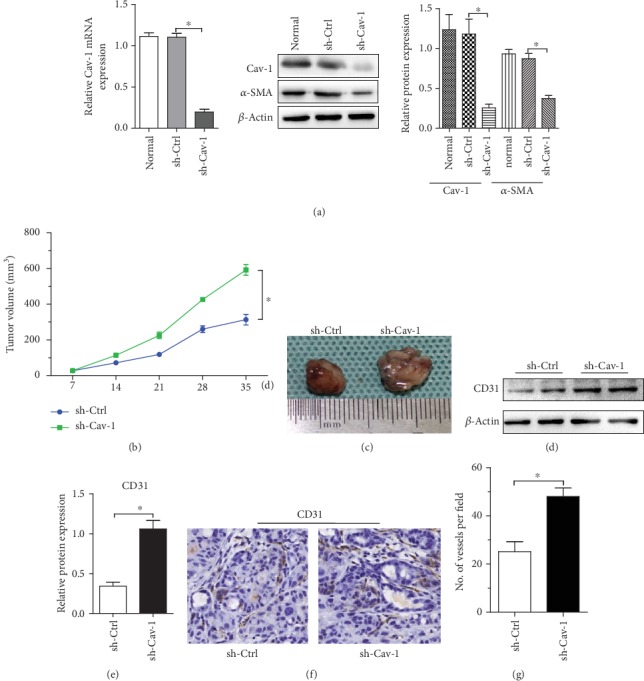
A more comprehensive understanding of the complexity of pancreatic cancer pathobiology, especially, and understanding of the role of the tumor microenvironment (TME) in disease progression should pave the way for therapies to improve patient response rates. Previous studies reported that caveolin-1 (Cav-1) has both tumor-promoting and tumor-suppressive functions. However, the function of Cav-1 in the pancreatic cancer microenvironment remains largely unexplored. Here, we show that coinjection of Cav-1-silenced pancreatic stellate cells (PSCs) with pancreatic cancer cells increased tumor growth. To comprehensively characterize paracrine communication between pancreatic cancer cells and PSCs, PSCs were cultured with pancreatic cancer cell conditioned medium (CM) containing cytokines. We reveal that Cav-1-silenced PSCs facilitated the growth of pancreatic cancer cells via enhanced paracrine shh/MMP2/bFGF/IL-6 signaling. Specifically, Cav-1-silenced PSCs exhibited increased shh expression, which heterotypically activated the shh signaling pathway in pancreatic cancer cells. Moreover, Cav-1-deficient PSCs accumulated ROS to enhance the shh pathway and angiogenesis in pancreatic cancer cells. In addition, overexpression of Nrf2 reversed the effects of Cav-1 knockdown on PSCs, increasing ROS production and enhancing paracrine shh/MMP2/bFGF/IL-6 signaling. Together, our findings show that stromal Cav-1 may mediate different mechanisms in the complex interaction between cancer cells and their microenvironment though Nrf2-induced shh signaling activation during pancreatic cancer progression.
更全面地了解胰腺癌病理生物学的复杂性,尤其是肿瘤微环境(TME)在疾病进展中的作用,应该为提高患者反应率的治疗方法铺平道路。先前的研究报告称,窖蛋白-1(Cav-1)具有促进肿瘤和抑制肿瘤的双重功能。然而,Cav-1 在胰腺癌微环境中的功能在很大程度上仍未得到探索。在这里,我们表明,沉默 Cav-1 的胰腺星状细胞(PSC)与胰腺癌细胞共注射会增加肿瘤生长。为了全面描述胰腺癌细胞与 PSC 之间的旁分泌通讯,我们用含有细胞因子的胰腺癌细胞条件培养基(CM)培养 PSC。我们揭示沉默 Cav-1 的 PSC 通过增强旁分泌 shh/MMP2/bFGF/IL-6 信号促进胰腺癌细胞的生长。具体而言,沉默 Cav-1 的 PSC 表现出更高的 shh 表达,这在胰腺癌细胞中异质激活了 shh 信号通路。此外,Cav-1 缺陷型 PSC 积累 ROS 以增强 shh 通路和胰腺癌细胞中的血管生成。此外,Nrf2 的过表达逆转了 Cav-1 敲低对 PSC 的影响,增加了 ROS 的产生,并增强了旁分泌 shh/MMP2/bFGF/IL-6 信号。总之,我们的研究结果表明,基质 Cav-1 可能通过 Nrf2 诱导的 shh 信号激活,在胰腺癌进展过程中,通过不同的机制介导癌细胞与其微环境之间的复杂相互作用。