Department of Pathology, College of Medicine, University of Sulaymaniyah, Sulaymaniyah, Iraq.
Department of Surgery, College of Medicine, University of Sulaymaniyah, Iraq.
Clin Appl Thromb Hemost. 2020 Jan-Dec;26:1076029620922913. doi: 10.1177/1076029620922913.
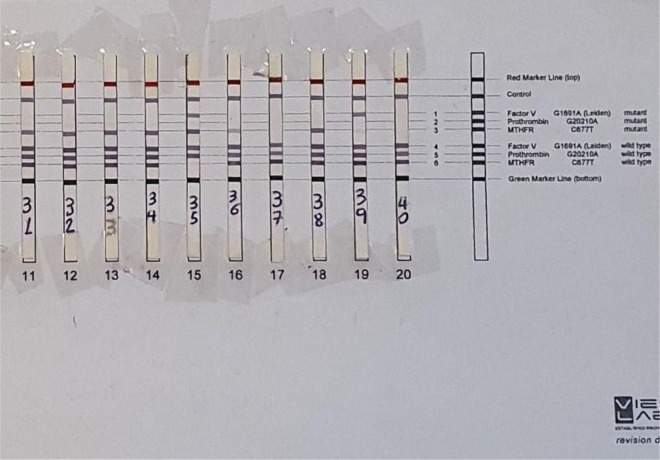
Thromboembolism (TE) is a complex disease caused by various acquired and inherited factors. The common mutations; factor V Leiden G1691A (FVL G1691A), prothrombin G20210A (PTG20210A), and methylene tetrahydrofolate reductase C677T (MTHFR C677T) are important inherited causes in both venous and arterial thrombosis. The association between ABO blood groups and thrombophilia has been noted by researchers. We aimed to determine the frequency and association of ABO blood groups as a risk factor along with 3 thrombophilia mutations and another 3 thrombophilia markers in a group of patients with unstimulated thrombosis. In a prospective case-control study, we focused on 100 samples, 50 patients with documented thrombosis as well as 50 healthy age-matched controls. Multiplex polymerase chain reaction and reverse hybridization to oligonucleotide particular probes were employed to detect FVL G1691A, PT G20210A, and MTHFR C677T mutations. Analysis of other thrombophilia markers including protein C (PC), protein S (PS), and antithrombin (AT) assays was also performed. ABO blood group typing was done according to standard methods. Non-O blood group was significantly more frequent among cases than controls (76% vs 54%) with high odds of TE (odds ratio [OR] = 2.69). Positivity for at least 1 thrombophilia marker was more in cases (60%) than controls (34%; OR = 2.9). The combined effect of non-O blood group and thrombophilia markers raised the risk of TE (OR = 4.16, = .001), particularly FVL (OR = 6.76). This study illustrates that harboring the non-O blood group poses an additive effect with other thrombophilia markers in the causation of TE.
血栓栓塞症(TE)是一种由多种获得性和遗传性因素引起的复杂疾病。常见的突变包括因子 V 莱顿 G1691A(FVL G1691A)、凝血酶原 G20210A(PTG20210A)和亚甲基四氢叶酸还原酶 C677T(MTHFR C677T),它们是静脉和动脉血栓形成的重要遗传性原因。研究人员已经注意到 ABO 血型与血栓形成倾向之间的关联。我们旨在确定 ABO 血型作为危险因素的频率和关联,以及在一组未刺激血栓形成的患者中与 3 种血栓形成突变和另外 3 种血栓形成标志物相关联。在一项前瞻性病例对照研究中,我们专注于 100 个样本,50 例有记录的血栓形成患者和 50 名年龄匹配的健康对照。采用多重聚合酶链反应和反向杂交到寡核苷酸特定探针来检测 FVL G1691A、PT G20210A 和 MTHFR C677T 突变。还进行了其他血栓形成标志物的分析,包括蛋白 C(PC)、蛋白 S(PS)和抗凝血酶(AT)测定。根据标准方法进行 ABO 血型分型。非 O 血型在病例中比对照中更为常见(76%比 54%),血栓栓塞症的可能性较高(比值比 [OR] = 2.69)。至少有 1 种血栓形成标志物阳性的病例(60%)比对照(34%;OR = 2.9)更多。非 O 血型和血栓形成标志物的联合作用增加了 TE 的风险(OR = 4.16,P =.001),特别是 FVL(OR = 6.76)。本研究表明,携带非 O 血型与其他血栓形成标志物在 TE 的发生中具有附加效应。