Eom Ki Seong
Department of Neurosurgery, Institute of Wonkwang Medical Science, Wonkwang University Hospital, Iksan, Korea.
J Korean Neurosurg Soc. 2020 Sep;63(5):631-639. doi: 10.3340/jkns.2019.0181. Epub 2020 May 8.
Traditionally, staged surgery has been preferred in the treatment of compound comminuted depressed fracture (FCCD) after traumatic brain injury (TBI) and involves the removal of primarily damaged bone and subsequent cranioplasty. The main reason for delayed cranioplasty was to reduce the risk of infection-related complications. Here, the author performed immediate reconstruction using a titanium mesh in consecutive patients with FCCD after TBI, reported the surgical results, and reviewed previous studies.
Nineteen consecutive patients who underwent single-stage reconstruction with titanium mesh for FCCD of the skull from April 2014 to June 2018 were retrospectively analyzed. The demographic and radiological characteristics of the patients with FCCD were investigated. The characteristics associated with surgery and outcome were also evaluated.
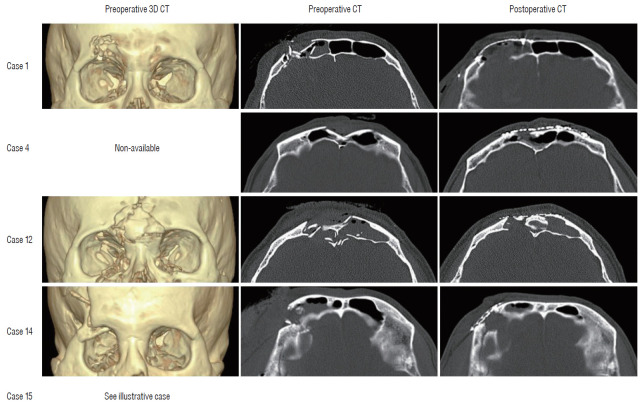
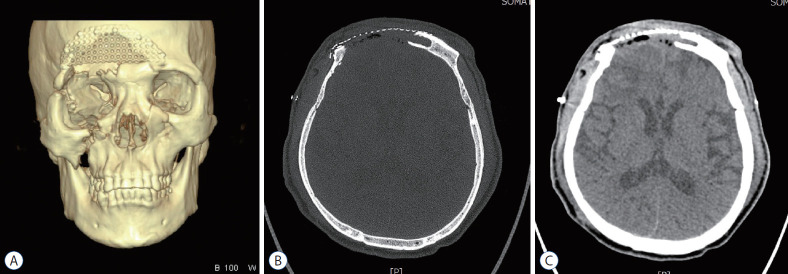
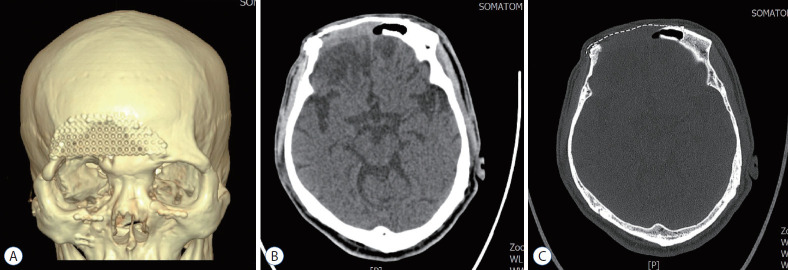
The frequency of TBI in men (94.7%) was significantly higher than that in women. Most FCCDs (73.7%) occurred during work, the rest were caused by traffic accidents. The mean interval between TBI and surgery was 7.0±3.9 hours. The median Glasgow coma scale score was 15 (range, 8-15) at admission and 15 (range, 10-15) at discharge. FCCD was frequently located in the frontal (57.9%) and parietal (31.6%) bones than in other regions. Of the patients with FCCDs in the frontal bone, 62.5% had paranasal sinus injury. There were five patients with fractures of orbital bone, and they were easily reconstructed using titanium mesh. These patients were cosmetically satisfied. Postoperatively, antibiotics were used for an average of 12.6 days. The mean hospital stay was 17.6±7.5 days (range, 8-33). There was no postoperative seizure or complications, such as infection.
Immediate bony fragments replacement and reconstruction with reconstruction titanium mesh for FCCD did not increase infectious sequelae, even though FCCD involved sinus. This suggests that immediate single-stage reconstruction with titanium mesh for FCCD is a suitable surgical option with potential benefits in terms of cost-effectiveness, safety, and cosmetic and psychological outcomes.
传统上,对于创伤性脑损伤(TBI)后复合粉碎性凹陷骨折(FCCD)的治疗,分期手术一直是首选方法,包括首先清除严重受损的骨组织,随后进行颅骨成形术。延迟颅骨成形术的主要原因是降低感染相关并发症的风险。在此,作者对连续的TBI后FCCD患者使用钛网进行即刻重建,报告手术结果,并回顾以往研究。
回顾性分析2014年4月至2018年6月期间连续19例因颅骨FCCD接受钛网单阶段重建的患者。调查FCCD患者的人口统计学和放射学特征。还评估了与手术及结果相关的特征。
男性TBI的发生率(94.7%)显著高于女性。大多数FCCD(73.7%)发生在工作期间,其余由交通事故引起。TBI与手术之间的平均间隔时间为7.0±3.9小时。入院时格拉斯哥昏迷量表评分中位数为15(范围8 - 15),出院时为15(范围10 - 15)。FCCD常位于额骨(57.9%)和顶骨(31.6%),而非其他区域。在额骨有FCCD的患者中,62.5%伴有鼻窦损伤。有5例眶骨骨折患者,使用钛网很容易进行重建。这些患者对外观满意。术后平均使用抗生素12.6天。平均住院时间为17.6±7.5天(范围8 - 33天)。没有术后癫痫发作或感染等并发症。
对于FCCD,即刻用重建钛网替换骨碎片并进行重建,即使FCCD累及鼻窦,也不会增加感染后遗症。这表明对于FCCD,即刻用钛网进行单阶段重建是一种合适的手术选择,在成本效益、安全性以及外观和心理结果方面具有潜在益处。