Institute of Brain and Psychological Sciences, Sichuan Normal University, Chengdu, China.
Research Center of Brain and Cognitive Neuroscience, Liaoning Normal University, Dalian, China.
Sci Rep. 2020 May 7;10(1):7706. doi: 10.1038/s41598-020-64825-4.
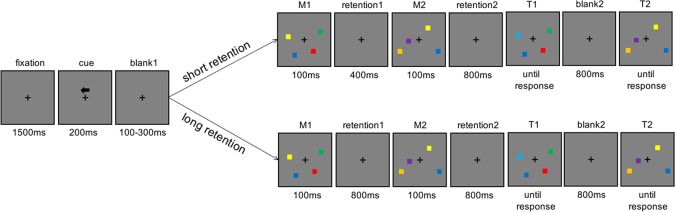
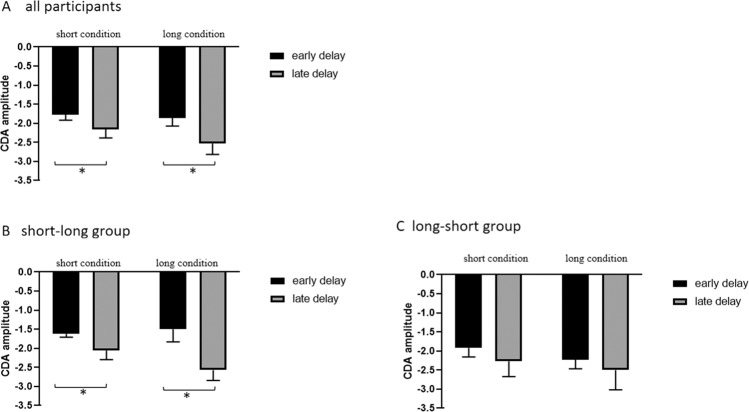
The visual information can be stored as either "active" representations in the active state or "activity-silent" representations in the passive state during the retention period in visual working memory (VWM). Catering to the dynamic nature of visual world, we explored how the temporally dynamic visual input was stored in VWM. In the current study, the memory arrays were presented sequentially, and the contralateral delay activity (CDA), an electrophysiological measure, was used to identify whether the memory representations were transferred into the passive state. Participants were instructed to encode two sequential arrays and retrieve them respectively, with two conditions of interval across the two arrays: 400 ms and 800 ms. These results provided strong evidence for the state-separated storage of two sequential arrays in different neural states if the interval between them was long enough, and the concurrent storage of them in the active state if the interval was relatively short. This conclusion was valid only when the participants encountered the task for the first time. Once participants have formed their mindset, they would apply the same storage mode to the subsequently extended or shortened interval condition.
在视觉工作记忆(VWM)的保持期内,视觉信息可以作为活跃状态下的“活跃”表示或被动状态下的“活动静默”表示进行存储。为了迎合视觉世界的动态性质,我们探索了时间动态视觉输入是如何在 VWM 中存储的。在当前的研究中,记忆数组按顺序呈现,使用对侧延迟活动(CDA)作为电生理测量指标,以确定记忆表示是否被转移到被动状态。参与者被指示分别对两个连续的数组进行编码和检索,两个数组之间有两种间隔条件:400ms 和 800ms。如果两个数组之间的间隔足够长,这些结果为在不同神经状态下分离存储两个连续数组提供了强有力的证据,并且如果间隔相对较短,则在活跃状态下同时存储它们。只有当参与者第一次遇到任务时,这个结论才有效。一旦参与者形成了他们的思维模式,他们将对随后扩展或缩短的间隔条件应用相同的存储模式。