Centrum für Hämatologie und Onkologie Bethanien, Frankfurt, Germany.
Onkologie Gilching, Gilching, Germany.
Hematol Oncol. 2020 Aug;38(3):344-352. doi: 10.1002/hon.2740. Epub 2020 May 8.
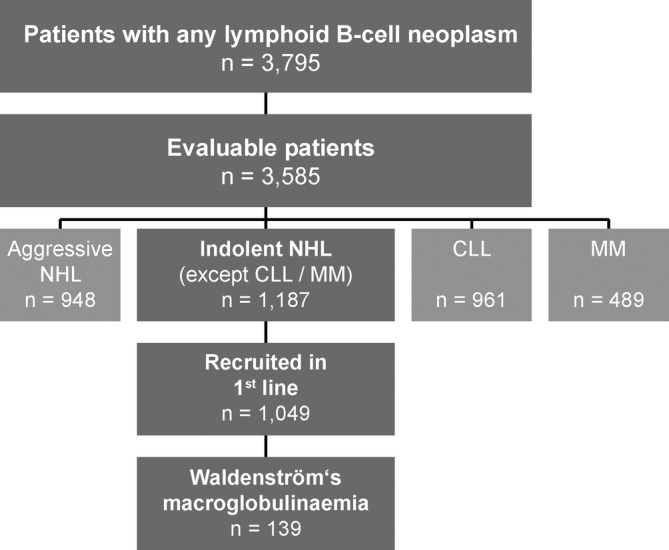
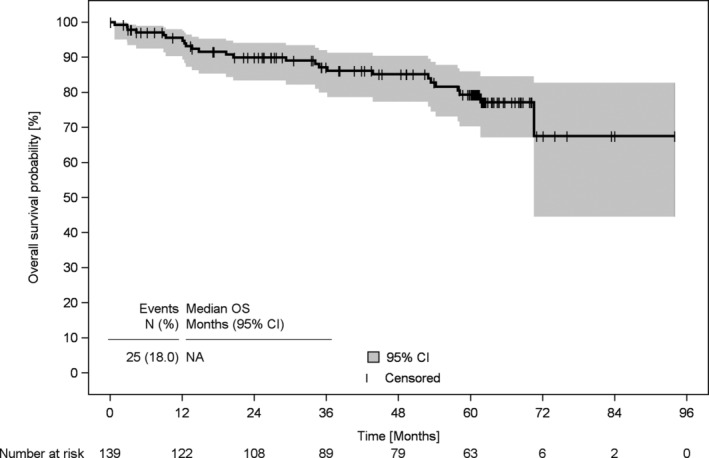
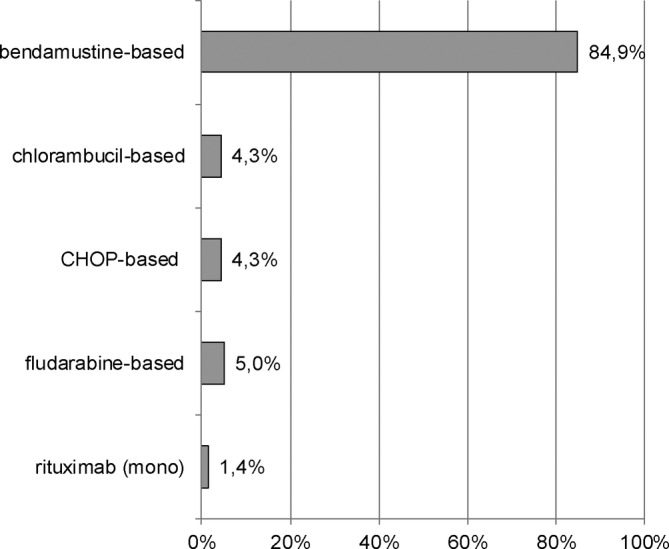
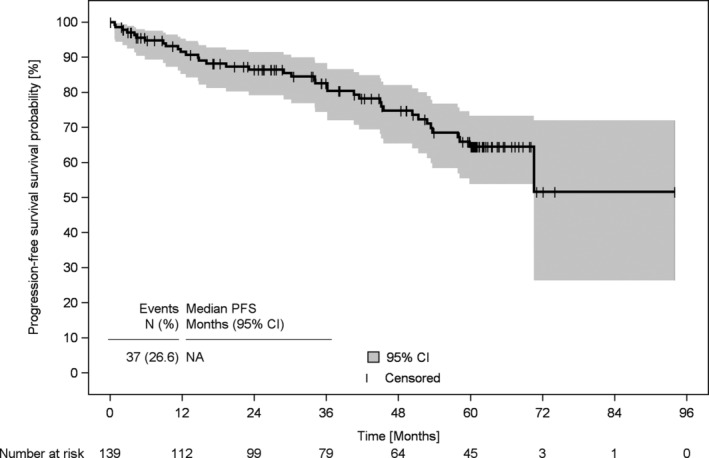
Waldenström's macroglobulinaemia (WM) is a rare indolent B-cell lymphoma for which only little prospective phase III evidence exists. Thus, real world data are important to provide insight into treatment and survival. We present here data on choice and outcome of systemic treatment of patients with WM treated in German routine practice. In total, 139 patients with WM who had been documented in the prospective clinical cohort study Tumour Registry Lymphatic Neoplasms (NCT00889798) were included into this analysis. We analysed the most frequently used first-line and second-line treatments between 2009 and 2017 and examined best response, progression-free survival (PFS) and overall survival (OS). Bendamustine plus rituximab, with a median of six cycles, was by far the most frequently used first-line treatment (81%). Second-line treatment was more heterogenous and mainly based on bendamustine, cyclophosphamide/doxorubicin/vincristine/prednisone (CHOP), fludarabine or ibrutinib, the latter approved in 2014. Three-year PFS from start of first-line treatment was 83% (95% confidence interval [CI] 74%-88%), 3-year OS was 87% (95% CI 80%-92%). These prospective data give valuable insights into the management and outcome of non-selected patients with WM treated in German routine practice. In the lack of prospective phase III clinical trials, real world data can help bridging the gap of evidence.
华氏巨球蛋白血症(WM)是一种罕见的惰性 B 细胞淋巴瘤,仅有少量前瞻性 III 期证据。因此,真实世界的数据对于了解治疗和生存情况非常重要。我们在此介绍了德国常规实践中治疗 WM 患者的系统治疗选择和结果的数据。在这项前瞻性临床队列研究肿瘤登记处淋巴肿瘤(NCT00889798)中,共纳入了 139 例 WM 患者。我们分析了 2009 年至 2017 年期间最常使用的一线和二线治疗,并检查了最佳反应、无进展生存期(PFS)和总生存期(OS)。苯达莫司汀联合利妥昔单抗,中位周期数为 6 个周期,是迄今为止最常使用的一线治疗(81%)。二线治疗更为混杂,主要基于苯达莫司汀、环磷酰胺/多柔比星/长春新碱/泼尼松(CHOP)、氟达拉滨或伊布替尼,后者于 2014 年获得批准。从一线治疗开始的 3 年 PFS 为 83%(95%置信区间 [CI]74%-88%),3 年 OS 为 87%(95%CI 80%-92%)。这些前瞻性数据为德国常规实践中治疗非选择性 WM 患者的管理和结果提供了有价值的见解。在缺乏前瞻性 III 期临床试验的情况下,真实世界的数据可以帮助填补证据空白。