Institute for Immunology and School of Medicine, Tsinghua University, Beijing, China.
Tsinghua-Peking Centre for Life Sciences, Tsinghua University, Beijing, China.
Nat Commun. 2020 May 8;11(1):2286. doi: 10.1038/s41467-020-16209-5.
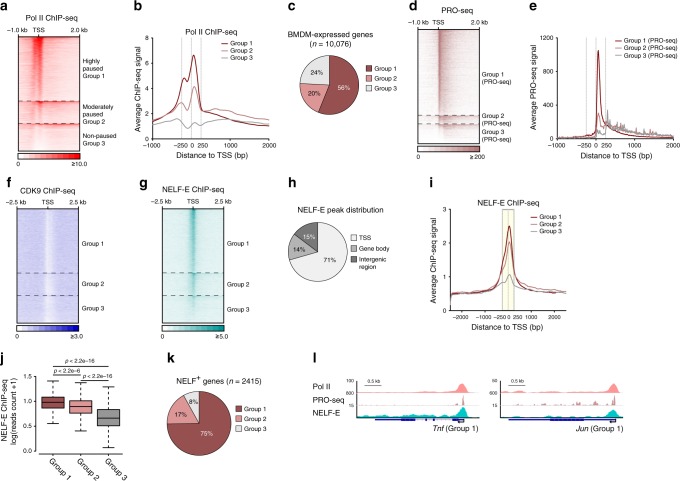
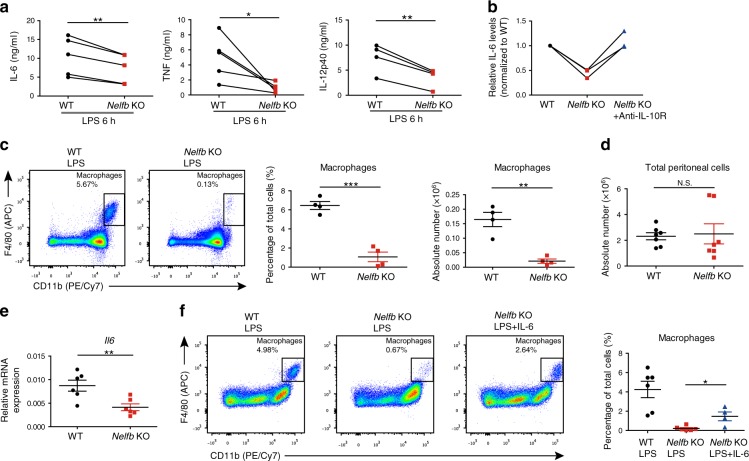
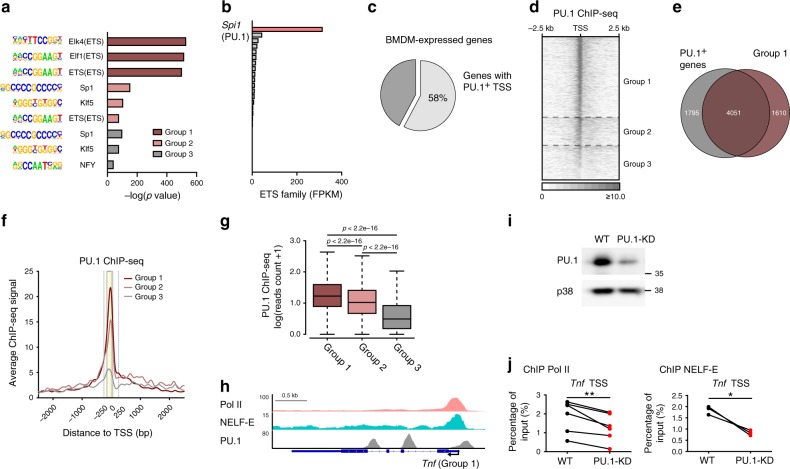
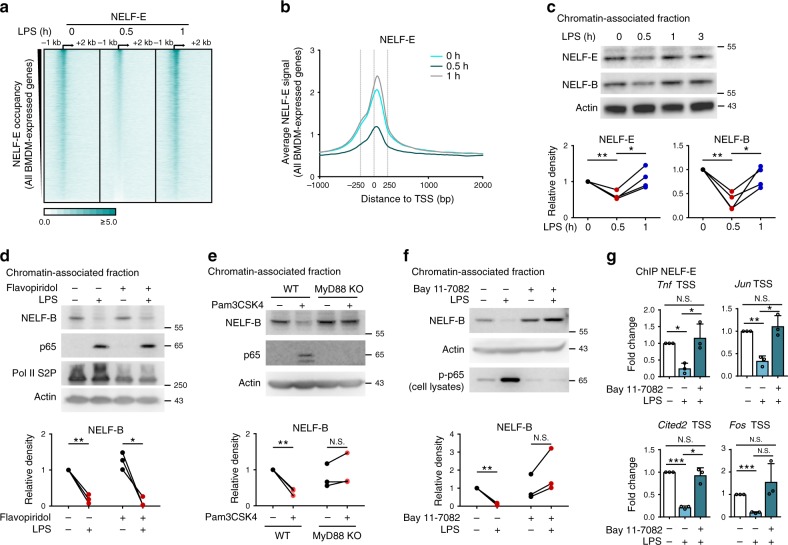
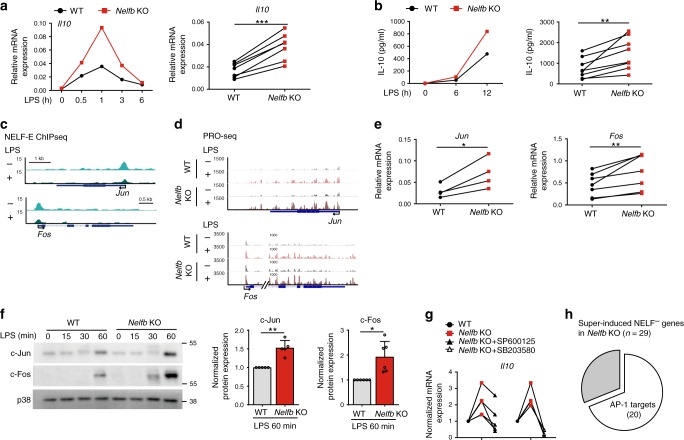
Studies on macrophage gene expression have historically focused on events leading to RNA polymerase II recruitment and transcription initiation, whereas the contribution of post-initiation steps to macrophage activation remains poorly understood. Here, we report that widespread promoter-proximal RNA polymerase II pausing in resting macrophages is marked by co-localization of the negative elongation factor (NELF) complex and facilitated by PU.1. Upon inflammatory stimulation, over 60% of activated transcriptome is regulated by polymerase pause-release and a transient genome-wide NELF dissociation from chromatin, unexpectedly, independent of CDK9, a presumed NELF kinase. Genetic disruption of NELF in macrophages enhanced transcription of AP-1-encoding Fos and Jun and, consequently, AP-1 targets including Il10. Augmented expression of IL-10, a critical anti-inflammatory cytokine, in turn, attenuated production of pro-inflammatory mediators and, ultimately, macrophage-mediated inflammation in vivo. Together, these findings establish a previously unappreciated role of NELF in constraining transcription of inflammation inhibitors thereby enabling inflammatory macrophage activation.
巨噬细胞基因表达的研究历史上一直集中在导致 RNA 聚合酶 II 募集和转录起始的事件上,而对于起始后步骤对巨噬细胞激活的贡献仍知之甚少。在这里,我们报告说,静止巨噬细胞中广泛存在的启动子近端 RNA 聚合酶 II 暂停,其特征是负延伸因子 (NELF) 复合物的共定位,并由 PU.1 促进。在炎症刺激下,超过 60%的激活转录组受聚合酶暂停释放和染色质上 NELF 的瞬时全基因组解离调节,出乎意料的是,这与 CDK9 无关,CDK9 被认为是 NELF 的激酶。巨噬细胞中 NELF 的遗传破坏增强了编码 AP-1 的 Fos 和 Jun 的转录,因此,包括 Il10 在内的 AP-1 靶基因。IL-10 的表达增强,一种关键的抗炎细胞因子,反过来又减弱了促炎介质的产生,并最终减弱了体内巨噬细胞介导的炎症。总之,这些发现确立了 NELF 在限制炎症抑制剂转录方面的先前未被认识的作用,从而使炎症巨噬细胞能够被激活。