Greater Los Angeles Veterans Affairs Healthcare System, Los Angeles, California.
Department of Medicine, University of California, School of Medicine, Los Angeles, California.
Am J Physiol Gastrointest Liver Physiol. 2020 Jun 1;318(6):G1070-G1087. doi: 10.1152/ajpgi.00079.2020. Epub 2020 May 11.
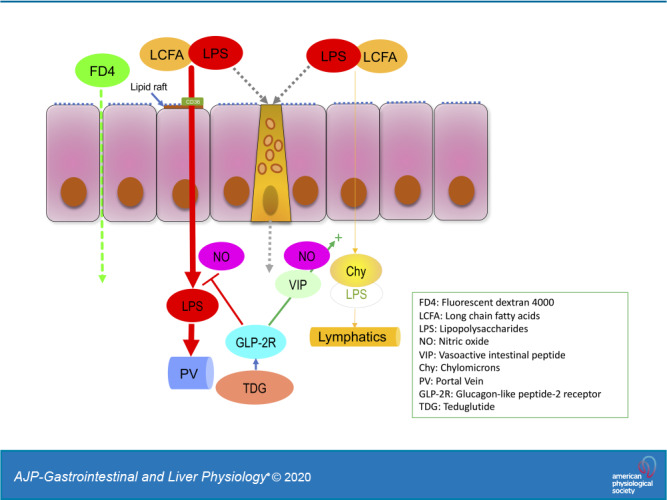
Lipopolysaccharides (LPS) are potent pro-inflammatory molecules that enter the systemic circulation from the intestinal lumen by uncertain mechanisms. We investigated these mechanisms and the effect of exogenous glucagon-like peptide-2 (GLP-2) on LPS transport in the rodent small intestine. Transmucosal LPS transport was measured in Ussing-chambered rat jejunal mucosa. In anesthetized rats, the appearance of fluorescein isothiocyanate (FITC)-LPS into the portal vein (PV) and the mesenteric lymph was simultaneously monitored after intraduodenal perfusion of FITC-LPS with oleic acid and taurocholate (OA/TCA). In vitro, luminally applied LPS rapidly appeared in the serosal solution only with luminal OA/TCA present, inhibited by the lipid raft inhibitor methyl-β-cyclodextrin (MβCD) and the CD36 inhibitor sulfosuccinimidyl oleate (SSO), or by serosal GLP-2. In vivo, perfusion of FITC-LPS with OA/TCA rapidly increased FITC-LPS appearance into the PV, followed by a gradual increase of FITC-LPS into the lymph. Rapid PV transport was inhibited by the addition of MβCD or by SSO, whereas transport into the lymph was inhibited by chylomicron synthesis inhibition. Intraveous injection of the stable GLP-2 analog teduglutide acutely inhibited FITC-LPS transport into the PV, yet accelerated FITC-LPS transport into the lymph via -nitro-l-arginine methyl ester (l-NAME)- and PG97-269-sensitive mechanisms. In vivo confocal microscopy in mouse jejunum confirmed intracellular FITC-LPS uptake with no evidence of paracellular localization. This is the first direct demonstration in vivo that luminal LPS may cross the small intestinal barrier physiologically during fat absorption via lipid raft- and CD36-mediated mechanisms, followed by predominant transport into the PV, and that teduglutide inhibits LPS uptake into the PV in vivo. We report direct in vivo confirmation of transcellular lipopolysaccharides (LPS) uptake from the intestine into the portal vein (PV) involving CD36 and lipid rafts, with minor uptake via the canonical chylomicron pathway. The gut hormone glucagon-like peptide-2 (GLP-2) inhibited uptake into the PV. These data suggest that the bulk of LPS absorption is via the PV to the liver, helping clarify the mechanism of LPS transport into the PV as part of the "gut-liver" axis. These data do not support the paracellular transport of LPS, which has been implicated in the pathogenesis of the "leaky gut" syndrome.
脂多糖 (LPS) 是一种强效的促炎分子,通过不确定的机制从肠道腔进入体循环。我们研究了这些机制以及外源性胰高血糖素样肽-2 (GLP-2) 对 LPS 在啮齿动物小肠中的转运的影响。在 Ussing 室培养的大鼠空肠黏膜中测量跨黏膜 LPS 转运。在麻醉大鼠中,在十二指肠内灌注油酸和牛磺胆酸钠 (OA/TCA) 后,同时监测荧光素异硫氰酸酯 (FITC)-LPS 进入门静脉 (PV) 和肠系膜淋巴的情况。在体外,仅在腔侧存在 OA/TCA 时,腔内应用 LPS 可迅速出现在浆膜侧溶液中,该过程被脂筏抑制剂甲基-β-环糊精 (MβCD) 和 CD36 抑制剂琥珀酰亚胺辛酸盐 (SSO) 或浆膜侧 GLP-2 抑制。在体内,OA/TCA 灌注 FITC-LPS 可迅速增加 FITC-LPS 进入 PV,随后逐渐增加进入淋巴。MβCD 或 SSO 的加入可抑制快速 PV 转运,而乳糜微粒合成抑制可抑制淋巴转运。静脉注射稳定的 GLP-2 类似物 teduglutide 可急性抑制 FITC-LPS 进入 PV,但通过 -硝基-l-精氨酸甲酯 (l-NAME) 和 PG97-269 敏感机制加速 FITC-LPS 进入淋巴。在小鼠空肠的体内共聚焦显微镜检查证实了细胞内 FITC-LPS 的摄取,没有证据表明细胞旁定位。这是首次直接在体内证明,在脂肪吸收过程中,腔侧 LPS 可能通过脂筏和 CD36 介导的机制生理性穿过小肠屏障,随后主要进入 PV,并且 teduglutide 抑制 LPS 在体内进入 PV 的摄取。我们报告了直接的体内证实,即从肠道摄取脂多糖 (LPS) 穿过细胞进入门静脉 (PV),涉及 CD36 和脂筏,通过典型的乳糜微粒途径摄取少量 LPS。肠激素胰高血糖素样肽-2 (GLP-2) 抑制了进入 PV 的摄取。这些数据表明,大部分 LPS 吸收是通过 PV 进入肝脏,有助于阐明 LPS 进入 PV 的机制作为“肠道-肝脏”轴的一部分。这些数据不支持 LPS 的细胞旁转运,细胞旁转运与“漏肠”综合征的发病机制有关。