Division of Metabolism and Biosystemic Science, Department of Internal Medicine, Asahikawa Medical University, Asahikawa, Japan.
Department of Diabetology, Endocrinology and Nephrology, Department of Internal Medicine, Shiga University of Medical Science, Otsu, Japan.
Front Endocrinol (Lausanne). 2020 Apr 24;11:214. doi: 10.3389/fendo.2020.00214. eCollection 2020.
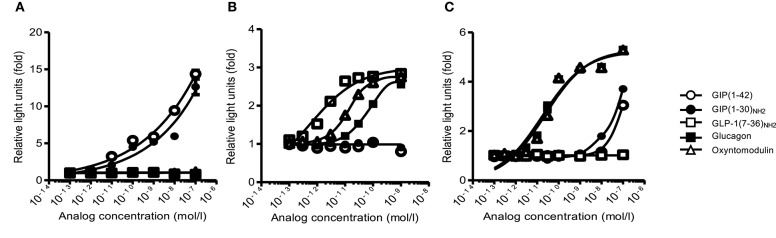
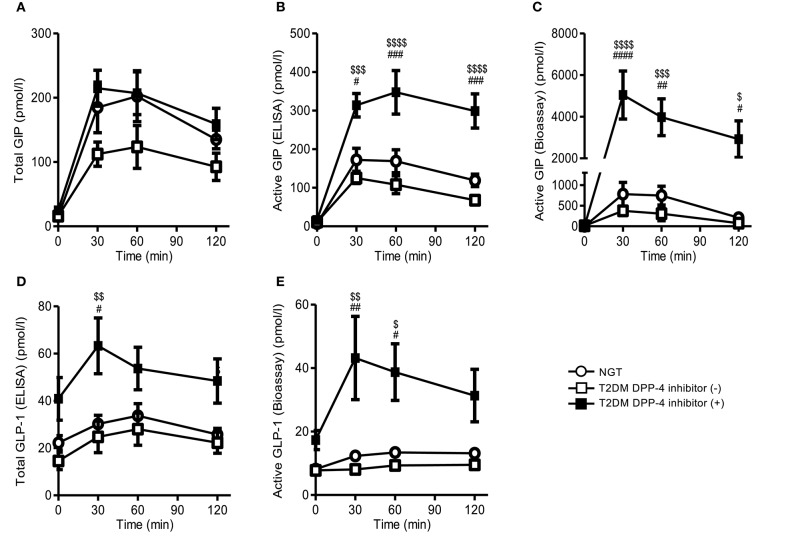
We recently observed a greater increase in plasma levels of bioactive glucose-dependent insulinotropic polypeptide (GIP) than glucagon-like peptide 1 (GLP-1) using the receptor-mediated bioassays in the subjects with normal glycemic tolerance (NGT) treated with dipeptidyl peptidase 4 (DPP-4) inhibitors, which may be unappreciated using conventional enzyme-linked immunosorbent assays (ELISAs) during oral glucose tolerance test. Thus, we determined incretin levels in addition to glucagon level using the bioassays in type 2 diabetes mellitus (T2DM) subjects with or without treatment of DPP-4 inhibitor, to evaluate whether these assays can accurately measure bioactivity of these peptides. We performed single meal tolerance test (MTT) by using a cookie meal (carbohydrate 75.0 g, protein 8.0 g, fat 28.5 g) in the subjects with NGT ( = 9), the subjects with T2DM treated without DPP-4 inhibitor ( = 7) and the subjects with T2DM treated with DPP-4 inhibitor ( = 10). All subjects fasted for 10-12 h before the MTT, and blood samples were collected at 0, 30, 60, and 120 min. We used the cell lines stably cotransfected with human-form GIP, GLP-1 or glucagon receptor, and a cyclic adenosine monophosphate-inducible luciferase expression construct for the bioassays. We measured active GIP, active GLP-1, and glucagon by the bioassays. To evaluate the efficacy of bioassay, we measured identical samples via ELISA kits. During the single MTT study, postprandial active GIP levels of T2DM with DPP-4 inhibitor treatment were drastically higher than those of NGT and T2DM without DPP-4 inhibitor, although the DPP-4 inhibitor-treated group showed moderate increase of active GIP and active GLP-1 , while active GLP-1 levels of T2DM subjects without DPP-4 inhibitor were comparable to those of NGT subjects. During the serial MTT, administration of DPP-4 inhibitor significantly increased active GIP levels, but not active GLP-1 . In comparison to conventional ELISA, receptor-mediated bioassay reflects dynamic change of GIP polypeptide by DPP-4 inhibitor treatment in subjects with type 2 diabetes.
我们最近观察到,在接受二肽基肽酶 4(DPP-4)抑制剂治疗的糖耐量正常(NGT)受试者中,使用受体介导的生物测定法检测到的生物活性葡萄糖依赖性胰岛素促分泌多肽(GIP)比胰高血糖素样肽 1(GLP-1)的血浆水平增加更大,而在口服葡萄糖耐量试验中使用常规酶联免疫吸附测定法(ELISA)可能无法检测到这一点。因此,我们在患有 2 型糖尿病(T2DM)的受试者中使用生物测定法测定了除胰高血糖素水平之外的肠降血糖素水平,无论是否接受 DPP-4 抑制剂治疗,以评估这些测定法是否可以准确测量这些肽的生物活性。我们在 NGT(=9)受试者、未接受 DPP-4 抑制剂治疗的 T2DM 受试者(=7)和接受 DPP-4 抑制剂治疗的 T2DM 受试者(=10)中进行了单餐耐量试验(MTT),使用了一种曲奇餐(碳水化合物 75.0g、蛋白质 8.0g、脂肪 28.5g)。所有受试者在 MTT 前禁食 10-12 小时,在 0、30、60 和 120 分钟采集血样。我们使用稳定共转染人形式 GIP、GLP-1 或胰高血糖素受体和环磷酸腺苷诱导的荧光素酶表达构建体的细胞系进行生物测定。我们通过生物测定法测量活性 GIP、活性 GLP-1 和胰高血糖素。为了评估生物测定的效果,我们使用 ELISA 试剂盒测量相同的样本。在单次 MTT 研究中,接受 DPP-4 抑制剂治疗的 T2DM 患者餐后活性 GIP 水平明显高于 NGT 和未接受 DPP-4 抑制剂治疗的 T2DM 患者,尽管 DPP-4 抑制剂治疗组显示出活性 GIP 和活性 GLP-1 的适度增加,而未接受 DPP-4 抑制剂治疗的 T2DM 患者的活性 GLP-1 水平与 NGT 患者相当。在连续 MTT 期间,给予 DPP-4 抑制剂可显著增加活性 GIP 水平,但不增加活性 GLP-1 水平。与传统 ELISA 相比,受体介导的生物测定法反映了 2 型糖尿病患者中 DPP-4 抑制剂治疗对 GIP 多肽的动态变化。