Fraunhofer Institute for Interfacial Engineering and Biotechnology, Stuttgart, Germany.
Procter & Gamble, Egham, England, United Kingdom.
PLoS One. 2020 May 11;15(5):e0232912. doi: 10.1371/journal.pone.0232912. eCollection 2020.
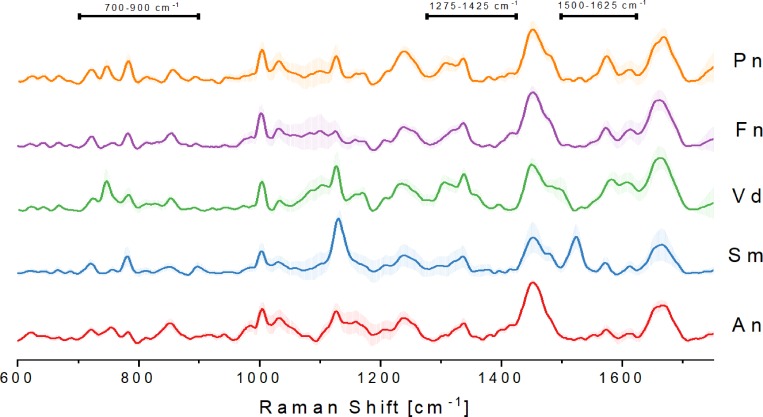
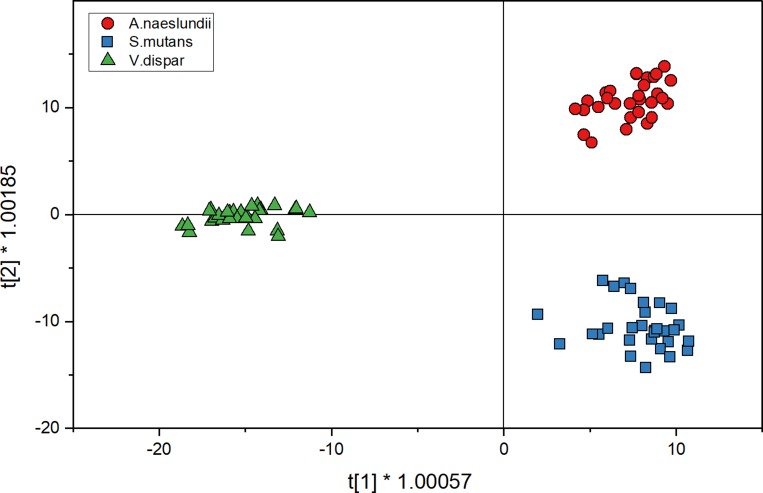
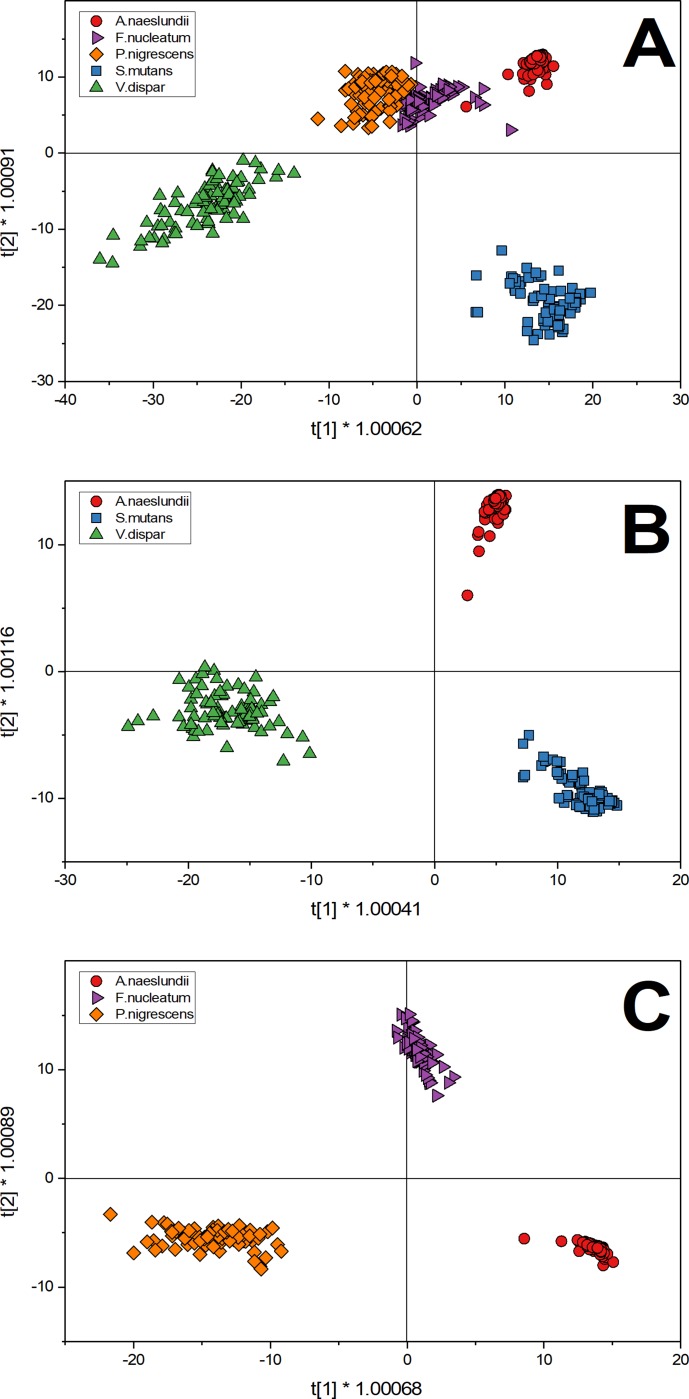
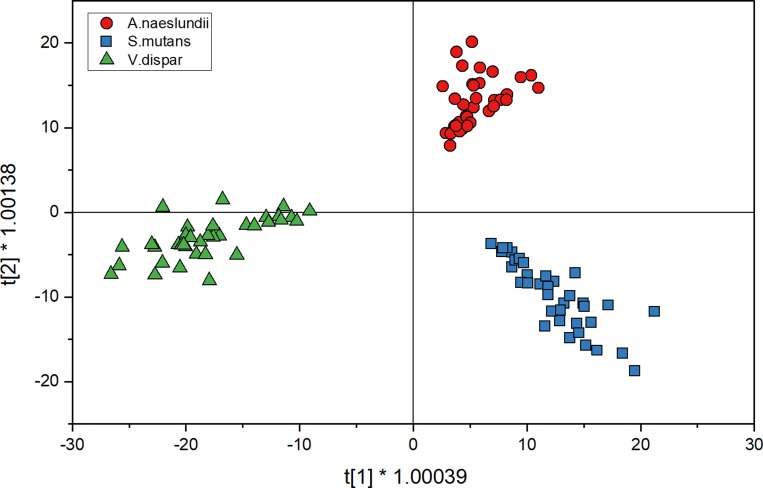
The study of oral disease progression, in relation to the accumulation of subgingival biofilm in gingivitis and periodontitis is limited, due to either the ability to monitor plaque in vitro. When compared, optical spectroscopic techniques offer advantages over traditional destructive or biofilm staining approaches, making it a suitable alternative for the analysis and continued development of three-dimensional structures. In this work, we have developed a confocal Raman spectroscopy analysis approach towards in vitro subgingival plaque models. The main objective of this study was to develop a method for differentiating multiple oral subgingival bacterial species in planktonic and biofilm conditions, using confocal Raman microscopy. Five common subgingival bacteria (Fusobacterium nucleatum, Streptococcus mutans, Veillonella dispar, Actinomyces naeslundii and Prevotella nigrescens) were used and differentiated using a 2-way orthogonal Partial Least Square with Discriminant Analysis (O2PLS-DA) for the collected spectral data. In addition to planktonic growth, mono-species biofilms cultured using the 'Zürich Model' were also analyzed. The developed method was successfully used to predict planktonic and mono-species biofilm species in a cross validation setup. The results show differences in the presence and absence of chemical bands within the Raman spectra. The O2PLS-DA model was able to successfully predict 100% of all tested planktonic samples and 90% of all mono-species biofilm samples. Using this approach we have shown that Confocal Raman microscopy can analyse and predict the identity of planktonic and mono-species biofilm species, thus enabling its potential as a technique to map oral multi-species biofilm models.
关于牙龈炎和牙周炎中龈下生物膜积累与口腔疾病进展的研究,由于体外监测牙菌斑的能力有限。与传统的破坏性或生物膜染色方法相比,光学光谱技术具有优势,使其成为分析和继续开发三维结构的合适替代方法。在这项工作中,我们开发了一种用于体外龈下牙菌斑模型的共焦拉曼光谱分析方法。本研究的主要目的是开发一种方法,用于区分浮游和生物膜条件下的多种口腔龈下细菌,使用共焦拉曼显微镜。使用了五种常见的龈下细菌(核梭杆菌、变形链球菌、差异韦荣球菌、奈瑟氏放线菌和变黑普雷沃菌),并使用收集的光谱数据的双向正交偏最小二乘判别分析(O2PLS-DA)进行区分。除了浮游生长外,还使用“苏黎世模型”培养单种生物膜。开发的方法成功地用于在交叉验证设置中预测浮游和单种生物膜物种。结果表明,拉曼光谱中存在和不存在化学带的差异。O2PLS-DA 模型能够成功预测所有测试浮游样本的 100%和所有单种生物膜样本的 90%。通过这种方法,我们已经表明共聚焦拉曼显微镜可以分析和预测浮游和单种生物膜物种的身份,从而使其有可能成为一种技术来绘制口腔多物种生物膜模型。