Department of Pathology, Peking University Cancer Hospital & Institute, Key Laboratory of Carcinogenesis and Translational Research (Ministry of Education/Beijing), Beijing, 100142, People's Republic of China.
Beijing Institute of Graphic Communication, Beijing, 102600, People's Republic of China.
Diagn Pathol. 2020 May 11;15(1):51. doi: 10.1186/s13000-020-00937-9.
BACKGROUND/OBJECTIVE: Acral and cutaneous melanomas are usually difficult to accurately diagnose in the early stage, owing to the similarity in clinical manifestations and morphology with those of dysplastic nevus (DN). In this study, we aimed to evaluate the diagnostic value of four-color fluorescence in-situ hybridization (FISH) probes specific to the RREB1,CCND1,and MYB genes, and centromere of chromosome 6, in distinguishing DN and melanoma.
Fifty one DN and 58 melanoma cases were collected and tested with four-color FISH. Histological features were reviewed and concordant morphologic diagnosis by three pathologists was considered the golden criterion.
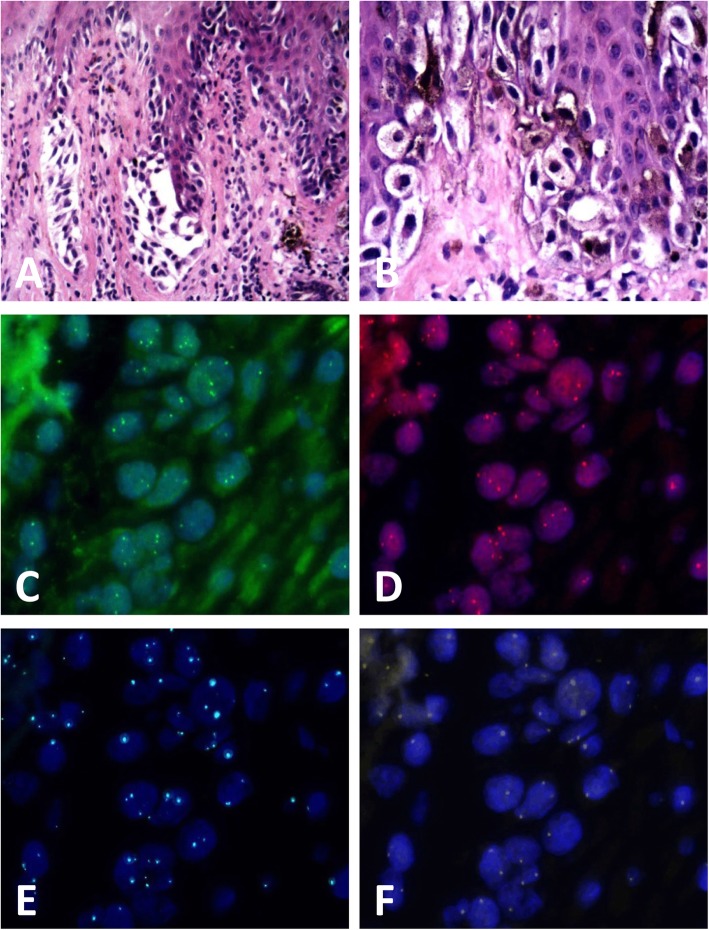
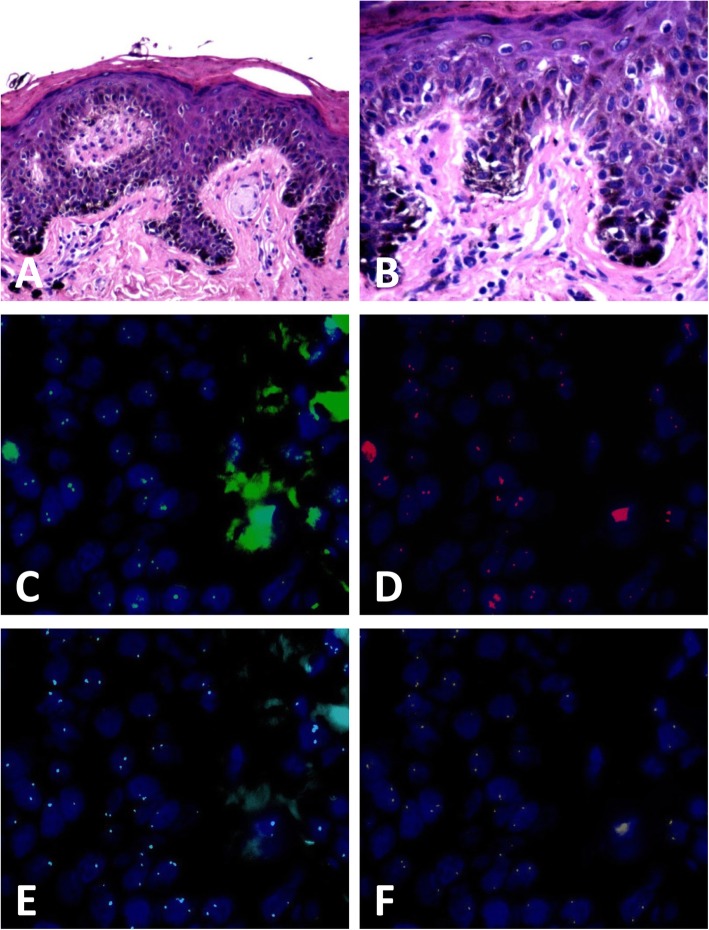
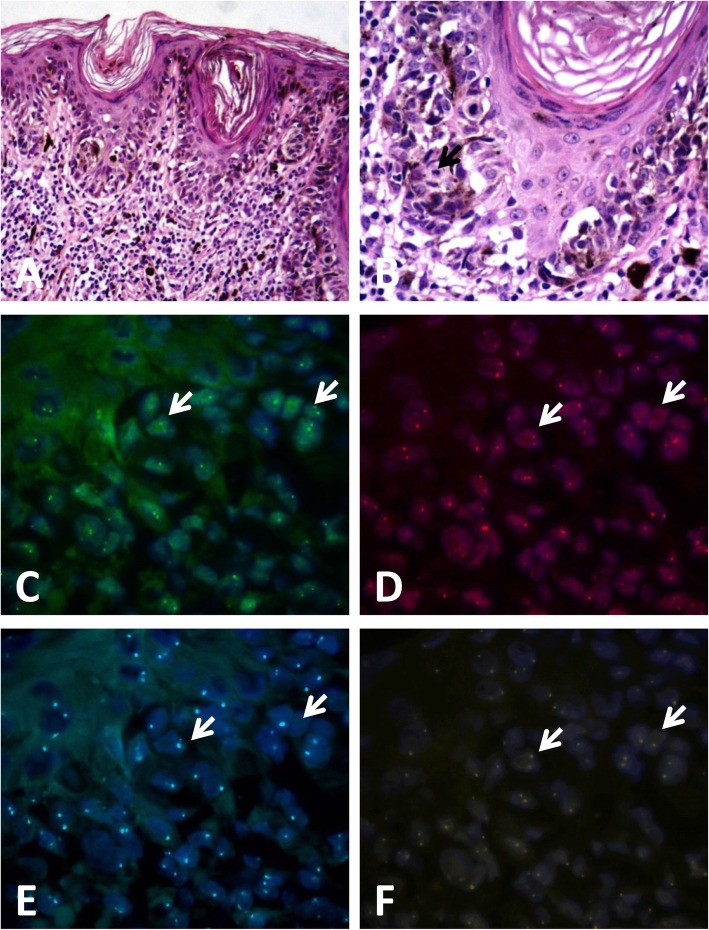
Fifty DN and 59 melanoma cases, with 37 melanomas in situ and 22 melanomas in Clark level 2, were confirmed finally; among them, 42 (71.2%) cases were acral. A comparison of clinicopathological features between the two entities showed that several features were considerably more frequently observed in the melanoma group, including more mitotic figures, stratum corneum pigmentation, lymphocyte infiltration, cell atypia, successive or pagetoid melanocyte growth pattern in the epidermis, larger tumor size, and older age at diagnosis. FISH was positive in 3 (6.0%) DN and 56 (94.9%) melanoma cases according to Gerami's criteria. In distinguishing the two groups, the sensitivity of the four-color FISH was 94.9% and specificity was 94.0%.We found that CCND1 gain was the most sensitive, either in Gerami's or Gaiser's criteria. Further analysis showed that CCND1gain was more obvious in the acral group of melanoma.
We conclude that the four-color FISH test was highly sensitive and specific in distinguishing early-stage acral and cutaneous melanomas from dysplastic nevus in Chinese population, and the most sensitive criterion was the gain of CCND1.
背景/目的:肢端和皮肤黑色素瘤在早期通常难以准确诊断,因为其临床表现和形态与发育不良痣(DN)相似。在这项研究中,我们旨在评估针对 RREB1、CCND1 和 MYB 基因以及 6 号染色体着丝粒的四色荧光原位杂交(FISH)探针在区分 DN 和黑色素瘤方面的诊断价值。
收集了 51 例 DN 和 58 例黑色素瘤病例,并进行了四色 FISH 检测。回顾了组织学特征,三位病理学家的一致形态学诊断被认为是金标准。
最终证实了 51 例 DN 和 59 例黑色素瘤病例,其中原位黑色素瘤 37 例,Clark 2 级黑色素瘤 22 例;其中 42 例(71.2%)为肢端。对这两种实体的临床病理特征进行比较后发现,黑色素瘤组中存在一些更常见的特征,包括更多的有丝分裂象、角质层色素沉着、淋巴细胞浸润、细胞异型性、表皮中连续或 paget 样黑素细胞生长模式、更大的肿瘤大小和更老的诊断年龄。根据 Gerami 的标准,FISH 在 3 例(6.0%)DN 和 56 例(94.9%)黑色素瘤病例中呈阳性。在区分这两组时,四色 FISH 的敏感性为 94.9%,特异性为 94.0%。我们发现,根据 Gerami 或 Gaiser 的标准,CCND1 增益都是最敏感的。进一步分析显示,CCND1 增益在肢端黑色素瘤组中更为明显。
我们得出结论,四色 FISH 试验在区分中国人群中早期肢端和皮肤黑色素瘤与发育不良痣方面具有高度的敏感性和特异性,最敏感的标准是 CCND1 增益。