Li Feng-Yan, Lian Chen-Lu, Lei Jian, Wang Jun, Hua Li, He Zhen-Yu, Wu San-Gang
Department of Radiation Oncology, Sun Yat-sen University Cancer Center, State Key Laboratory of Oncology in South China, Collaborative Innovation Center of Cancer Medicine, Guangzhou 510060, China.
Department of Radiation Oncology, the First Affiliated Hospital of Xiamen University, Teaching Hospital of Fujian Medical University, Xiamen 361003, China.
Ann Transl Med. 2020 Apr;8(7):489. doi: 10.21037/atm.2020.03.49.
The utility of postmastectomy radiotherapy (PMRT) in breast cancer patients with T1-2 (tumor size ≤5 cm) and N1 (one to three lymph nodes involved) disease remains controversial. The aim of this population-based study was to investigate the effectiveness of PMRT in this patient subset in the current clinical practice.
We included T1-2N1 breast cancer patients treated with mastectomy from 2004 to 2012 using the data form the Surveillance, Epidemiology, and End Results program. The association of PMRT administration with breast cancer-specific survival was determined using multivariable Cox analysis.
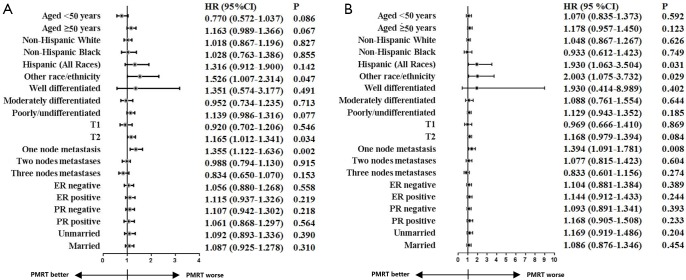
We identified 10,248 patients of this study, including 3,725 (36.3%) received PMRT and 6,523 (63.7%) patients did not receive PMRT. Use of PMRT showed increase from 2008 onward; the percentage of patients receiving PMRT was 30.6% in 2004 and was 47.1% in 2012 (P<0.001). Patients diagnosis after 2008, aged <50 years, high tumor grade, T2 stage, and ≥2 positive lymph nodes were independently related to PMRT receipt. Multivariate analysis indicated that PMRT was not related to better breast cancer-specific survival compared to those without PMRT both before (P=0.186) and after propensity score matching (P=0.137).
In breast cancer with T1-2N1 disease, PMRT does not appear to improve survival in the era of modern systemic therapy.
对于肿瘤大小为T1-2(肿瘤大小≤5cm)且有N1(一至三个淋巴结受累)的乳腺癌患者,乳房切除术后放疗(PMRT)的效用仍存在争议。这项基于人群的研究旨在调查在当前临床实践中,PMRT对此类患者亚组的有效性。
我们纳入了2004年至2012年接受乳房切除术的T1-2N1乳腺癌患者,数据来自监测、流行病学和最终结果计划。使用多变量Cox分析确定PMRT的使用与乳腺癌特异性生存率之间的关联。
我们在本研究中确定了10248例患者,其中3725例(36.3%)接受了PMRT,6523例(63.7%)患者未接受PMRT。PMRT的使用从2008年起呈上升趋势;2004年接受PMRT的患者比例为30.6%,2012年为47.1%(P<0.001)。2008年后诊断的患者、年龄<50岁、肿瘤分级高、T2期以及≥2个阳性淋巴结与接受PMRT独立相关。多变量分析表明,与未接受PMRT的患者相比,无论在倾向评分匹配前(P=0.186)还是匹配后(P=0.137),PMRT均与更好的乳腺癌特异性生存率无关。
在患有T1-2N1疾病的乳腺癌中,在现代全身治疗时代,PMRT似乎并不能提高生存率。