Xu L M, Li N N, Wang Z, Wu X X, Dong Y J, Fu X R, Liu Y, Hu L D, Li X F, Wang Y N, Wu Y M, Ren H Y, Zhang M Z, Wang M H, Li Y H, Huang W R
Department of Hematology, Chinese PLA General Hospital, Beijing 100853, China.
Institute of Hematology, Fujian Provincial Key Laboratory on Hematology, Union Hospital of Fujian Medical University, Fuzhou 350001, China.
Zhonghua Xue Ye Xue Za Zhi. 2019 Jul 14;40(7):573-577. doi: 10.3760/cma.j.issn.0253-2727.2019.07.007.
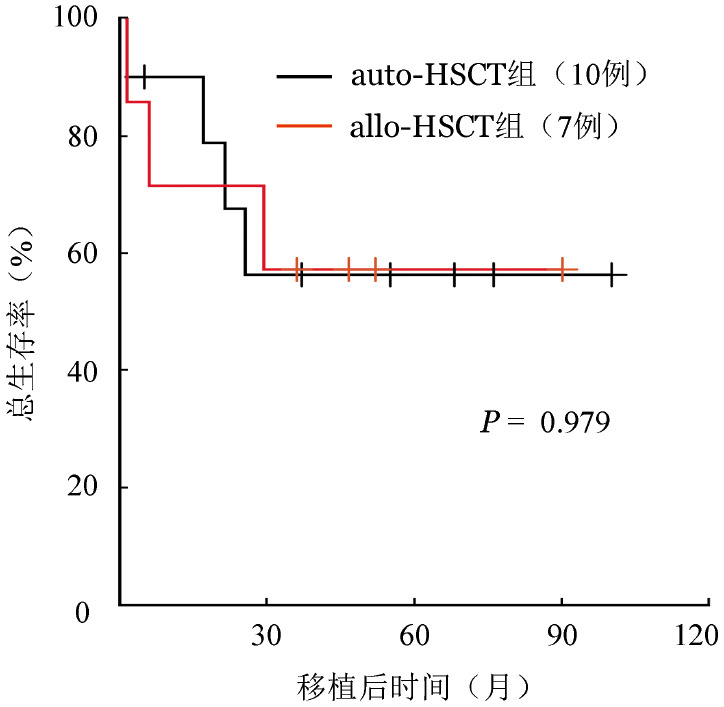
To evaluate clinical outcomes of autologous (auto-HSCT) and allogeneic hematopoietic stem cell transplantation (allo-HSCT) for angioimmunoblastic T-cell lymphoma (AITL) . From June 2007 to June 2017, clinical data of AITL patients who underwent HSCT in eight hospitals were assessed retrospectively. Of 19 patients, 13 male and 6 female with a median age of 50 (32-60) years old, 12 auto-HSCT and 7 allo-HSCT recipients were enrolled in this study, all donors were HLA-identical siblings. Two of allo-HSCT recipients were relapsed auto-HSCT ones. There were 5 patients (5/12) in complete response (CR) status and 7 (7/12) in partial remission (PR) status before transplantation in auto-HSCT group, and 2 (2/7) in PR status and 3 (3/7) in progression disease (PD) status before transplantation in allo-HSCT group. The median follow-up for the surviving patients was 46.5 months (range, 1-100 months) for the whole series, two patients lost in auto-HSCT group. Three patients developed acute graft-versus-host disease (aGVHD) and 5 chronic graft-versus-host disease (cGVHD) after allo-HSCT. Three patients died of primary disease and 1bleeding in auto-HSCT group. One patient died of primary disease and 2 transplantation-related mortality in allo-HSCT group. The 3-year cumulative overall survival (OS) were 56% (95% 32%-100%) and 57% (95% 30%-100%) for auto-HSCT and allo-HSCT, respectively (=0.979) . The 3-year cumulative progression-free survival (PFS) were 34% (95% 14%-85%) and 57% (95% 30%-100%) for auto-HSCT and allo-HSCT, respectively (=0.451) . Both auto-HSCT and allo-HSCT were optimal choices for AITL. In clinical practice, which HSCT was better for AITL patients should be based on comprehensive factors including sensitivity to chemotherapy, risk stratification and disease status at transplantation.
评估自体造血干细胞移植(auto-HSCT)和异基因造血干细胞移植(allo-HSCT)治疗血管免疫母细胞性T细胞淋巴瘤(AITL)的临床疗效。回顾性分析2007年6月至2017年6月期间在8家医院接受HSCT的AITL患者的临床资料。19例患者中,男性13例,女性6例,中位年龄50(32 - 60)岁,本研究纳入12例接受auto-HSCT和7例接受allo-HSCT的患者,所有供者均为HLA全相合的同胞。allo-HSCT患者中有2例为auto-HSCT复发患者。auto-HSCT组移植前完全缓解(CR)状态5例(5/12),部分缓解(PR)状态7例(7/12);allo-HSCT组移植前PR状态2例(2/7),疾病进展(PD)状态3例(3/7)。全组存活患者的中位随访时间为46.5个月(范围1 - 100个月),auto-HSCT组有2例失访。allo-HSCT后3例发生急性移植物抗宿主病(aGVHD),5例发生慢性移植物抗宿主病(cGVHD)。auto-HSCT组3例死于原发病,1例死于出血。allo-HSCT组1例死于原发病,2例死于移植相关死亡。auto-HSCT和allo-HSCT的3年累积总生存率(OS)分别为56%(95% 32% - 100%)和57%(95% 30% - 100%)(P = 0.979)。auto-HSCT和allo-HSCT的3年累积无进展生存率(PFS)分别为34%(95% 14% - 85%)和57%(95% 30% - 100%)(P = 0.451)。auto-HSCT和allo-HSCT都是AITL的最佳选择。在临床实践中,对于AITL患者哪种HSCT更好应基于包括对化疗的敏感性、风险分层和移植时的疾病状态等综合因素。