Rashid Md Al Mamunur, Hayati Dini, Kwak Kyungwon, Hong Jongin
Department of Chemistry, Chung-Ang University, Seoul 06974, Korea.
Center for Molecular Spectroscopy and Dynamics, Institute for Basic Science (IBS) & Department of Chemistry, Korea University, Seoul 02841, Korea.
Nanomaterials (Basel). 2020 May 9;10(5):914. doi: 10.3390/nano10050914.
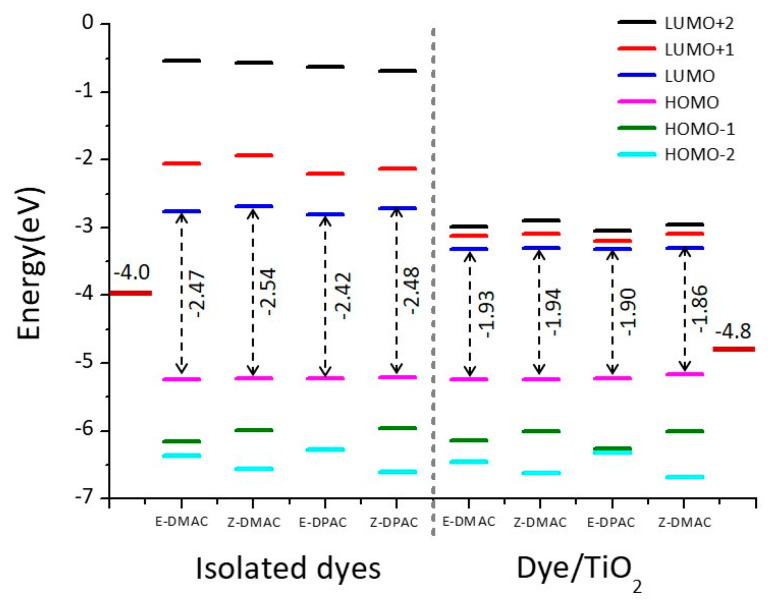
Two donor-π-spacer-acceptor (D-π-A) organic dyes were designed as photochromic dyes with the same π-spacer and acceptor but different donors, based on their electron-donating strength. Various structural, electronic, and optical properties, chemical reactivity parameters, and certain crucial factors that affect short-circuit current density () and open circuit voltage () were investigated computationally using density functional theory and time-dependent density functional theory. The - isomerization of these azobenzene-based dyes and its effect on their properties was studied in detail. Furthermore, the dye-(TiO) anatase nanoparticle system was simulated to understand the electronic structure of the interface. Based on the results, we justified how the - isomerization and different donor groups influence the physical properties as well as the photovoltaic performance of the resultant dye-sensitized solar cells (DSSCs). These theoretical calculations can be used for the rapid screening of promising dyes and their optimization for photochromic DSSCs.
基于两种供体-π-间隔体-受体(D-π-A)有机染料的给电子强度,设计了两种具有相同π-间隔体和受体但供体不同的光致变色染料。使用密度泛函理论和含时密度泛函理论,对各种结构、电子和光学性质、化学反应活性参数以及影响短路电流密度()和开路电压()的某些关键因素进行了计算研究。详细研究了这些基于偶氮苯的染料的-异构化及其对其性质的影响。此外,对染料-(TiO)锐钛矿纳米颗粒体系进行了模拟,以了解界面的电子结构。基于这些结果,我们阐明了-异构化和不同的供体基团如何影响所得染料敏化太阳能电池(DSSC)的物理性质以及光伏性能。这些理论计算可用于快速筛选有前景的染料并对其进行光致变色DSSC的优化。