Department of Prosthetic Dentistry, University Hospital, LMU Munich, Goethestrasse 70, 80336, Munich, Germany.
Clin Oral Investig. 2020 Dec;24(12):4301-4311. doi: 10.1007/s00784-020-03294-5. Epub 2020 May 12.
To present a digital approach to measure and compare material wear behavior of antagonistic first molar restorations made of an experimental CAD/CAM composite (COMP) and lithium disilicate ceramic (LS2) in patients with reconstructed vertical dimension of occlusion (VDO) after generalized hard tissue loss.
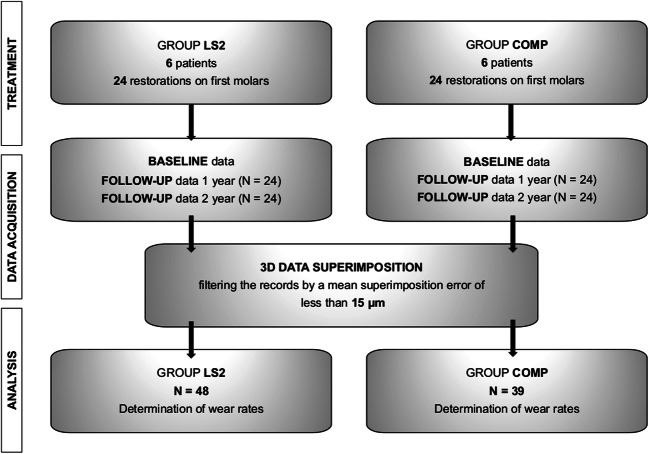
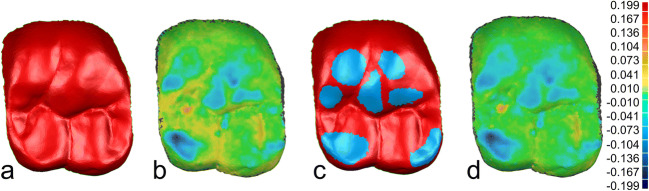
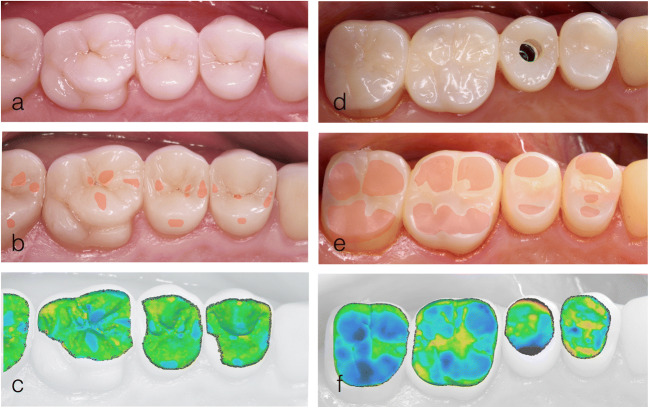
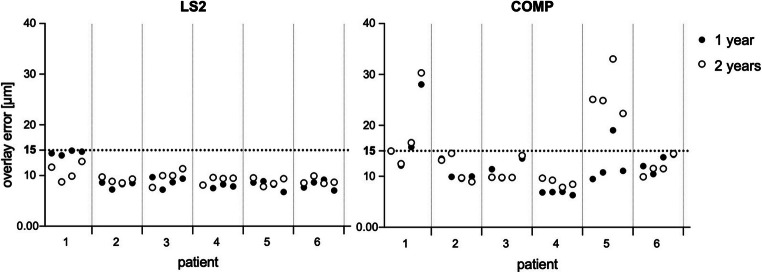
A total of 12 patients underwent complete full jaw rehabilitation with full occlusal coverage restorations made either of COMP or LS2. The first molar restorations (n = 48) were chosen for wear examination. At annual recall appointments, polyether impressions were taken, and resulting plaster casts were digitalized using a laboratory scanner. Mean observation period was 371 days for first and 769 days for second year. The resulting 96 datasets were analyzed by superimposition of 3-D datasets using an iterative best-fit method. Based on the superimposition data, the wear rates of the occlusal contact areas (OCAs) were calculated.
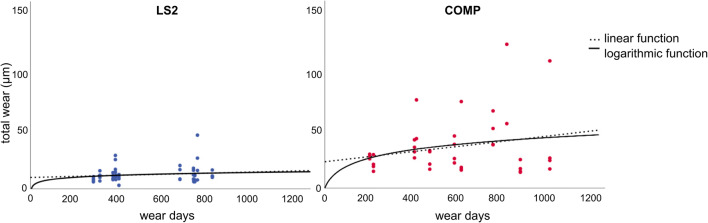
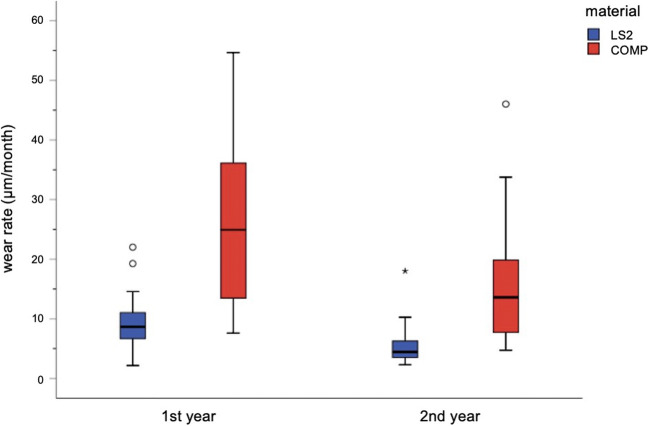
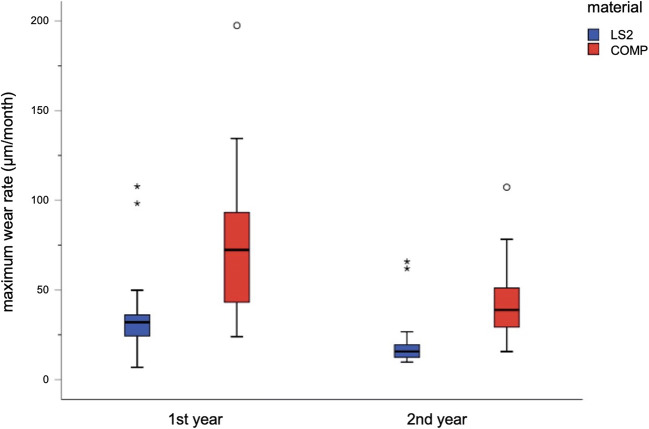
For antagonistic restorations made of COMP, the average wear rate was 24.8 ± 13.3 μm/month, while for LS2, it was 9.5 ± 4.3 μm/month in first year, with significant differences (p < 0.0001) between the materials. In second year, monthly wear rates decreased significantly for both materials: COMP (16.2 ± 10.7 μm/month) and LS2 (5.5 ± 3.3 μm/month). Statistical comparison between wear time showed significant differences for both materials: COMP p < 0.037 and LS2 p < 0.001. A logarithmic fit (COMP R = 0.081; LS2 R = 0.038) of the data was calculated to estimate the wear progression.
In patients with reconstructed VDO, restorations made of LS2 show a more stable wear behavior than ones out of experimental CAD/CAM composite. In cases of complete rehabilitation, load bearing CAD/CAM-composite restorations should be critically considered for application due to their occlusal wear behavior. However, when choosing a restorative material, not only the functional occlusal stability should be taken into account but also the prospect of minimally invasive treatment with maximum preservation of natural tooth structures.
提出一种数字化方法来测量和比较因广义硬组织丧失而重建垂直距离后,具有咬合覆盖修复体的患者的第一磨牙修复体的材料磨损行为,这些修复体分别由实验性 CAD/CAM 复合材料(COMP)和锂硅玻璃陶瓷(LS2)制成。
共有 12 名患者接受了全颌全口义齿修复,修复体采用 COMP 或 LS2 制成,具有完全的咬合覆盖。选择第一磨牙修复体(n=48)进行磨损检查。在每年的复诊时,采用聚醚印模,并用实验室扫描仪对所得石膏模型进行数字化。第一年末的平均观察期为 371 天,第二年为 769 天。使用迭代最佳拟合方法对 3D 数据集进行叠加,对所得的 96 组数据集进行分析。基于叠加数据,计算咬合接触区(OCAs)的磨损率。
对于 COMP 制成的拮抗修复体,平均磨损率为 24.8±13.3μm/月,而 LS2 在第一年的磨损率为 9.5±4.3μm/月,两种材料之间存在显著差异(p<0.0001)。第二年,两种材料的月磨损率均显著下降:COMP(16.2±10.7μm/月)和 LS2(5.5±3.3μm/月)。对两种材料的磨损时间进行统计学比较,结果显示差异均有统计学意义:COMP p<0.037,LS2 p<0.001。对数据进行对数拟合(COMP R=0.081;LS2 R=0.038),以估计磨损进展情况。
在重建垂直距离的患者中,LS2 制成的修复体比实验性 CAD/CAM 复合材料制成的修复体具有更稳定的磨损行为。在完全修复的情况下,由于其咬合磨损行为,应慎重考虑使用承重 CAD/CAM 复合材料修复体。但是,在选择修复材料时,不仅要考虑功能咬合稳定性,还要考虑到最大限度地保留天然牙结构的微创治疗前景。