Università della Svizzera italiana, CH-6900 Lugano, Switzerland.
Institute for Research in Biomedicine, CH-6500 Bellinzona, Switzerland.
Mol Biol Cell. 2020 Jul 1;31(14):1512-1524. doi: 10.1091/mbc.E20-04-0269. Epub 2020 May 13.
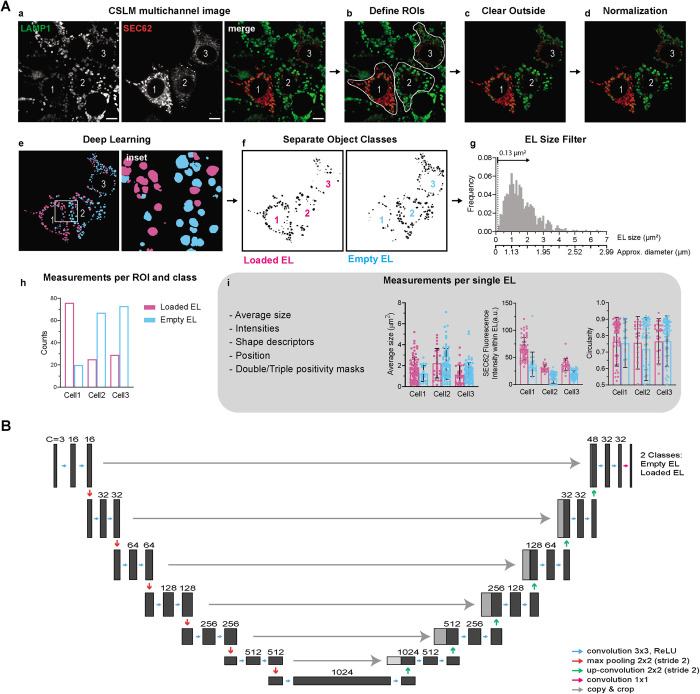
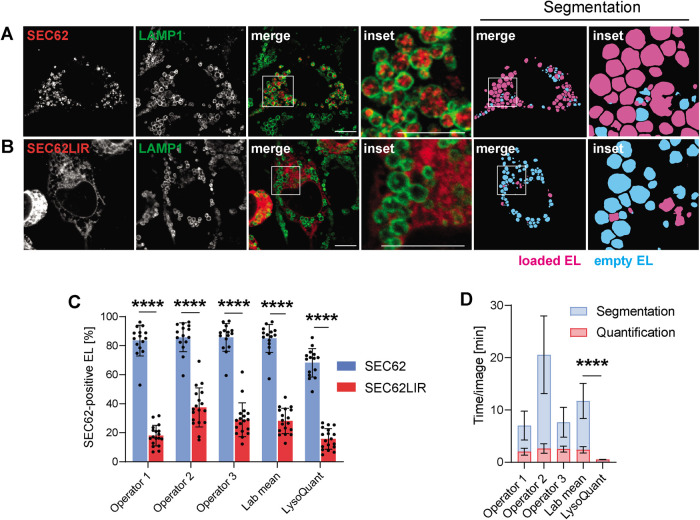
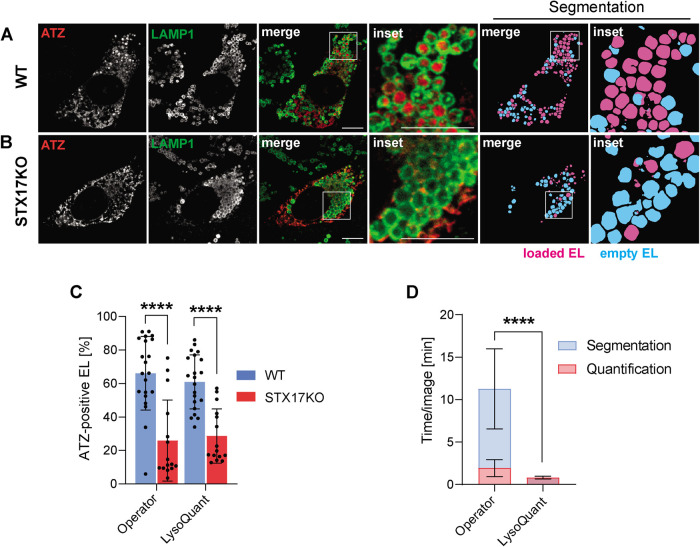
Endolysosomal compartments maintain cellular fitness by clearing dysfunctional organelles and proteins from cells. Modulation of their activity offers therapeutic opportunities. Quantification of cargo delivery to and/or accumulation within endolysosomes is instrumental for characterizing lysosome-driven pathways at the molecular level and monitoring consequences of genetic or environmental modifications. Here we introduce LysoQuant, a deep learning approach for segmentation and classification of fluorescence images capturing cargo delivery within endolysosomes for clearance. LysoQuant is trained for unbiased and rapid recognition with human-level accuracy, and the pipeline informs on a series of quantitative parameters such as endolysosome number, size, shape, position within cells, and occupancy, which report on activity of lysosome-driven pathways. In our selected examples, LysoQuant successfully determines the magnitude of mechanistically distinct catabolic pathways that ensure lysosomal clearance of a model organelle, the endoplasmic reticulum, and of a model protein, polymerogenic ATZ. It does so with accuracy and velocity compatible with those of high-throughput analyses.
内溶酶体隔室通过清除细胞内功能失调的细胞器和蛋白质来维持细胞的健康。调节它们的活性为治疗提供了机会。货物在溶酶体内的传递和/或积累的定量分析对于在分子水平上描述溶酶体驱动的途径以及监测遗传或环境修饰的后果至关重要。在这里,我们介绍了 LysoQuant,这是一种用于分割和分类荧光图像的深度学习方法,用于捕获内溶酶体中用于清除的货物传递。LysoQuant 经过训练,可以进行无偏见和快速识别,准确率达到人类水平,并且该流水线提供了一系列定量参数,例如内溶酶体的数量、大小、形状、在细胞内的位置和占用率,这些参数报告了溶酶体驱动途径的活性。在我们选择的示例中,LysoQuant 成功地确定了确保模型细胞器内质网和模型蛋白聚合 ATZ 在内溶酶体清除中具有不同机制的途径的幅度。它的准确性和速度与高通量分析兼容。