Abdominal Center, Department of Transplantation and Liver Surgery, Helsinki University Hospital and University of Helsinki, Helsinki, Finland.
Department of Medicine, Houston Methodist Hospital, Houston, Texas.
Clin J Am Soc Nephrol. 2020 Jun 8;15(6):813-821. doi: 10.2215/CJN.13711119. Epub 2020 May 13.
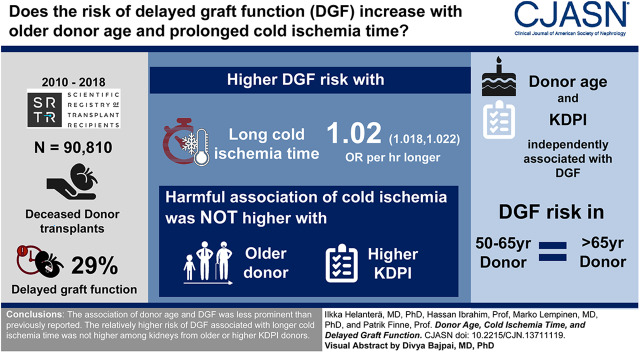
Increased donor age is one of the most important risk factors for delayed graft function (DGF), and previous studies suggest that the harmful effect of cold ischemia time is increased in kidneys from older donors. Our aim was to study the association of increased donor age and cold ischemia time with the risk of delayed graft function in a large cohort kidney transplants from the current era.
DESIGN, SETTING, PARTICIPANTS, & MEASUREMENTS: The Scientific Registry of Transplant Recipients was used for this observational, retrospective registry analysis to identify all deceased donor kidney transplantations in the United States between 2010 and September 2018, who were on dialysis pretransplantation (=90,810). The association of donor age and cold ischemia time with the risk of DGF was analyzed in multivariable models adjusted for recipient characteristics (age, race, sex, diabetes, calculated panel-reactive antibodies, pretransplant dialysis duration) and donor characteristics (cause of death, sex, race, body mass index, creatinine, donation after circulatory death status, history of hypertension, and HLA mismatch).
Cold ischemia time and donor age were independently associated with the risk of DGF, but the risk of DGF was not statistically significantly lower in donor age categories between 50 and 64 years, compared with donors ≥65 years. The harmful association of cold ischemia time was not higher in kidneys from older donors in any age category, not even among donation after circulatory death donors. When donor risk was assessed with kidney donor profile index, although a statistically significant interaction with cold ischemia time was found, no practically meaningful increase in cold-ischemia susceptibility of kidneys with a high kidney donor profile index was found.
We were unable to demonstrate an association between donor age and DGF. The association of longer cold ischemia time with the risk of DGF was not magnified in older or more marginal donors.
供者年龄增加是导致移植肾功能延迟恢复(DGF)的最重要危险因素之一,既往研究表明,高龄供者肾脏冷缺血时间的有害影响会增加。本研究旨在探讨在当前时代的大量肾脏移植队列中,供者年龄增加和冷缺血时间与 DGF 风险之间的相关性。
设计、地点、参与者和测量方法:本研究使用美国移植受者科学注册处(Scientific Registry of Transplant Recipients)进行观察性、回顾性队列分析,以确定 2010 年至 2018 年 9 月期间美国所有接受透析治疗的移植前死亡供者的肾移植(=90810 例)。在调整了受者特征(年龄、种族、性别、糖尿病、计算性群体反应性抗体、移植前透析时间)和供者特征(死亡原因、性别、种族、体重指数、肌酐、循环死亡后捐献状态、高血压史和 HLA 错配)的多变量模型中,分析了供者年龄和冷缺血时间与 DGF 风险的相关性。
冷缺血时间和供者年龄与 DGF 风险独立相关,但与≥65 岁的供者相比,50-64 岁年龄组供者的 DGF 风险无统计学显著降低。在任何年龄组中,高龄供者的冷缺血时间对 DGF 的有害关联并不更高,甚至在循环死亡后供者中也如此。当用肾脏捐献者风险指数评估供者风险时,尽管发现了与冷缺血时间的统计学显著交互作用,但没有发现高肾脏捐献者风险指数的肾脏对冷缺血的敏感性有实际意义的增加。
本研究未能证明供者年龄与 DGF 之间存在关联。冷缺血时间与 DGF 风险之间的相关性在高龄或更边缘供者中没有放大。