Lin Jian-Chun, Liu Zhong-Guo, Liu Rui-Ren, Xie Liang-Wen, Xie Huang-Lin, Cai He-Guo
Department of Orthopaedics, The Third Hospital of Xiamen, Xiamen, China.
J Clin Lab Anal. 2020 May;34(5):e23204. doi: 10.1002/jcla.23204. Epub 2020 May 14.
Hip fracture in the elderly is a health burden worldwide due to its high mortality rate. This study was conducted to determine the possible mechanisms of osteopontin (OPN) and β-carboxy-terminal cross-linking telopeptide of type I collagen (β-CTX) in hip fracture in the elderly.
In the study, we recruited 108 elderly patients with hip fracture diagnosed from May 2012 to May 2015 at the Third Hospital of Xiamen and 86 healthy individuals without a history of hip fracture were taken as controls. Serum levels of OPN and β-CTX were then determined. The T and Z values for bone mineral density (BMD) were also measured. Moreover, logistic regression analysis was performed to assess the risk and protective factors for hip fracture in the elderly.
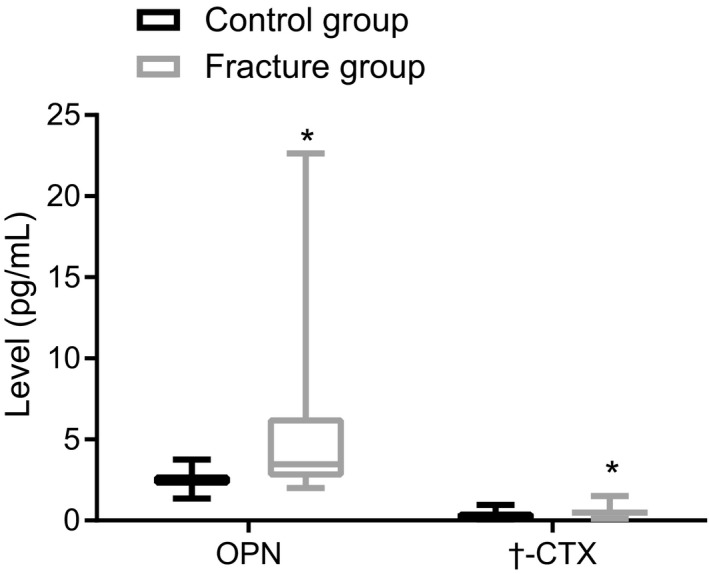
Serum levels of both OPN and β-CTX were increased in elderly patients with hip fracture. OPN was positively correlated with β-CTX. In addition, the levels of OPN and β-CTX shared a positive association with the age, and a negative association with the BMD, in terms of T and Z values of the hip. In addition, increased BMD and outdoor sports might be protective factors for hip fracture, and an increase in levels of OPN and β-CTX might be associated with a higher risk of hip fracture in the elderly population.
Collectively, increased serum levels of OPN and β-CTX might be correlated with a higher risk of a hip fracture and have predictive values in the occurrence of hip fracture in the elderly.
由于老年髋部骨折死亡率高,它已成为全球范围内的一项健康负担。本研究旨在确定骨桥蛋白(OPN)和I型胶原β羧基末端交联肽(β-CTX)在老年髋部骨折中的可能作用机制。
本研究纳入了2012年5月至2015年5月在厦门大学附属第三医院确诊的108例老年髋部骨折患者,并选取86例无髋部骨折病史的健康个体作为对照。随后测定血清OPN和β-CTX水平。同时测量骨密度(BMD)的T值和Z值。此外,进行逻辑回归分析以评估老年髋部骨折的风险和保护因素。
老年髋部骨折患者血清OPN和β-CTX水平均升高。OPN与β-CTX呈正相关。此外,就髋部的T值和Z值而言,OPN和β-CTX水平与年龄呈正相关,与BMD呈负相关。此外,骨密度增加和户外运动可能是髋部骨折的保护因素,而OPN和β-CTX水平升高可能与老年人群髋部骨折风险较高有关。
总体而言,血清OPN和β-CTX水平升高可能与髋部骨折风险较高相关,并对老年髋部骨折的发生具有预测价值。