
肥胖和糖尿病患者循环中的淀粉样蛋白浓度升高会导致血管功能障碍。
Elevated circulating amyloid concentrations in obesity and diabetes promote vascular dysfunction.
机构信息
Division of Systems Medicine, School of Medicine, Ninewells Hospital and Medical School, Dundee, United Kingdom.
Discovery and Translational Science Department, Leeds Institute of Cardiovascular and Metabolic Medicine, University of Leeds, Leeds, United Kingdom.
出版信息
J Clin Invest. 2020 Aug 3;130(8):4104-4117. doi: 10.1172/JCI122237.
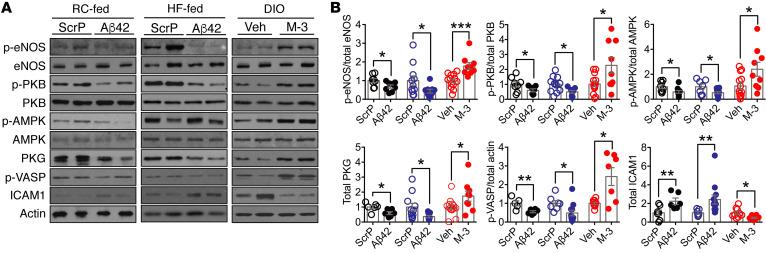
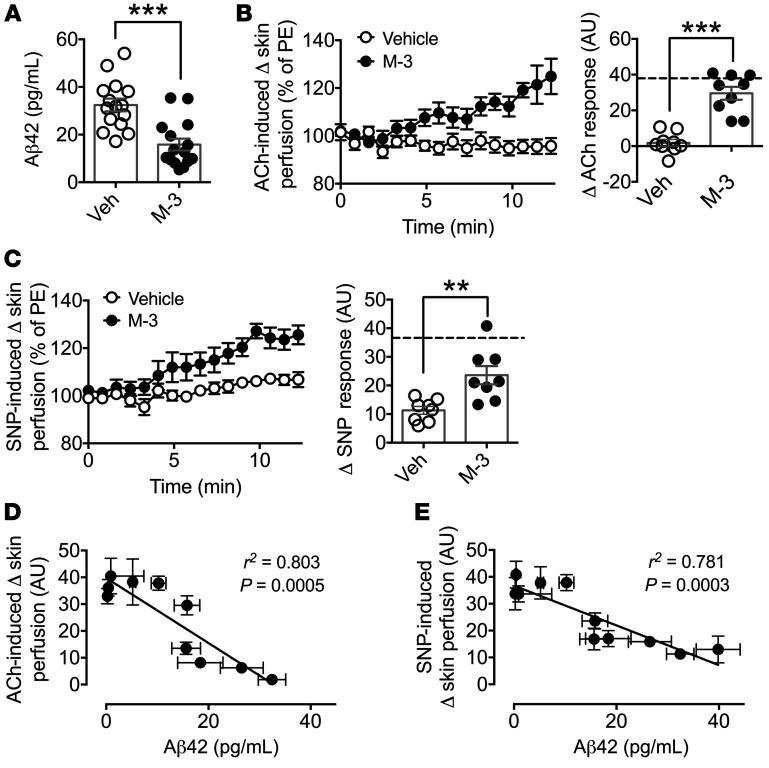
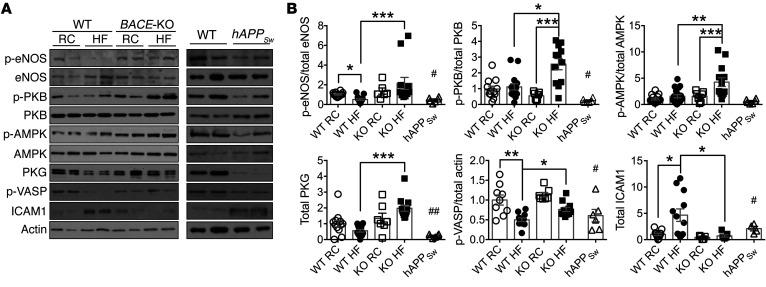
Diabetes, obesity, and Alzheimer's disease (AD) are associated with vascular complications and impaired nitric oxide (NO) production. Furthermore, increased β-site amyloid precursor protein-cleaving (APP-cleaving) enzyme 1 (BACE1), APP, and β-amyloid (Aβ) are linked with vascular disease development and increased BACE1 and Aβ accompany hyperglycemia and hyperlipidemia. However, the causal relationship between obesity and diabetes, increased Aβ, and vascular dysfunction is unclear. We report that diet-induced obesity (DIO) in mice increased plasma and vascular Aβ42 that correlated with decreased NO bioavailability, endothelial dysfunction, and increased blood pressure. Genetic or pharmacological reduction of BACE1 activity and Aβ42 prevented and reversed, respectively, these outcomes. In contrast, expression of human mutant APP in mice or Aβ42 infusion into control diet-fed mice to mimic obese levels impaired NO production, vascular relaxation, and raised blood pressure. In humans, increased plasma Aβ42 correlated with diabetes and endothelial dysfunction. Mechanistically, higher Aβ42 reduced endothelial NO synthase (eNOS), cyclic GMP (cGMP), and protein kinase G (PKG) activity independently of diet, whereas endothelin-1 was increased by diet and Aβ42. Lowering Aβ42 reversed the DIO deficit in the eNOS/cGMP/PKG pathway and decreased endothelin-1. Our findings suggest that BACE1 inhibitors may have therapeutic value in the treatment of vascular disease associated with diabetes.
糖尿病、肥胖和阿尔茨海默病(AD)与血管并发症和一氧化氮(NO)生成受损有关。此外,β 位淀粉样前体蛋白裂解(APP 裂解)酶 1(BACE1)、APP 和 β-淀粉样蛋白(Aβ)的增加与血管疾病的发展有关,而 BACE1 和 Aβ 的增加伴随着高血糖和高血脂。然而,肥胖和糖尿病、Aβ 增加以及血管功能障碍之间的因果关系尚不清楚。我们报告,饮食诱导的肥胖(DIO)在小鼠中增加了血浆和血管中的 Aβ42,这与 NO 生物利用度降低、内皮功能障碍和血压升高有关。BACE1 活性和 Aβ42 的遗传或药物减少分别预防和逆转了这些结果。相比之下,在对照饮食喂养的小鼠中表达人突变 APP 或输注 Aβ42 以模拟肥胖水平会损害 NO 产生、血管松弛和升高血压。在人类中,血浆 Aβ42 的增加与糖尿病和内皮功能障碍有关。从机制上讲,较高的 Aβ42 独立于饮食降低了内皮型一氧化氮合酶(eNOS)、环鸟苷酸(cGMP)和蛋白激酶 G(PKG)的活性,而内皮素-1 则因饮食和 Aβ42 而增加。降低 Aβ42 逆转了 DIO 在 eNOS/cGMP/PKG 途径中的不足,并降低了内皮素-1。我们的研究结果表明,BACE1 抑制剂在治疗与糖尿病相关的血管疾病方面可能具有治疗价值。



 Zotero 插件