Postgraduate Programme in Tropical Biodiversity, Federal University of Amapá, Macapá, Amapá, Brazil.
Ecology and Conservation of Amazonian Vertebrates Research Group, Federal University of Amapá, Macapá, Amapá, Brazil.
Sci Rep. 2020 May 15;10(1):8082. doi: 10.1038/s41598-020-65074-1.
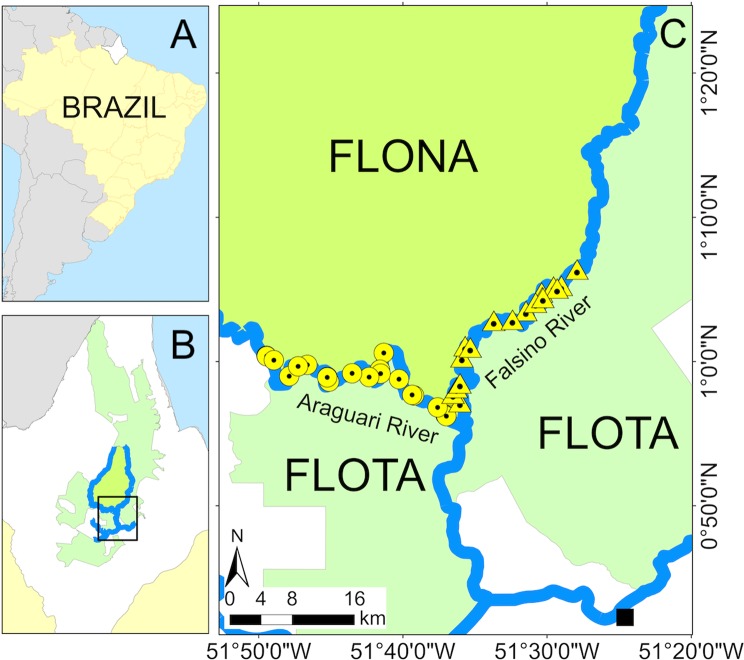
Substrate type determines nesting success and fitness in turtles and is a critical consideration for nesting area protection and restoration. Here, we evaluated the effect of substrate on nest removal by humans in the eastern Brazilian Amazon. We analyzed substrate composition and fate of 216 P. unifilis nests along 88 km of rivers. River segment and substrate type were the most important predictors of nest removal by humans. We found up to 36% lower removal of nests in fine sand and experimental results support the hypothesis that wind more often obscures tracks of nesting females in substrates with more (>66%) fine sand. Our findings are useful for informing the restoration of artificial nesting areas across the Amazon, as nesting area substrates should be selected not only to maintain hatchling sex ratios, but also to minimize nest removal by humans.
基质类型决定了海龟的筑巢成功率和适应性,是保护和恢复筑巢区的关键考虑因素。在这里,我们评估了基质对巴西亚马逊东部地区人类移除海龟巢的影响。我们分析了 216 个 P. unifilis 巢穴沿 88 公里河流的基质组成和命运。河流段和基质类型是人类最有可能移除巢穴的最重要预测因子。我们发现,在细沙中的巢穴被移除的比例低至 36%,实验结果支持了这样的假设,即在含有更多(>66%)细沙的基质中,风更经常掩盖筑巢雌性的足迹。我们的研究结果有助于为整个亚马逊地区的人工筑巢区的恢复提供信息,因为筑巢区的基质选择不仅要维持孵化后幼龟的性别比例,还要尽量减少人类对巢穴的移除。