Mekbib Yeshitila, Huang Shi-Xu, Ngarega Boniface K, Li Zhi-Zhong, Shi Tao, Ou Ke-Fang, Liang Yu-Ting, Chen Jin-Ming, Yang Xing-Yu
CAS Key Laboratory of Aquatic Botany and Watershed Ecology, Wuhan Botanical Garden, Chinese Academy of Sciences, Wuhan, 430074, China.
Center of Conservation Biology, Core Botanical Gardens, Chinese Academy of Sciences, Wuhan, 430074, China.
Bot Stud. 2020 May 16;61(1):15. doi: 10.1186/s40529-020-00293-3.
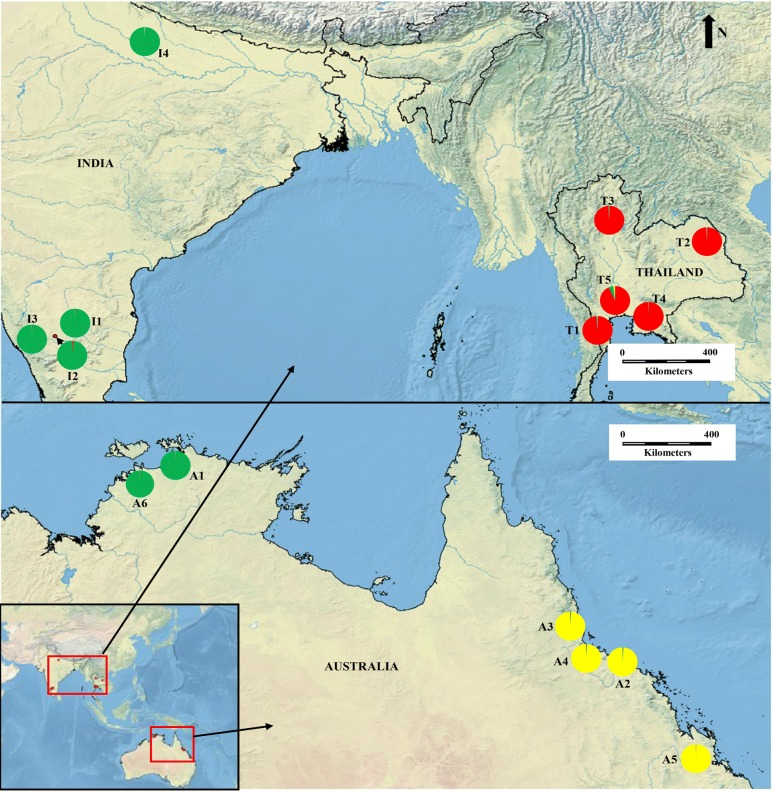
Nelumbo nucifera Gaertn., a perennial aquatic macrophyte species, has been cultivated in several Asian countries for its economic importance, and medicinal uses. Two distinct ecotypes of the species are recognized based on the geographical location where the genotypes are adapted, i.e., tropical lotus and temperate lotus. The genetic diversity levels and differentiation of the tropical lotus from poorly studied geographic regions still remain unclear. Here, the population genetic diversity and structure of 15 tropical lotus populations sampled from the previous understudied natural distribution ranges, including India, Thailand, and Australia, were assessed using nine polymorphic SSR markers.
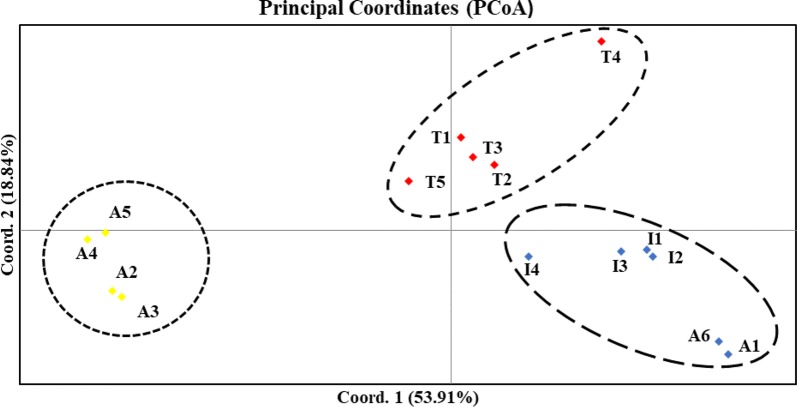
The SSR markers used to genotype the 216 individuals yielded 65 alleles. The highest and lowest genetic diversity estimates were found in Thailand and Indian populations, respectively. STRUCTURE analysis revealed three distinct genetic clusters, with relatively low admixtures, supported by PCoA cluster analysis. Low levels of gene flow (mean Nm = 0.346) among the three genetic clusters signified the Mantel test for isolation by distance, revealing the existence of a positive correlation between the genetic and geographic distances (r = 0.448, P = 0.004). Besides, AMOVA analysis revealed a higher variation among populations (59.98%) of the three groups. Overall, the populations used in this study exposed a high level of genetic differentiation (F = 0.596).
The nine polymorphic microsatellite markers used in our study sufficiently differentiated the fifteen tropical N. nucifera populations based on geography. These populations presented different genetic variability, thereby confirming that populations found in each country are unique. The low genetic diversity (H = 0.245) could be explained by limited gene flow and clonal propagation. Conserving the available diversity using various conservation approaches is essential to enable the continued utilization of this economically important crop species. We, therefore, propose that complementary conservation approaches ought to be introduced to conserve tropical lotus, depending on the genetic variations and threat levels in populations.
莲(Nelumbo nucifera Gaertn.)是一种多年生水生大型植物,因其经济重要性和药用价值,在几个亚洲国家都有种植。根据基因型适应的地理位置,该物种可分为两种不同的生态型,即热带莲和温带莲。来自研究较少的地理区域的热带莲的遗传多样性水平和分化情况仍不清楚。在此,我们使用9个多态性SSR标记,对从前研究较少的自然分布范围(包括印度、泰国和澳大利亚)采集的15个热带莲种群的群体遗传多样性和结构进行了评估。
用于对216个个体进行基因分型的SSR标记共产生了65个等位基因。遗传多样性估计值最高和最低的分别是泰国种群和印度种群。结构分析揭示了三个不同的遗传簇,混合程度相对较低,主坐标分析(PCoA)聚类分析也支持这一结果。三个遗传簇之间的基因流水平较低(平均Nm = 0.346),这意味着通过距离隔离的Mantel检验,揭示了遗传距离和地理距离之间存在正相关(r = 0.448,P = 0.004)。此外,方差分析(AMOVA)显示,三组种群间的变异较高(59.98%)。总体而言,本研究中使用的种群表现出较高水平的遗传分化(F = 0.596)。
我们研究中使用的9个多态性微卫星标记能够根据地理位置充分区分15个热带莲种群。这些种群呈现出不同的遗传变异性,从而证实每个国家的种群都是独特的。遗传多样性低(H = 0.245)可能是由于基因流有限和克隆繁殖所致。采用各种保护方法来保护现有多样性对于持续利用这种具有重要经济价值的作物物种至关重要。因此,我们建议应根据种群的遗传变异和受威胁程度,引入互补的保护方法来保护热带莲。