Butryn Michaela, Neumann Jens, Rolfes Leoni, Bartels Claudius, Wattjes Mike P, Mahmoudi Nima, Seeliger Tabea, Konen Franz F, Thiele Thea, Witte Torsten, Meuth Sven G, Skripuletz Thomas, Pawlitzki Marc
. Department of Neurology, Otto-von-Guericke University, 39120 Magdeburg, Germany.
Department of Neurology with Institute of Translational Neurology, University Hospital Münster, 41849 Münster, Germany.
J Clin Med. 2020 May 14;9(5):1482. doi: 10.3390/jcm9051482.
To identify radiological and laboratory hallmarks in patients with primary Sjögren's syndrome (pSS) presenting with spinal cord involvement.
Clinical and laboratory routine parameters were analyzed in a retrospective multicenter case series of four patients who developed myelitis associated with pSS. Serological and cerebrospinal fluid (CSF) measurements of pSS associated anti-SSA(Ro)-antibodies were initiated, and CSF neurofilament light chain (NFL) levels were assessed. NFL values were compared with results from 15 sex- and age-matched healthy controls. Radiological assessment was performed using multi-sequence spinal cord magnetic resonance imaging.
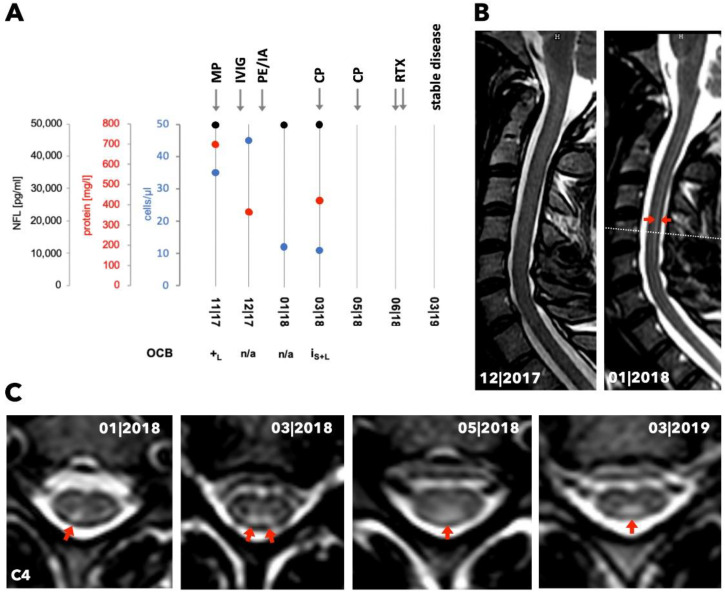
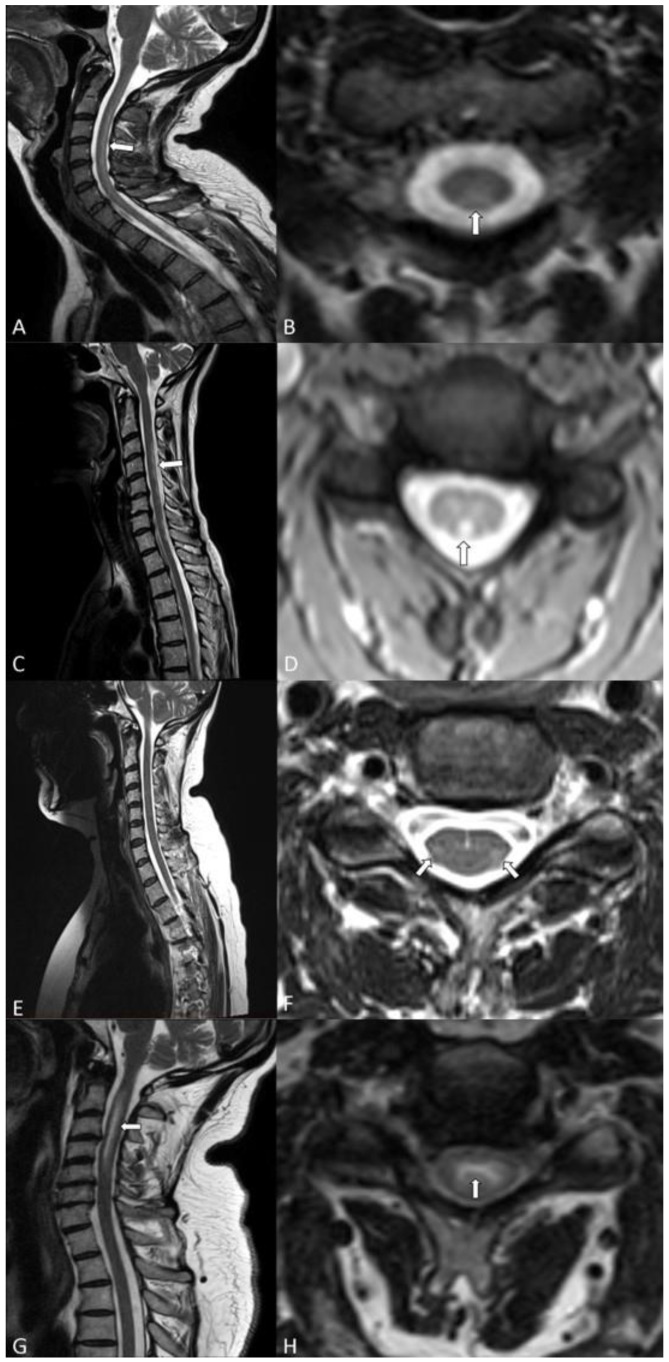
Three of the four patients initially developed neurological signs suggestive of myelitis and were subsequently diagnosed with pSS. All patients presented a longitudinal spinal T2-hyperintense lesion in the cervical spinal cord, whereas only two patients showed pleocytosis and oligoclonal bands in the CSF. Median (range) CSF-NFL levels were significantly elevated in patients compared to controls (6672 pg/mL (621-50000) vs. 585 pg/mL (357-729), = 0.009). One patient showed sustained, highly increased NFL levels (50000 pg/mL) in the initial assessment when radiological signs of axonal injury were still absent. Anti-SSA(Ro)-antibodies were found in the serum of three patients, while two patients additionally presented intrathecal anti-SSA(Ro)-antibody production. Elevated CSF-NFL levels and intrathecal synthesis of anti-SSA(Ro)-antibodies were associated with a relapsing and treatment-resistant disease course.
Inflammatory spinal cord lesions associated with pSS are a rare but serious disease leading to severe disability. NFL and anti-SSA(Ro)-antibodies in CSF might serve as prognostic biomarkers and should be routinely assessed in patients with pSS.
确定出现脊髓受累的原发性干燥综合征(pSS)患者的影像学和实验室特征。
对4例发生与pSS相关的脊髓炎患者的回顾性多中心病例系列进行临床和实验室常规参数分析。开始对与pSS相关的抗SSA(Ro)抗体进行血清学和脑脊液(CSF)检测,并评估CSF神经丝轻链(NFL)水平。将NFL值与15名年龄和性别匹配的健康对照的结果进行比较。使用多序列脊髓磁共振成像进行影像学评估。
4例患者中有3例最初出现提示脊髓炎的神经学体征,随后被诊断为pSS。所有患者颈髓均出现纵向脊髓T2高信号病变,而只有2例患者CSF中出现细胞增多和寡克隆带。与对照组相比,患者的CSF-NFL水平中位数(范围)显著升高(6672 pg/mL(621 - 50000)对585 pg/mL(357 - 729),P = 0.009)。1例患者在初始评估时NFL水平持续、大幅升高(50000 pg/mL),此时仍无轴索损伤的影像学征象。3例患者血清中发现抗SSA(Ro)抗体,2例患者还出现鞘内抗SSA(Ro)抗体产生。CSF-NFL水平升高和鞘内抗SSA(Ro)抗体合成与疾病复发和治疗抵抗的病程相关。
与pSS相关的炎症性脊髓病变是一种罕见但严重的疾病,可导致严重残疾。CSF中的NFL和抗SSA(Ro)抗体可能作为预后生物标志物,应在pSS患者中常规评估。