Department of Neurosurgery, Karolinska University Hospital, Stockholm, Sweden.
Department of Clinical Neuroscience and Department of Medicine, Karolinska Institutet, Stockholm, Sweden.
J Neurooncol. 2020 Jun;148(2):281-290. doi: 10.1007/s11060-020-03490-z. Epub 2020 May 19.
To investigate outcomes after surgery for rare brain tumors using the Swedish Brain Tumor Registry (SBTR).
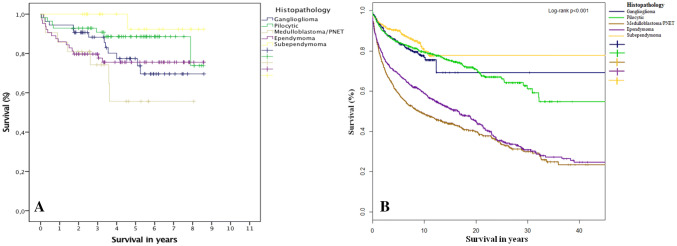
This is a nationwide study of patient in the SBTR, validated in the Surveillance, Epidemiology, and End Results (SEER) registries. We included all adults diagnosed 2009-2015 with a rare brain tumor entity (n = 216), defined as ependymoma (EP, n = 64), subependymoma (SUBEP, n = 21), ganglioglioma (GGL, n = 54), pilocytic astrocytoma (PA, n = 56) and primitive neuroectodermal tumor (PNET, n = 21). We analyzed symptomatology, tumor characteristics and outcomes.
Mean age was 38.3 ± 17.2 years in GGL, 36.2 ± 16.9 in PA, 37.0 ± 19.1 in PNET, 51.7 ± 16.3 in EP and 49.8 ± 14.3 in SUBEP. The most common symptom was focal deficit (39.6-71.4%), and this symptom was most common in GGL patients with 64.2% of GGL presenting with seizures. Most patients had no or little restriction in activity before surgery (Performance Status 0-1), although up to 15.0% of PNET patients had a performance status of 4. Gross total resection was achieved in most (> 50%) tumor categories. Incidence of new deficits was 11.1-34.4%. In terms of postoperative complications, 0-4.8% had a hematoma of any kind, 1.9-15.6% an infection, 0-7.8% a venous thromboembolism and 3.7-10.9% experienced a complication requiring reoperation. There were 3 deaths within 30-days of surgery, and a 1-year mortality of 0-14.3%.
We have provided benchmarks for the current symptomatology, tumor characteristics and outcomes after surgery for rare brain tumors as collected by the SBTR and validated our results in an independent registry. These results may aid in clinical decision making and advising patients.
使用瑞典脑肿瘤登记处(SBTR)研究罕见脑肿瘤手术后的结果。
这是一项在 SBTR 中进行的全国性患者研究,在监测、流行病学和最终结果(SEER)登记处得到验证。我们纳入了所有在 2009 年至 2015 年期间被诊断为罕见脑肿瘤实体的成年人(n=216),这些肿瘤实体被定义为室管膜瘤(EP,n=64)、室旁瘤(SUBEP,n=21)、神经节胶质瘤(GGL,n=54)、毛细胞星形细胞瘤(PA,n=56)和原始神经外胚层肿瘤(PNET,n=21)。我们分析了症状、肿瘤特征和结果。
GGL 患者的平均年龄为 38.3±17.2 岁,PA 为 36.2±16.9 岁,PNET 为 37.0±19.1 岁,EP 为 51.7±16.3 岁,SUBEP 为 49.8±14.3 岁。最常见的症状是局灶性缺损(39.6-71.4%),GGL 患者中这种症状最为常见,64.2%的 GGL 患者出现癫痫发作。大多数患者在手术前没有或只有轻微的活动受限(表现状态 0-1),尽管多达 15.0%的 PNET 患者的表现状态为 4。大多数肿瘤类型(>50%)达到了大体全切除。新发缺损的发生率为 11.1-34.4%。在术后并发症方面,0-4.8%有任何类型的血肿,1.9-15.6%有感染,0-7.8%有静脉血栓栓塞,3.7-10.9%有需要再次手术的并发症。术后 30 天内有 3 例死亡,1 年死亡率为 0-14.3%。
我们提供了 SBTR 收集的罕见脑肿瘤手术后当前症状、肿瘤特征和结果的基准,并在一个独立的登记处验证了我们的结果。这些结果可能有助于临床决策和向患者提供建议。