Barfod Kristoffer Weisskirchner, Nielsen Emil Graakjær, Olsen Beth Hærsted, Vinicoff Pablo Gustavo, Troelsen Anders, Holmich Per
Sports Orthopedic Research Center-Copenhagen, Arthroscopic Center, Department of Orthopedic Surgery, Copenhagen University Hospital, Amager-Hvidovre, Hvidovre, Denmark.
Department of Radiology, Copenhagen University Hospital, Amager-Hvidovre, Hvidovre, Denmark.
Orthop J Sports Med. 2020 Apr 28;8(4):2325967120915909. doi: 10.1177/2325967120915909. eCollection 2020 Apr.
Immobilization of the ankle joint has been suggested as a key element in the pathogenesis leading to deep vein thrombosis (DVT).
To investigate whether early controlled ankle motion (ECM) could reduce the incidence of DVT compared with immobilization (IM) in the treatment of acute Achilles tendon rupture.
Randomized controlled trial; Level of evidence, 2.
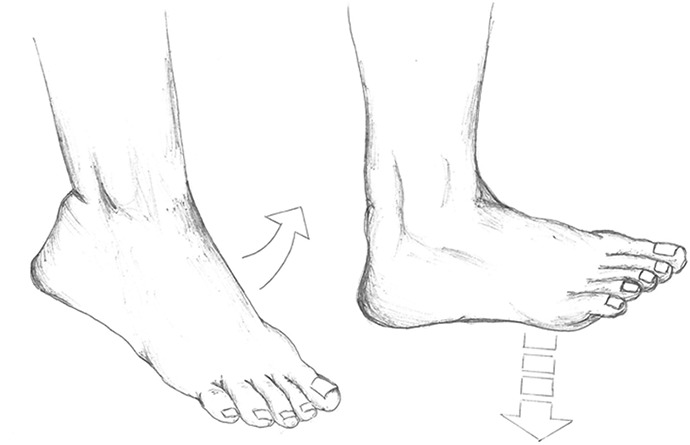
Patients aged 18 to 70 years were eligible for inclusion, and treatment was nonoperative. The ECM group performed movements of the ankle 5 times a day from weeks 3 to 8 after rupture. The control group was immobilized for 8 weeks. The outcome measure was DVT diagnosed with color Doppler ultrasound for above- and below-knee DVT at 2 and 8 weeks. The Achilles tendon Total Rupture Score, the heel-rise work test, and the Copenhagen Achilles ultrasonographic Length Measurement were performed at 4-, 6-, and 12-month follow-up.
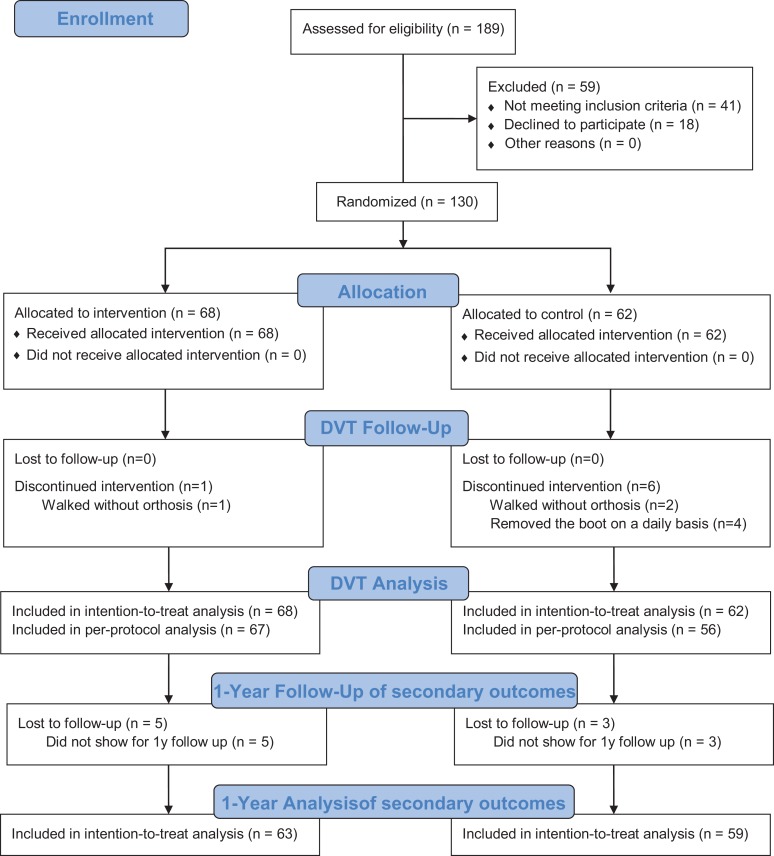
A total of 189 patients were assessed for eligibility from February 2014 to December 2016. Of these, 130 were randomized: 68 patients were allocated to the ECM group and 62 to the IM group. All patients participated in follow-up at 8 weeks assessing for DVT. In total, 62 (47.7%) patients were diagnosed with DVT: 33 of 68 (48.5%) in the ECM group and 28 of 61 (46.8%) in the IM group ( = .84). DVT did not affect treatment outcomes at 4, 6, and 12 months. D-dimer had low sensitivity (71%) for detecting DVT.
We found that 1 in 2 patients presented with DVT in nonoperative treatment of acute Achilles tendon rupture. The ECM protocol revealed no benefit versus IM in reducing the incidence of DVT. DVT did not influence functional and patient-reported outcomes the first year after rupture. D-dimer seems an inappropriate test for detection of DVT in patients with acute Achilles tendon rupture.
NCT02015364 (ClinicalTrials.gov identifier).
踝关节制动被认为是导致深静脉血栓形成(DVT)发病机制中的关键因素。
探讨在急性跟腱断裂治疗中,与制动(IM)相比,早期控制踝关节活动(ECM)是否能降低DVT的发生率。
随机对照试验;证据等级,2级。
年龄在18至70岁的患者符合纳入标准,采用非手术治疗。ECM组在跟腱断裂后第3至8周每天进行5次踝关节活动。对照组制动8周。结局指标是在第2周和第8周通过彩色多普勒超声诊断膝上和膝下DVT。在4个月、6个月和12个月随访时进行跟腱完全断裂评分、提踵功测试和哥本哈根跟腱超声长度测量。
2014年2月至2016年12月共有189例患者接受资格评估。其中,130例被随机分组:68例患者被分配到ECM组,62例被分配到IM组。所有患者均在第8周参与DVT评估随访。共有62例(47.7%)患者被诊断为DVT:ECM组68例中的33例(48.5%),IM组61例中的28例(46.8%)(P = 0.84)。DVT在4个月、6个月和12个月时不影响治疗结局。D - 二聚体检测DVT的敏感性较低(71%)。
我们发现,在急性跟腱断裂非手术治疗中,每2例患者中就有1例出现DVT。在降低DVT发生率方面,ECM方案与IM相比无益处。DVT在跟腱断裂后第一年不影响功能和患者报告的结局。D - 二聚体似乎不适用于检测急性跟腱断裂患者的DVT。
NCT02015364(ClinicalTrials.gov标识符)